

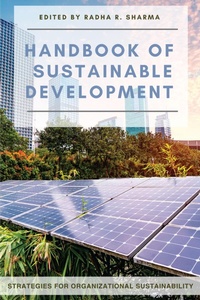
Handbook of Sustainable Development
Description

Sustainable development has garnered the attention of the global community when United Nations created Brundtland Commission in 1983 to suggest various ways to save the human environment and natural resources and promote economic and social development. Sustainable development is a way of organizing that an organization can function in the long term. United Nation's sustainable development goals provide a framework to translate these into solutions through responsible business and investment by incorporating the ten Principles of the UN Global Compact into strategies, policies and procedures, and establishing a culture of integrity which are expected to bring out transformative change and create enabling environment for doing business globally. Thus, corporate sustainability, to a large extent, would depend on the capability of the firm to function over a long period with sustainable relationships with the stakeholders.
The Handbook of Sustainable Development: Strategies for Organizational Sustainability provides guiding principles and diagnostic tools for transformation, generates knowledge about sustainable organizational designs, co-creating value with multiple stakeholders, managing diversity responsibly, ecopreneurship with entrepreneurial bricolage, sustainable business model, developing positive synergy, sustainability reporting and organizational transformation for sustainability which are pivotal issues to be addressed in management education and corporate world.
More details
Other editions
Additional editions

Person
Content
- Cover
- Handbook of Sustainable Development
- Dedication
- Contents
- Acknowledgments
- Preface
- Foreword
- CHAPTER 1: A Manager's Role in Triple Bottom Line: Global Compact and Responsible Value Creation
- CHAPTER 2: On Designing and Developing Sustainable Organizations
- CHAPTER 3: Generating Knowledge for Sustainable Development: The Case against the Corporate Objective Function
- CHAPTER 4: Corporate Citizenship for Responsible Management
- CHAPTER 5: Corporate Impacts
- CHAPTER 6: Managing Cultural Diversity
- CHAPTER 7: Ecopreneurship for Sustainability: Role of Entrepreneurial Bricolage, Design Thinking, and Creative Self-Efficacy
- CHAPTER 8: Walking a Tightrope between Business and Sustainable Development: A Social Enterprise Marketing Perspective
- CHAPTER 9: Developing Positive Synergy
- CHAPTER 10: CSR Reporting: Prevalent Practices in Businesses
- CHAPTER 11: Organizational Transformation for Sustainability
- About the Editor & Authors
- Index
- Ad Page
- Back Cover
