

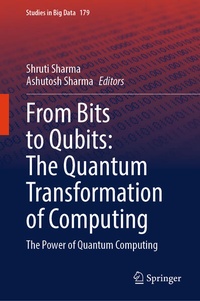
From Bits to Qubits: The Quantum Transformation of Computing
Description

The rapidly developing field of quantum computing and its potential to upend science, business, and society are examined in Bits to Qubits: The Quantum Transformation of Computing. This book provides a thorough and approachable overview of one of the most revolutionary technologies of the twenty-first century by bridging the gap between the classical underpinnings of computation and new quantum concepts.
The book starts by demystifying the basic components of quantum computing-qubits, superposition, entanglement, and quantum gates-for researchers, graduate students, engineers, and inquisitive readers. Next, it moves on to programming frameworks, real-world architectures, and innovative quantum algorithms like Grover's and Shor's. Applications in cryptography, optimization, machine learning, and materials science are covered along with practical concerns such as hardware problems, quantum cloud platforms, and quantum error correction.
This book offers a clear road map of where quantum computing is now and where it's going to go in the future, regardless of whether you're switching from classical computing or entering the field for the first time. It functions as a guide for the future as well as an academic reference thanks to its case studies, real-world examples, and straightforward mathematical explanations.
More details
Other editions
Additional editions
Persons
Dr. Shruti Sharma
is Director at Sukhari Zintech Private Limited, Delhi, India. She has worked as a Research Scientist at Ajou University, Korea. She earned her PhD in Electrical and Computer Engineering at Ajou University, Korea in AI and Wireless Communication Systems. She holds a Master's degree in Electronics from Pt. Ravishankar Shukla University, Raipur, India, and a Postgraduate Diploma in Computer Applications from Guru Ghasidas Vishwavidyalaya, India, along with a Diploma in Embedded Systems and Design from CDAC, Kolkata, India. She also has three year of industry experience in Genpact India. Additionally, she has two years of teaching experience at CMD P.G. Science College, India.
Dr. Ashutosh Sharma is an Associate Professor in the Department of Physics at Amity University Jharkhand, Ranchi, India and also working with University of Seoul, South. Korea. Previously, he served as an Assistant Professor at Ajou University, South Korea. He has more than 12 years of research and teaching experience. He earned a PhD at IIT Kharagpur, India. His research focuses on electrochemical deposition, lead free soldering, AI in microelectronic packaging, additive manufacturing, high entropy alloys, and biomaterials. He has been recognized by TMS and has been ranked in the top 2% of scientists globally by Stanford University for the past three consecutive years.
Content
Section A: Quantum computing in AI/5G/IOT.- Section B: Quantum computing in Health Sector.- Section C: Quantum computing in Cryptography.- Section D: Role of Quantum Computing in Digital Marketing.- Section E: Quantum Computing in semiconductor materials.
