

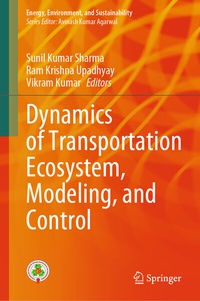
Dynamics of Transportation Ecosystem, Modeling, and Control
Description

Transportation is the lifeblood of modern society, connecting people, goods, and information across the world. However, as our cities grow and the demand for transportation increases, it becomes imperative to understand and manage the intricate dynamics of the transportation ecosystem. This book provides an in-depth exploration of the complex dynamics of transportation systems, with a focus on modeling and control strategies that can enhance efficiency, sustainability, and resilience. It is an indispensable resource for transportation engineers, researchers, students, and professionals seeking a comprehensive understanding of the complex dynamics at play in transportation systems. By delving into advanced modeling techniques, control strategies, and sustainability considerations, this book equips readers with the knowledge needed to navigate and optimize the evolving transportation landscape. This book offers a comprehensive examination of the interconnected elements within the transportation ecosystem, including vehicles, infrastructure, traffic flow, and emerging technologies. It explores advanced modeling and simulation techniques for understanding and predicting transportation system behavior, discussing control strategies that can be applied to optimize transportation systems, enhancing safety, and mitigating congestion, addressing the challenges of sustainability and resilience in transportation, including the integration of eco-friendly technologies and disaster response.
More details
Other editions
Additional editions
Persons
Dr. Sunil Kumar Sharma is an assistant professor at the Gati Shakti Vishwavidyalaya, Vadodara, a Central University, established by the Ministry of Railway, Government of India. He has received his Ph.D. from the Indian Institute of Technology, Roorkee. He worked at the Non-destructive Evaluation and Structural Health Monitoring Laboratory at C. N. University, South Korea. His research interests include vehicle dynamics, contact mechanics, mechatronics, and real-time software-enabled control systems for high-speed rail vehicles. He published several research articles in national and international journals, published book chapters, and edited a book. Dr. Sharma is also featured among the top 2% of scientists in a global list compiled by Stanford University, USA.
Dr. Ram Krishna Upadhyay is currently working as an assistant professor at the Gati Shakti Vishwavidyalaya, Vadodara, a Central University, established by the Ministry of Railway, Government of India.He has received his Ph.D. and M.Tech. from the Indian Institute of Technology (ISM) Dhanbad in Mechanical Engineering with a broad specialization in Surface Engineering and Tribology. Before joining Gati Shakti Vishwavidyalaya, Dr. Ram worked as Postdoctoral Fellow at the Indian Institute of Technology Kanpur. His research interests include lubrication and materials wear for industrial application, tribology of additive manufactured parts, and nanocomposites. He is a recipient of the SERB-ACS NPDF best poster competition award by the Science and Engineering Research Board, New Delhi, and the American Chemical Society, U.S.A. He published several journal papers, book chapters, edited a book, and completed a project funded by the Science and Engineering Research Board, New Delhi.
Dr. Vikram Kumar is currently at IIT Kanpur. He received his Ph.D. in Mechanical Engineering from the Indian Institute of Technology Kanpur, India, in 2018. His areas of research include polymer and composite coating; wear, friction, and lubrication; IC engine tribology; alternative fuels; advanced low-temperature combustion; engine emissions measurement; particulate characterization. Dr. Kumar has edited 4 books and authored 10 book chapters and 19 research articles in international journals and conferences. He has been awarded with 'ISEES Best Ph.D. Thesis Award' (2018), 'Senior Research Associateship under 'CSIR-POOL Scientist' (2018-2021). He is a lifetime member of ISEES.
Content
Chapter 1: Introduction to Dynamics of Transportation Ecosystem, Modeling and Control.- Chapter 2: Comparing meta-heuristic algorithms for transit network design.- Chapter 3: Railway Induced Noise And Vibration.- Chapter 4: Reducing Transaction Costs And Increasing Traceability In Indian Food Supply Chain Using Blockchain.- Chapter 5: Transport Decarbonisation in Nigeria: A Dialectic Review.- Chapter 6: Sustainable supply chain management challenges in petroleum transportation.- Chapter 7: Assessment and Mapping of Traffic Noise Levels in Coal Capital of India, Dhanbad, India: Implications for Noise Pollution Management.- Chapter 8: Generalized ANN assisted data-driven aerodynamic optimization technique.- Chapter 9: Hydrogen Powered Rolling Stock: A Review.- Chapter 10: Theoretical and Application Aspects of Determining the Curvature of the Railway Track Axis by the Moving Chord Method.- Chapter 11: Train delay prediction using machine learning technique.- Chapter 12: TechnologicalImprovement in F&V Cold Chain in India.- Chapter 13: Designing a Framework for Sustainable Supply Chain Management of Coal Transportation.- Chapter 14: Environmental Assessment of the of DFCCIL.- Chapter 15: Modelling and analysis of the hydraulic system parameters under different loading conditions.- Chapter 16: Study of the Bullwhip Effect in a Multistage Supply Chain considering Four Retailers with a Callback Structure.- Chapter 17: Warehousing and Supply Chain Management of Dangerous Goods.- Chapter 18: Pyrolysis of plastic waste as a route to a circular economy: An advanced chemistry approach.- Chapter 19: Determinstic and Probabilistic Forced Response Analysis of A Railway Coach Using FEA.- Chapter 20: Reliability Model of Railroad Traffic Control System Equipped With Peltier Cell.
