

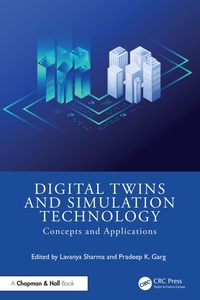
Digital Twins and Simulation Technology
Concepts and Applications
Published on 4. July 2025
230 pages
978-1-040-39218-8 (ISBN)
Description

This book provides a comprehensive overview of the concept of digital twins, emphasising its strategic importance across various commercial domains. This book covers the fundamentals, data requirements, tools, and technologies essential for understanding and implementing digital twins. It discusses how digital twins are used for running simulations, analysing performance issues, and generating potential improvements to optimise business processes. The book explores the architecture, historical background, and real-time applications in sectors including urban planning, healthcare, smart cities, and manufacturing.
Explains digital twin technology, including its core principles, architecture, and how it replicates physical objects in virtual platforms, in detail
Covers the data types and tools necessary for creating and maintaining digital twins, including sensors, data processing systems, and integration methodologies
Explores technologies such as Computer Vision, IoT, AI, ML, 5G, AR, and VR that drive the functionality and application of digital twins
Analyses practical applications in diverse sectors like urban planning, smart cities, healthcare, manufacturing operations, and power-generation equipment, showcasing real-world use cases and benefits
Examines real-time challenges and limitations associated with implementing digital twin technology, providing a balanced view of its capabilities and constraints
It is a reference book for researchers, scholars, and students who are working or interested in learning about digital twin technology.
Explains digital twin technology, including its core principles, architecture, and how it replicates physical objects in virtual platforms, in detail
Covers the data types and tools necessary for creating and maintaining digital twins, including sensors, data processing systems, and integration methodologies
Explores technologies such as Computer Vision, IoT, AI, ML, 5G, AR, and VR that drive the functionality and application of digital twins
Analyses practical applications in diverse sectors like urban planning, smart cities, healthcare, manufacturing operations, and power-generation equipment, showcasing real-world use cases and benefits
Examines real-time challenges and limitations associated with implementing digital twin technology, providing a balanced view of its capabilities and constraints
It is a reference book for researchers, scholars, and students who are working or interested in learning about digital twin technology.
More details
Language
English
Place of publication
London
United Kingdom
Publishing group
Taylor & Francis Ltd
Target group
Professional and scholarly
Illustrations
7 Tables, black and white; 32 Line drawings, black and white; 15 Halftones, black and white; 47 Illustrations, black and white
File size
19,74 MB
ISBN-13
978-1-040-39218-8 (9781040392188)
Copyright in bibliographic data and cover images is held by Nielsen Book Services Limited or by the publishers or by their respective licensors: all rights reserved.
Schweitzer Classification
Other editions
Additional editions
Lavanya Sharma | Pradeep Kumar Garg
Digital Twins and Simulation Technology
Concepts and Applications
Book
07/2025
1st Edition
Chapman & Hall/CRC
€207.60
Shipment within 10-20 days
Persons
Lavanya Sharma received her Ph.D. (Computer Science) from Uttarakhand Technical University (State Government University), India in 2018, in the area of Digital Image Processing and Computer Vision. She also received TEQIP scholarship for the same. She received her M.Tech (Computer Science) in 2013 from Manav Rachna College of Engineering, affiliated to Maharshi Dayanand University, Haryana, India. She is currently working in New Delhi Institute of Management, Delhi, India as an Assistant Professor in the department of Information technology, Research & Innovation. A certified professional 20 professional certificates. Her work is on Motion based Object Detection using Background Subtraction Technique for Smart Video Surveillance. She is recipient of several prestigious awards during her academic career and qualified certification courses from ISRO Dehradun unit, India. She has 8 books (Authored and Edited) and over 70 research articles to her credit. She has 5 patents in the area of Computer Vision, Image Processing, Machine Learning and Medical Imaging. She acted as Organizing Committee Member, Conference Chair, Session Chair, Reviewer, Technical Program Committee (TCP) member of various International conferences and journals. Besides, supervising a large number of undergraduate projects, she has guided more than 40 Post Graduates projects. Her primary research interests are Digital Image Processing and Computer Vision, Artificial Intelligence, Machine learning, deep learning, Internet of Things, Remote Sensing & GIS.
https://www.researchgate.net/profile/Lavanya-Sharma-5
https://scholar.google.com/citations?user=TqVT0B4AAAAJ&hl=en
P.K. Garg worked as a Vice Chancellor, Uttarakhand Technical University, Dehradun. Presently he is working in the department of Civil Engineering, IIT Roorkee as a Professor. He has completed B.Tech (Civil Engg.) in 1980 and M.Tech (Civil Engg) in 1982 both from the University of Roorkee (now IIT Roorkee). He was a recipient of the gold medal at IIT Roorkee during his M.Tech programme, the Commonwealth Scholarship Award for doing Ph.D. from University of Bristol (UK), and the Commonwealth Fellowship Award to carry out post-doctoral research work at University of Reading (UK). Prof. Garg has published more than 300 technical papers in national and international journals. He has undertaken 26 research projects and provided technical services to 83 consultancy projects on various aspects of Civil Engineering, generating funds for the Institute. He has authored and edited various books and produced two technical films on Story of Mapping. He has developed several new courses and practical exercises in Geomatics Engineering. Besides, supervising a large number of undergraduate projects, he has guided about 74 M.Tech and 30 Ph.D. Thesis. He is instrumental in prestigious MHRD funded projects on e-learning; Development of Virtual Labs, Pedagogy and courses under NPTEL. He has served as an expert on various national committees, including Ministry of Environment & Forest, EAEC Committee, NBA (AICTE) and Project Evaluation Committee, DST, New Delhi. He has successfully organized multiple conferences and workshops, and 44 programmes in advanced areas of Surveying, Photogrammetry, Remote Sensing, GIS and GPS. He is a life member of 24 professional societies, out of which he is a Fellow member of 8 societies.
Https://Www.Researchgate.Net/Profile/Pradeep-Garg-4
Https://Scholar.Google.Co.In/Citations?User=Ys_F33saaaaj&Hl=En
https://www.researchgate.net/profile/Lavanya-Sharma-5
https://scholar.google.com/citations?user=TqVT0B4AAAAJ&hl=en
P.K. Garg worked as a Vice Chancellor, Uttarakhand Technical University, Dehradun. Presently he is working in the department of Civil Engineering, IIT Roorkee as a Professor. He has completed B.Tech (Civil Engg.) in 1980 and M.Tech (Civil Engg) in 1982 both from the University of Roorkee (now IIT Roorkee). He was a recipient of the gold medal at IIT Roorkee during his M.Tech programme, the Commonwealth Scholarship Award for doing Ph.D. from University of Bristol (UK), and the Commonwealth Fellowship Award to carry out post-doctoral research work at University of Reading (UK). Prof. Garg has published more than 300 technical papers in national and international journals. He has undertaken 26 research projects and provided technical services to 83 consultancy projects on various aspects of Civil Engineering, generating funds for the Institute. He has authored and edited various books and produced two technical films on Story of Mapping. He has developed several new courses and practical exercises in Geomatics Engineering. Besides, supervising a large number of undergraduate projects, he has guided about 74 M.Tech and 30 Ph.D. Thesis. He is instrumental in prestigious MHRD funded projects on e-learning; Development of Virtual Labs, Pedagogy and courses under NPTEL. He has served as an expert on various national committees, including Ministry of Environment & Forest, EAEC Committee, NBA (AICTE) and Project Evaluation Committee, DST, New Delhi. He has successfully organized multiple conferences and workshops, and 44 programmes in advanced areas of Surveying, Photogrammetry, Remote Sensing, GIS and GPS. He is a life member of 24 professional societies, out of which he is a Fellow member of 8 societies.
Https://Www.Researchgate.Net/Profile/Pradeep-Garg-4
Https://Scholar.Google.Co.In/Citations?User=Ys_F33saaaaj&Hl=En
Content
1.An Introduction to Digital Twins and Simulation 2. A Multilayered Architecture of Digital Twin Technology 3. Understanding Data Framework for Digital Twinning 4. A Digital Twinning for Advanced Precision Medicine and Patient Care: Tools and Technologies 5. Metaverse Marketing Strategies using IoT and 5G 6. Geospatial Digital Twins - An Emerging Technology in GIS 7. A Cardiac Medicine and Surgery using Digital Twinning: A New Era in Patient Care 8.Applications of Digital Twins in Personalized Medicine and Healthcare 9. Building Future-Ready Cities: The Power of Digital Twins in Indo-Dutch Collaboration 10. Transductive and Inductive GNNs for Moving Object Detection in Surface Scenes for Digital Twin Generation 11. Towards Graph Refactoring in Latent Space for Underwater Moving Object Detection for Digital Twins 12. Towards a Complete System for Pupil Monitoring using Deep Learning for Digital Twins 13. Emerging Application of Digital Twin Technology towards Development of Smart Infrastructure 14. Navigating the Complexities: Limitations and Challenges of Digital Twin Technology in Smart Cities
