

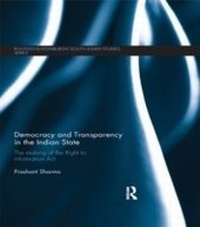
Democracy and Transparency in the Indian State
The Making of the Right to Information Act
1st Edition
Published on 24. March 2015
258 pages
978-1-317-62394-6 (ISBN)
Description

The enactment of the national Right to Information (RTI) Act in 2005 has been produced, consumed, and celebrated as an important event of democratic deepening in India both in terms of the process that led to its enactment (arising from a grassroots movement) and its outcome (fundamentally altering the citizen--state relationship). This book proposes that the explanatory factors underlying this event may be more complex than imagined thus far.
The book discusses how the leadership of the grassroots movement was embedded within the ruling elite and possessed the necessary resources as well as unparalleled access to spaces of power for the movement to be successful. It shows how the democratisation of the higher bureaucracy along with the launch of the economic liberalisation project meant that the urban, educated, high-caste, upper-middle class elite that provided critical support to the demand for an RTI Act was no longer vested in the state and had moved to the private sector. Mirroring this shift, the framing of the RTI Act during the 1990s saw its ambit reduced to the government, even as there was a concomitant push to privatise public goods and services. It goes on to investigate the Indian RTI Act within the global explosion of freedom of information laws over the last two decades, and shows how international pressures had a direct and causal impact both on its content and the timing of its enactment.
Taking the production of the RTI Act as a lens, the book argues that while there is much to celebrate in the consolidation of procedural democracy in India over the last six decades, existing social and political structures may limit the extent and forms of democratic deepening occurring in the near future. It will be of interest to those working in the fields of South Asian Law, Asian Politics, and Civil Society.
The book discusses how the leadership of the grassroots movement was embedded within the ruling elite and possessed the necessary resources as well as unparalleled access to spaces of power for the movement to be successful. It shows how the democratisation of the higher bureaucracy along with the launch of the economic liberalisation project meant that the urban, educated, high-caste, upper-middle class elite that provided critical support to the demand for an RTI Act was no longer vested in the state and had moved to the private sector. Mirroring this shift, the framing of the RTI Act during the 1990s saw its ambit reduced to the government, even as there was a concomitant push to privatise public goods and services. It goes on to investigate the Indian RTI Act within the global explosion of freedom of information laws over the last two decades, and shows how international pressures had a direct and causal impact both on its content and the timing of its enactment.
Taking the production of the RTI Act as a lens, the book argues that while there is much to celebrate in the consolidation of procedural democracy in India over the last six decades, existing social and political structures may limit the extent and forms of democratic deepening occurring in the near future. It will be of interest to those working in the fields of South Asian Law, Asian Politics, and Civil Society.
Reviews / Votes
Sharma provides valuable insights and provocations, not only on the RTI in India but also on the notion of access to information more broadly. [...] This book will be of significance to people interested in ex ante policymaking processes, in South Asian law and politics, and in social movements and civil society.Gaia von Hatzfeldt, University of Edinburgh, in Governance, Vol 29, issue 3.
Prashant Sharma's book provides the reader with a fresh perspective on the emergence of the RTI Act and on the different actors and locations involved in the process of drafting and enactment. [...] Overall, Sharma sets out the argument of the book very clearly. There is a lot of detail, particularly in the chapters on the role of the state and the international context, which adds to our understanding of the emergence of the RTI in India. [The book] contributes to an ongoing debate, particularly in light of the implications of its critique of the potential of grassroots movement politics [...].
Martin Webb, Goldsmiths, University of London, in Pacific Affairs
More details
Series
Edition
1. Auflage
Language
English
Place of publication
London
United Kingdom
Publishing group
Taylor & Francis Ltd
Target group
College/higher education
Product notice
Reflowable
Illustrations
2 s/w Abbildungen, 9 s/w Tabellen, 2 s/w Zeichnungen
9 Tables, black and white; 2 Line drawings, black and white; 2 Illustrations, black and white
File size
1,70 MB
ISBN-13
978-1-317-62394-6 (9781317623946)
Copyright in bibliographic data and cover images is held by Nielsen Book Services Limited or by the publishers or by their respective licensors: all rights reserved.
Schweitzer Classification
Other editions
Additional editions
Prashant Sharma
Democracy and Transparency in the Indian State
The Making of the Right to Information Act
Book
01/2018
1st Edition
Routledge
€69.00
Shipment within 10-20 days
Prashant Sharma
Democracy and Transparency in the Indian State
The Making of the Right to Information Act
Book
10/2014
1st Edition
Routledge
€223.21
Shipment within 10-20 days
Person
Prashant Sharma is a Global Fellow at the Open Society Foundations, New York and is currently conducting research on the accountability of public--private partnerships. He is also a Visiting Fellow at the United Nations Research Institute for Social Development (UNRISD), Geneva and is associated with the Swiss Graduate School of Public Administration (IDHEAP), University of Lausanne. He did his PhD at the London School of Economics and Political Science and has also studied at the School of Oriental and African Studies (SOAS), University of London; Jamia Millia Islamia University, New Delhi; and the University of Delhi.
Content
Prologue 1. Democratic Deepening and the Right to Information 2. The Dominant Narrative 3.Digging Up the Grassroots 4.Opening Up the Government 5.The Foreign Hand 6.How Deep is My Democracy?
