

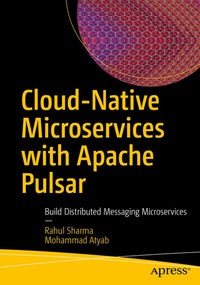
Cloud-Native Microservices with Apache Pulsar
Description

You'll begin with an introduction to Apache Pulsar architecture. The first few chapters build a foundation of message-driven architecture. Next, you'll perform a setup of all the required Pulsar components. The book also covers work with Apache Pulsar client library to build producers and consumers for the discussed patterns.
You'll then explore the transformation, filter, resiliency, and tracing capabilities available with Pulsar. Moving forward, the book will discuss best practices when building message schemas and demonstrate integration patterns using microservices. Security is an important aspect of any application;the book will cover authentication and authorization in Apache Pulsar such as Transport Layer Security (TLS), OAuth 2.0, and JSON Web Token (JWT). The final chapters will cover Apache Pulsar deployment in Kubernetes. You'll build microservices and serverless components such as AWS Lambda integrated with Apache Pulsar on Kubernetes.
After completing the book, you'll be able to comfortably work with the large set of out-of-the-box integration options offered by Apache Pulsar. What You'll Learn
- Examine the important Apache Pulsar components
- Build applications using Apache Pulsar client libraries
- Use Apache Pulsar effectively with microservices
- Deploy Apache Pulsar to the cloud
Who This Book Is For
Cloud architects and software developers who build systems in the cloud-native technologies.
More details
Other editions
Additional editions
Persons
Rahul Sharma
is a software developer with around 17 years of experience in Java/J2EE and Python applications. Being an open-source enthusiast, he has contributed to various projects like Apache Crunch, and so on. In his career, he has worked with companies of various sizes, from enterprises to start-ups. He has worked on Kubernetes and microservices extensively for enterprises.
Mohammad Atyab
is a software developer with more than 13 years of developing products. He has worked in various languages primarily Java/J2EE, Python, C++. He has a passion of building products and has created web based scalable applications in chat bots, ecommerce, marketing and financial domains. He has worked in large enterprises as well as startups and worked extensively in the areas of Big Data and AI.
