

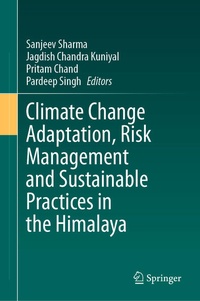
Climate Change Adaptation, Risk Management and Sustainable Practices in the Himalaya
Description

This volume analyzes ecological and socio-economic risks due to climate change in the Himalayan mountain ecosystems, communities, and proposes adaptation strategies and sustainability practices. In order to better understand the potential actions required to improve natural resource conservation and the development of mountain people's livelihoods. The authors discuss the current status of local knowledge system on various environmental aspects of conservation and sustainable use of mountain resources in the Himalaya. The book addresses the institutional capacities, gaps, and priority areas of capacity building to strengthen policies and governance in regard to climate change, landuse management, biodiversity conservation, and sustainable management in the Himalayan region. The aim of this book is to enhance coordination building among policymakers, planners, mountain communities to foster collaboration between different stakeholders by understanding local perceptions of climate change as well as variability issues, and establishing adaptation strategies to cope with these impacts. The chapters incorporate theoretical and applied aspects, and may serve as baseline information for the sustainability of mountain ecosystems through the contribution of multidisciplinary and interdisciplinary expertise from the Himalayan region. The book will be useful for students, teachers, and researchers working in different areas pertaining to mountain ecosystems, as well as policymakers and planners working on issues related to the sustainability of the mountain ecosystem.
More details
Other editions
Additional editions
Persons
Dr. Sanjeev Sharma has been teaching as an Assistant Professor in the Centre for Study of Regional Development, School of Social Science at Jawaharlal Nehru University New Delhi-India. Presently he is on deputation as Associate Professor, at Dr. Ambedkar International Centre, Ministry of Social Justice & Empowerment, Govt. of India, New Delhi. Over the past one and half decades he has worked in different academic and research institute viz. Dr. H.S. Gour Central University of Sagar, IISER- Mohali, WWF-India and G. B. Pant National Institute of Himalayan Environment (NIHE). He has done M.A., M.Phil.; Ph.D. (HPU, Shimla) Post Doctorate (IISER, Mohali) and PG Diploma in Environmental Law and Policy (NLU, Delhi). His research expertise is in human ecology; environmental impact assessment and management; disaster management; policy planning and nature conservation; natural resource management; community based participatory management; science society and nature study specifically in the high altitude of Indian Himalaya Region
Dr. Jagdish Chandra Kuniyal has joined NIHE as a Scientist-B in November 1993 and is currently working as a Scientist-G & Head: Centre for Environmental Assessment and Climate Change (CEA&CC), GB Pant National Institute of Himalayan Environment, Kosi-Katarmal, Almora, Uttarakhand. He did PhD in 'Regional Development Planning'. He has been involved in different research sectors such as solid waste management, carrying capacity studies, ambient air quality, Strategic Environmental Assessment (SEA) of hydropower projects, aerosol and climate science research, land use and land cover change and crop biodiversity. His current areas of research supported by external funding agencies (ISRO, DST, UNDP, etc.) have mainly been 'ambient air quality', 'aerosol over glaciers and its ion chemistry', 'aerosols climatology' and 'climate change and glacier melting', 'Forest resources and plant biodiversity', and 'Habitat Degradation and restoration'. He has published more than 185 papers in the international and national journals. So far, 15 research students have obtained Ph.D. degrees under his supervision in multi-disciplinary areas.
Dr. Pritam Chand is currently working as an Assistant Professor in the Department of Geography, School of Environment and Earth Sciences, Central University of Punjab, Bathinda, Punjab (India). He received his integrated M.Phil.-Ph.D. degree from Jawaharlal Nehru University, New Delhi (India) (with lab collaborative research at Physical Research Laboratory, Deptt. of Space, Ahmedabad, India). He received a distinction in his joint Post Graduate Diploma in Geo-informatics from The International Institute for Geo-Information Science and Earth Observation-Netherland and IIRS-ISRO, Dehradun (India). His research is mainly concentrated to comprehend the response of glacier dynamics to changing climate and resulting contribution to regional water balance; to understand the timing and extent of Quaternary glaciations in the Himalayan region and its impact on landscape evolution; and to identify the risk of triggering glacial hazards in context to reported climate warming and glacial fluctuation in the Himalaya in order to formulate risk-based adaptation strategies.
Dr. Pardeep Singh is presently working as an Assistant Professor, at Department of Environmental Studies, PGDAV College, University of Delhi, New Delhi, India. He has obtained his master'smaster's degree from the Department of Environmental Science, Banaras Hindu University, Varanasi, India doctorate from the Indian Institute of Technology (Banaras Hindu University), Varanasi. He has published more than 75 research/review papers in international journals in the field of various environmental emerging issues. He has also edited more than 50 books with various international publishers like Elsevier, Springer Nature, Willey, CRC, etc.
