

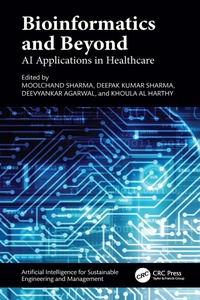
Bioinformatics and Beyond
AI Applications in Healthcare
1st Edition
Published on 19. March 2025
310 pages
978-1-040-30011-4 (ISBN)
Description

This book is a comprehensive exploration of the dynamic interplay between bioinformatics and artificial intelligence (AI) within the healthcare landscape. This book introduces readers to the foundational principles of bioinformatics and AI, elucidating their integration and collaborative potential.
Bioinformatics and Beyond: AI Applications in Healthcare explores the transformative impact of data-driven insights, showcasing the applications of machine learning in diagnostics, personalized medicine, and genomic advancements. The book unveils the pivotal role AI plays in accelerating pharmaceutical research. Moreover, it addresses the practical implementation of AI in clinical decision support systems, while also critically examining challenges and ethical considerations associated with these technologies. Finally, the book looks toward the future, envisioning emerging trends and technologies that promise to reshape the future of healthcare. Aimed at professionals, researchers, and students across diverse disciplines, this book serves as an invaluable guide to understanding and navigating the evolving landscape of AI applications in healthcare.
This book is tailored to meet the needs of scientists, researchers, practitioners, professionals, and educators actively engaged in the realms of bioinformatics, artificial intelligence, and healthcare. It will be an indispensable resource for those seeking advanced strategies to address challenges and harness opportunities in the rapidly evolving fields of medical and biomedical research.
Bioinformatics and Beyond: AI Applications in Healthcare explores the transformative impact of data-driven insights, showcasing the applications of machine learning in diagnostics, personalized medicine, and genomic advancements. The book unveils the pivotal role AI plays in accelerating pharmaceutical research. Moreover, it addresses the practical implementation of AI in clinical decision support systems, while also critically examining challenges and ethical considerations associated with these technologies. Finally, the book looks toward the future, envisioning emerging trends and technologies that promise to reshape the future of healthcare. Aimed at professionals, researchers, and students across diverse disciplines, this book serves as an invaluable guide to understanding and navigating the evolving landscape of AI applications in healthcare.
This book is tailored to meet the needs of scientists, researchers, practitioners, professionals, and educators actively engaged in the realms of bioinformatics, artificial intelligence, and healthcare. It will be an indispensable resource for those seeking advanced strategies to address challenges and harness opportunities in the rapidly evolving fields of medical and biomedical research.
More details
Series
Edition
1. Auflage
Language
English
Place of publication
London
United Kingdom
Publishing group
Taylor & Francis Ltd
Target group
College/higher education
Professional and scholarly
Illustrations
18 Tables, black and white; 30 Line drawings, black and white; 28 Halftones, black and white; 58 Illustrations, black and white
File size
31,51 MB
ISBN-13
978-1-040-30011-4 (9781040300114)
Copyright in bibliographic data and cover images is held by Nielsen Book Services Limited or by the publishers or by their respective licensors: all rights reserved.
Schweitzer Classification
Other editions
Additional editions
Moolchand Sharma | Deepak Kumar Sharma | Deevyankar Agarwal
Bioinformatics and Beyond
AI Applications in Healthcare
Book
approx. 07/2026
1st Edition
CRC Press
€66.00
Not yet published
Moolchand Sharma | Deepak Kumar Sharma | Deevyankar Agarwal
Bioinformatics and Beyond
AI Applications in Healthcare
Book
03/2025
1st Edition
CRC Press
€210.60
Shipment within 10-20 days

Moolchand Sharma | Deepak Kumar Sharma | Deevyankar Agarwal
Bioinformatics and Beyond
AI Applications in Healthcare
Book
02/2025
CRC Press
Unfortunately, price unknown
Available (delivery time upon request)
Persons
Moolchand Sharma is currently an Assistant Professor in the Department of Computer Science and Engineering at the Maharaja Agrasen Institute of Technology, GGSIPU Delhi. His research areas include Artificial Intelligence, Nature-Inspired Computing, Security in Cloud Computing, Machine Learning, and Search Engine Optimization.
Deepak Kumar Sharma is an Associate Professor in the Department of Information Technology, Indira Gandhi Delhi Technical University for Women (IGDTUW), Kashmere Gate, Delhi, India. Earlier, he has worked as Assistant Professor at Netaji Subhas University of Technology (Formerly N.S.I.T.), Dwarka, Delhi. He obtained his Ph. D in Computer Engineering from University of Delhi, India in 2016. His research interests include opportunistic networks, wireless ad hoc and sensor networks, Software Defined Networks and IoT Networks. He has over 17 years of experience in Academics.
Deevyankar Agarwal received his Ph.D. with outstanding grades in the applied Artificial intelligence domain from the Department of Information Technology and Telecommunications, University of Valladolid, Spain. He has extensive experience in machine learning, having conducted research on applied deep learning. He has 22 years of experience as an educator and has been working at the University of Technology and Applied Sciences, Muscat, since September 2013 as a Lecturer in the Computer Engineering Department. Additionally, he also worked as a research coordinator, where his job is to keep track of the funding process applied by professors in the engineering department, act as a go-between for funding agencies, enterprises, and the department, and try to get as much funding as possible to develop products and projects that will benefit society.
Khoula Al Harthy is an esteemed researcher with a focus on information security and a keen interest in Blockchain technology. Her career is dedicated to the empowerment of local expertise in cutting-edge technologies. She served as the President of the Oman Blockchain Club for 2 years. She is the Head of computer science and Creative Technologies department at GCET. Notably, she is the initiator of the Blockchain Research Thematic Group, driving forward the academic exploration and application of blockchain technology. Her work in this area highlights her commitment to integrating advanced tech into academia and beyond, shaping the future of information cybersecurity security and AI in the region.
Deepak Kumar Sharma is an Associate Professor in the Department of Information Technology, Indira Gandhi Delhi Technical University for Women (IGDTUW), Kashmere Gate, Delhi, India. Earlier, he has worked as Assistant Professor at Netaji Subhas University of Technology (Formerly N.S.I.T.), Dwarka, Delhi. He obtained his Ph. D in Computer Engineering from University of Delhi, India in 2016. His research interests include opportunistic networks, wireless ad hoc and sensor networks, Software Defined Networks and IoT Networks. He has over 17 years of experience in Academics.
Deevyankar Agarwal received his Ph.D. with outstanding grades in the applied Artificial intelligence domain from the Department of Information Technology and Telecommunications, University of Valladolid, Spain. He has extensive experience in machine learning, having conducted research on applied deep learning. He has 22 years of experience as an educator and has been working at the University of Technology and Applied Sciences, Muscat, since September 2013 as a Lecturer in the Computer Engineering Department. Additionally, he also worked as a research coordinator, where his job is to keep track of the funding process applied by professors in the engineering department, act as a go-between for funding agencies, enterprises, and the department, and try to get as much funding as possible to develop products and projects that will benefit society.
Khoula Al Harthy is an esteemed researcher with a focus on information security and a keen interest in Blockchain technology. Her career is dedicated to the empowerment of local expertise in cutting-edge technologies. She served as the President of the Oman Blockchain Club for 2 years. She is the Head of computer science and Creative Technologies department at GCET. Notably, she is the initiator of the Blockchain Research Thematic Group, driving forward the academic exploration and application of blockchain technology. Her work in this area highlights her commitment to integrating advanced tech into academia and beyond, shaping the future of information cybersecurity security and AI in the region.
Content
Contents
Preface
About the book
About the editors
List of Contributors
Introduction and Scope
1. AI and Machine Learning in Modern Healthcare
Kshatrapal Singh, Vijay Shukla, Dhiraj Gupta, Yogesh Kumar Sharma
2. Telemedicine and Remote Prenatal Care: A Soft Computing Approach
Pradnya S. Mehta, Pranav Bafna, Atharv Sawant, Pratik Patil, Niraj Pandit
3. Detection of Abnormality in Heart Rhythm Using Machine Learning Approach
Prabhudutta Ray, Raj Rawal, Ahsan Z. Rizvi
4. AI in Drug Discovery and Development
Tahreem Shahzad, Arooj Fatima Tul Zahra, Ayesha Naeem, Mujahid Tabassum
5. Transforming Healthcare: Leveraging Machine Learning Algorithms for Diagnosis, Treatment, and Management
Indu Joseph Thoppil, K. Ashtalakshmi, Ramesh Chundi
6. Gestational Diabetes Prediction Using Hybrid Probabilistic Machine Learning Models
Lakshmi K, Umme Salma M., Sangeetha Shathish
7. AI in Diagnostics and Disease Prediction: Urolithiasis
Suneel Kumar and Dashrath Singh
8. Unveiling Cheminformatics for Accelerated Drug Discovery and Development: A Computational-Guided Approach
Amanpreet Kaur and Debasish Mandal
9. Transformative Applications of AI and Machine Learning in Bioinformatics for Healthcare Systems
Arooj Fatima Tul Zahra, Mujahid Tabassum , Nabiea Shehma, Moeza Anam, Tripti Sharma
10. Revolutionizing Drug Development: The Role of AI in Modern Pharmaceutical Research
Samridhi Agarwal and Amit Kumar Dutta
11. Impact of AI on Healthcare from Diagnostics to Drug Discovery
Smrita Singh and Ashutosh Singh Chauhan
12. Biomedical Imaging Techniques in AI Applications
T. Kalpana, R.Thamilselvan and T.M.Saravanan
13. Ethical Implications of AI in CRISPR: Responsible Genome Editing
Umesh Gupta, Ayushman Pranav, Rajesh Kumar Modi, and Ankit Dubey
Index
Preface
About the book
About the editors
List of Contributors
Introduction and Scope
1. AI and Machine Learning in Modern Healthcare
Kshatrapal Singh, Vijay Shukla, Dhiraj Gupta, Yogesh Kumar Sharma
2. Telemedicine and Remote Prenatal Care: A Soft Computing Approach
Pradnya S. Mehta, Pranav Bafna, Atharv Sawant, Pratik Patil, Niraj Pandit
3. Detection of Abnormality in Heart Rhythm Using Machine Learning Approach
Prabhudutta Ray, Raj Rawal, Ahsan Z. Rizvi
4. AI in Drug Discovery and Development
Tahreem Shahzad, Arooj Fatima Tul Zahra, Ayesha Naeem, Mujahid Tabassum
5. Transforming Healthcare: Leveraging Machine Learning Algorithms for Diagnosis, Treatment, and Management
Indu Joseph Thoppil, K. Ashtalakshmi, Ramesh Chundi
6. Gestational Diabetes Prediction Using Hybrid Probabilistic Machine Learning Models
Lakshmi K, Umme Salma M., Sangeetha Shathish
7. AI in Diagnostics and Disease Prediction: Urolithiasis
Suneel Kumar and Dashrath Singh
8. Unveiling Cheminformatics for Accelerated Drug Discovery and Development: A Computational-Guided Approach
Amanpreet Kaur and Debasish Mandal
9. Transformative Applications of AI and Machine Learning in Bioinformatics for Healthcare Systems
Arooj Fatima Tul Zahra, Mujahid Tabassum , Nabiea Shehma, Moeza Anam, Tripti Sharma
10. Revolutionizing Drug Development: The Role of AI in Modern Pharmaceutical Research
Samridhi Agarwal and Amit Kumar Dutta
11. Impact of AI on Healthcare from Diagnostics to Drug Discovery
Smrita Singh and Ashutosh Singh Chauhan
12. Biomedical Imaging Techniques in AI Applications
T. Kalpana, R.Thamilselvan and T.M.Saravanan
13. Ethical Implications of AI in CRISPR: Responsible Genome Editing
Umesh Gupta, Ayushman Pranav, Rajesh Kumar Modi, and Ankit Dubey
Index
