

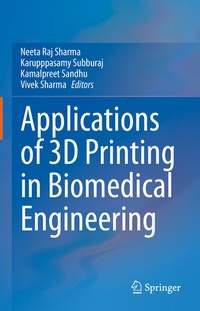
Applications of 3D printing in Biomedical Engineering
Description

This book focuses on applications of three-dimensional (3D) printing in healthcare. It first describes a range of biomaterials, including their physicochemical and biological properties. It then reviews the current state of the art in bioprinting techniques and the potential application of bioprinting, computer-aided additive manufacturing of cells, tissues, and scaffolds to create organs in regenerative medicine. Further, it discusses the orthopedic applications of 3D printing in the design and fabrication of dental implants, and the use of 3D bioprinting in oral and maxillofacial surgery and in tissue and organ engineering. Lastly, the book examines the 3D printing technologies that are used for the fabrication of the drug delivery system. It also explores the current challenges and the future of 3D bioprinting in medical sciences, as well as the market demand.
More details
Other editions
Additional editions
Persons
Neeta Raj Sharma is the Additional Dean and Head of the School of Bioengineering and Biosciences at Lovely Professional University, Phagwara, Punjab. She completed her doctorate degree in Biochemistry from Jiwaji University Gwalior, India. She is a visiting Professor at Birmingham City University, UK, and works in association with the University of British Columbia, McGill University, Laval University and the University of Victoria in Canada. She has extensive multidisciplinary experience in the field of applied bioengineering for the development of diagnostic tools and exploration of bioanalytical instrumentation in the area of Biomedical Engineering. Dr. Sharma is a fellow of the Association of Biotechnology and Pharmacy and of International Science Congress Association and is also a member of various societies, including Association of Indian Science Congress (Elected Member for North Region ISC106); Association of Microbiologists of India, Indo-US Collaboration of Engineering Education 2013. She is a life member of the Association for Promotion of DNA Finger Printing and other DNA Technologies. She has published more than 70 research/review articles and edited books, holds 28 published patents and 6 copyrights.
Karupppasamy Subburaj is an Assistant Professor and the lead for Healthcare Engineering and Design track in the Engineering Product Development (EPD) Pillar at Singapore University of Technology and Design (SUTD) since (2014). He leads the Medical Engineering and Design (MED) laboratory, an interdisciplinary research group specializes in design and development of medical devices, medical imaging and image analysis methods, and computing tools for diagnosing, treating, and potentially preventing musculoskeletal disorders and disabilities. Recognizing that collaborative bridges between different disciplines are the key to advancement in research, he brings basic scientists, clinical researchers, design engineers, and physicians together to conduct clinically relevant research and translate it to patient care. He is also passionate about design education and teaching and received the SUTD Outstanding Education Award: Excellence in Teaching (2019) for his contributions. His research work resulted in 4 patents, 2 books, 50 peer-reviewed technical articles in highly referred international journals, and 80 international conference articles and presentations. Subburaj received his doctorate (2019) from the Indian Institute of Technology Bombay and postdoctoral (2010-2014) research training in Musculoskeletal Quantitative Imaging Research laboratory in the Department of Radiology and Biomedical Imaging at the University of California San Francisco (UCSF).
Kamalpreet Sandhu is an Assistant Professor in the Product and Industrial Design Department at Lovely Professional University, Phagwara, Punjab. His primary focus is on design and development of footwear products and injuries prevention. He has done different projects in Podiatric Medicine at Defence Institute of Physiology and Allied Sciences, DRDO, Delhi, i.e. Design and developed new kind of orthosis for social needs and work result in publication "Effect of Shod Walking on Plantar Pressure with Varying Insole". His area of research is 3D printing, Ergonomics in Podiatric Medicine and Design Thinking. He is also the Editor of Books, SPRINGER NATURE Emerging Application of 3D printing during Covid19 pandemic, Sustainability for 3D Printing, Revolutions in Product Design for Healthcare and Food Printing: 3D printing in Food sector. He is also acting as an Editorial Review board member for International Journal of Technology and Human Interaction (IJTHI) and Advances in Science, Technology and Engineering Systems Journal (ASTESJ). He is working in collaboration with Prof. Karupppasamy Subburaj, Medical Engineering and Design (MED) laboratory, Singapore University of Technology and Design (SUTD).
Vivek Sharma is an Assistant Professor in the Department of Product & Industrial Design at the Lovely Professional University, Punjab. His research interest involves affective computing, biomedical products, and kansei engineering etc. He has also published more than 15 research articles in the peer-reviewed international journals and co-authored 2 books, and 4 book chapters.
