

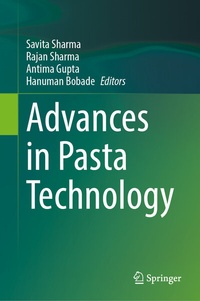
Advances in Pasta Technology
Description

Advances in Pasta Technology documents the history of pasta and its rise from niche to mainstream. The book is divided into 4 sections including an introduction that covers pasta history, global market statistics, traditional pasta making technology and processing along with quality characteristics. Another section is dedicated to nutritive valorization of pasta including modulation in the bio-functional characteristics as a function of ingredients including development of gluten free pasta, micronutrient fortification approach and use of protein, fibre and antioxidant rich flours as potential alternative ingredients. Further sections focus on technological approaches to enhance the performance of specialty pasta including additives, modification of flours and processing techniques and quality management, plant project profile and cost analysis details. This text highlights every aspect of pasta science, technology and market control.
More details
Other editions
Additional editions
Persons
Savita Sharma is a Principal Food Technologist in the Department of Food Science and Technology at Punjab Agricultural University in Ludhiana, India
Rajan Sharma is a Researcher in the Department of Food Science and Technology at Punjab Agricultural University in Ludhiana, India
Antima Gupta is a Researcher in the Department of Food Science and Technology at Punjab Agricultural University in Ludhiana, India
Hanuman Bobade is a Researcher in the Department of Food Science and Technology at Punjab Agricultural University in Ludhiana, India
Content
Section A: Introduction.- History and Origin of Pasta.- Global market scenario: Socio-economic opportunities and challenges.- Technology of pasta making.- Equipment and machinery involved in pasta processing., Quality characteristics of pasta., Section B: Nutritional Valorization of Pasta.- Gluten free pasta.- Protein enriched pasta.- Fibre enriched pasta.- Micro-nutrient fortified pasta.- Antioxidant rich pasta.- Section C: Technological Interventions.- Hydrocolloids as potential additives.- Modified flours as additives.- Three Dimensional (3D) Printed Pasta.- Ready to eat/Instant Pasta.- Section D: Quality Control and Project Profile.- Quality management and shelf life of Pasta.- Project profile and cost analysis of Pasta.
