

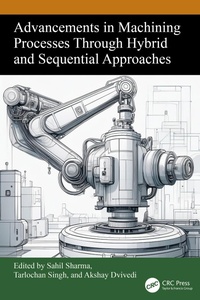
Advancements in Machining Processes Through Hybrid and Sequential Approaches
1st Edition
Published on 4. April 2025
170 pages
978-1-040-32480-6 (ISBN)
Description

Advancements in Machining Processes Through Hybrid and Sequential Approaches is a multi-contributed book that details the most current research in machining techniques to manufacture complex structures in difficult-to-machine materials.
This book begins with an introduction to advanced machining techniques and highlights their key areas of application. Subsequently, it explores in detail developments in the field, focusing on thermal, mechanical, and electrochemical energy-based hybrid and sequential approaches. It covers topics such as triplex energy-based hybrid machining processes, which include grinding-assisted electrochemical discharge machining and ultrasonic-assisted electrochemical discharge machining processes. It also delves into the sequential machining processes and the postprocessing of materials through advanced finishing techniques such as abrasive flow finishing, electropolishing, ultrasonic vibration assisted polishing, etc. With its focus on advanced machining techniques and their applications in mechanical, biomedical, automotive, and aerospace engineering, this book is sure to pique the interest of those seeking to expand their understanding and enhance their practice.
This book is a must-read for professionals in the field of machining, offering a wealth of knowledge and insights that can inspire new approaches and solutions.
This book begins with an introduction to advanced machining techniques and highlights their key areas of application. Subsequently, it explores in detail developments in the field, focusing on thermal, mechanical, and electrochemical energy-based hybrid and sequential approaches. It covers topics such as triplex energy-based hybrid machining processes, which include grinding-assisted electrochemical discharge machining and ultrasonic-assisted electrochemical discharge machining processes. It also delves into the sequential machining processes and the postprocessing of materials through advanced finishing techniques such as abrasive flow finishing, electropolishing, ultrasonic vibration assisted polishing, etc. With its focus on advanced machining techniques and their applications in mechanical, biomedical, automotive, and aerospace engineering, this book is sure to pique the interest of those seeking to expand their understanding and enhance their practice.
This book is a must-read for professionals in the field of machining, offering a wealth of knowledge and insights that can inspire new approaches and solutions.
More details
Edition
1. Auflage
Language
English
Place of publication
London
United Kingdom
Publishing group
Taylor & Francis Ltd
Target group
Professional and scholarly
Illustrations
5 Tables, black and white; 27 Line drawings, black and white; 43 Halftones, black and white; 70 Illustrations, black and white
File size
7,69 MB
ISBN-13
978-1-040-32480-6 (9781040324806)
Copyright in bibliographic data and cover images is held by Nielsen Book Services Limited or by the publishers or by their respective licensors: all rights reserved.
Schweitzer Classification
Other editions
Additional editions
Sahil Sharma | Tarlochan Singh | Akshay Dvivedi
Advancements in Machining Processes Through Hybrid and Sequential Approaches
Book
approx. 07/2026
1st Edition
CRC Press
€66.00
Not yet published
Sahil Sharma | Tarlochan Singh | Akshay Dvivedi
Advancements in Machining Processes Through Hybrid and Sequential Approaches
Book
04/2025
1st Edition
CRC Press
€121.50
Shipment within 10-20 days
Persons
Sahil Sharma is working as a research scholar at the Indian Institute of Technology, Roorkee, India. He received a B.Tech in Mechanical Engineering from Kurukshetra University in 2014 and an M.Tech from the YMCA University in 2017. Before joining IIT, Sahil served as a research associate cum assistant professor at the Entrepreneurship and Incubation Council (EPIC) Not-For-Profit Centre, affiliated with the Ambala College of Engineering and Applied Research (ACE) and the Department of Science and Technology (DST), Government of India, under the NIDHI-TBI scheme. During this time, he contributed to various research and development projects, gaining valuable experience and expertise. His academic background provides a strong foundation for his current research interests, which revolve around the advancement of machining techniques for difficult-to-machine materials and the development of hybrid machining systems for corrosion-resistant materials. Additionally, he is involved in the creation of microfluidic devices using the ECDM process on glass substrates. He has published six peer-reviewed journal articles, authored two book chapters, completed one government-funded project, and filed two patents, highlighting his commitment to knowledge dissemination and innovation. He received the Academic Excellence Award (2013) and the Best Paper Award (2017) at the national conference. Through his work, he aims to contribute to the advancement of manufacturing technologies and pioneer innovative solutions for the industry.
Tarlochan Singh is working as a Faculty Member in School of Product and Industrial Design at Lovely Professional University (LPU), Jalandhar, India. Before joining the LPU, Dr. Singh was an Institutional Postdoctoral fellow at the Indian Institute of Technology, Bombay, India. He received a B.Tech in Mechanical Engineering from Punjab Technical University in 2011 and an M.Tech from the Indian Institute of Technology Roorkee in 2013. He received a Ph.D in Advanced Manufacturing from the Indian Institute of Technology Roorkee in 2019. His present research interests include the development of advanced manufacturing processes for the machining of difficult-to-machine materials. Currently, his research work is aimed toward the development of microfluidic devices on glass material with the ECDM process. He is also working on the ECDM process for the surface modification of ceramics and metals for MEMS and biomedical applications. He has published 24 peer-reviewed journal papers, 11 patents, and 3 book chapters. Dr. Singh has received the University Gold Medalist Award (2011), Outstanding Reviewing Award (2017), Editor's Choice Award (2019), and Best Paper Award (2013, 2019). Furthermore, Dr. Singh is also working on product design and development through human-centric approaches.
Akshay Dvivedi is currently serving as a Professor at the Indian Institute of Technology, Roorkee, India. He has held various notable positions within the institute, including Associate Dean of Corporate Interaction (ADCI), Tinkering Lab Coordinator, Professor-in-Charge of the Department Web Management Committee, and Chairman of Planning, Information, and Special Events. Currently, he is the Dean of Sponsored Research and Industrial Consultancy (SRIC), overseeing crucial responsibilities related to research collaboration and industrial engagement. His research interests encompass a wide range of areas such as product design and development, fabrication and machining of metal matrix composites, micromachining of difficult-to-machine materials, quality management, and QFD for service sectors. With an outstanding academic record, Professor Dvivedi has published over 100 peer-reviewed journal articles and international conference papers. His expertise is further reflected in his five patents. To date, he has successfully supervised the research work of 18 Ph.D candidates and over 30 Master's candidates. His exceptional contributions and achievements have earned him numerous accolades, including the Outstanding Teacher's Award twice, the Best Conference Paper Award twice, and the Editor's Choice Paper Award by Precision Engineering Journal in 2019. Moreover, he was nominated for the INAE Young Entrepreneur Award in 2020 and recognized by the India Innovators Association in their compilation of the "Best 100 Innovations" for the Adaptive Feedback-Controlled Electric Hydro-Dissection Device, representing the finest innovation from the institute in 2019.
Tarlochan Singh is working as a Faculty Member in School of Product and Industrial Design at Lovely Professional University (LPU), Jalandhar, India. Before joining the LPU, Dr. Singh was an Institutional Postdoctoral fellow at the Indian Institute of Technology, Bombay, India. He received a B.Tech in Mechanical Engineering from Punjab Technical University in 2011 and an M.Tech from the Indian Institute of Technology Roorkee in 2013. He received a Ph.D in Advanced Manufacturing from the Indian Institute of Technology Roorkee in 2019. His present research interests include the development of advanced manufacturing processes for the machining of difficult-to-machine materials. Currently, his research work is aimed toward the development of microfluidic devices on glass material with the ECDM process. He is also working on the ECDM process for the surface modification of ceramics and metals for MEMS and biomedical applications. He has published 24 peer-reviewed journal papers, 11 patents, and 3 book chapters. Dr. Singh has received the University Gold Medalist Award (2011), Outstanding Reviewing Award (2017), Editor's Choice Award (2019), and Best Paper Award (2013, 2019). Furthermore, Dr. Singh is also working on product design and development through human-centric approaches.
Akshay Dvivedi is currently serving as a Professor at the Indian Institute of Technology, Roorkee, India. He has held various notable positions within the institute, including Associate Dean of Corporate Interaction (ADCI), Tinkering Lab Coordinator, Professor-in-Charge of the Department Web Management Committee, and Chairman of Planning, Information, and Special Events. Currently, he is the Dean of Sponsored Research and Industrial Consultancy (SRIC), overseeing crucial responsibilities related to research collaboration and industrial engagement. His research interests encompass a wide range of areas such as product design and development, fabrication and machining of metal matrix composites, micromachining of difficult-to-machine materials, quality management, and QFD for service sectors. With an outstanding academic record, Professor Dvivedi has published over 100 peer-reviewed journal articles and international conference papers. His expertise is further reflected in his five patents. To date, he has successfully supervised the research work of 18 Ph.D candidates and over 30 Master's candidates. His exceptional contributions and achievements have earned him numerous accolades, including the Outstanding Teacher's Award twice, the Best Conference Paper Award twice, and the Editor's Choice Paper Award by Precision Engineering Journal in 2019. Moreover, he was nominated for the INAE Young Entrepreneur Award in 2020 and recognized by the India Innovators Association in their compilation of the "Best 100 Innovations" for the Adaptive Feedback-Controlled Electric Hydro-Dissection Device, representing the finest innovation from the institute in 2019.
Content
1. Introduction and Overview of Advanced Machining Processes 2. Introduction and Overview of Hybrid Machining Processes 3. Triplex Hybrid Based Grinding Assisted Electrochemical Discharge Machining process 4. Triplex Hybridized Based Magnetic Assistance Rotary Electrochemical Discharge Machining Process: 3D FEM Simulation and Experimental Investigation 5. Triplex Hybrid Based Ultrasonic-assisted Electrochemical Discharge Machining process 6. Introduction and Overview of Sequential Machining Processes 7.Thermal plus Electrochemical Based Sequential Machining Processes 8. Thermo plus Mechanical Based Sequential Machining Processes 9. Thermo plus Mechanical Based Sequential Machining Processes 10. Advances in Surface Finish Techniques for Additively Manufactured Components: A Conceptual Review
