

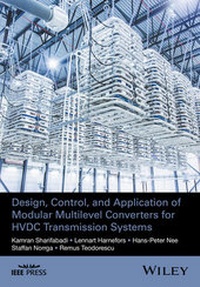
Design, Control, and Application of Modular Multilevel Converters for HVDC Transmission Systems
Published on 22. August 2016
416 pages
978-1-118-85154-8 (ISBN)
Description

Design, Control and Application of Modular Multilevel Converters for HVDC Transmission Systems is a comprehensive guide to semiconductor technologies applicable for MMC design, component sizing control, modulation, and application of the MMC technology for HVDC transmission.
Separated into three distinct parts, the first offers an overview of MMC technology, including information on converter component sizing, Control and Communication, Protection and Fault Management, and Generic Modelling and Simulation. The second covers the applications of MMC in offshore WPP, including planning, technical and economic requirements and optimization options, fault management, dynamic and transient stability. Finally, the third chapter explores the applications of MMC in HVDC transmission and Multi Terminal configurations, including Supergrids.
Key features:
* Unique coverage of the offshore application and optimization of MMC-HVDC schemes for the export of offshore wind energy to the mainland.
* Comprehensive explanation of MMC application in HVDC and MTDC transmission technology.
* Detailed description of MMC components, control and modulation, different modeling approaches, converter dynamics under steady-state and fault contingencies including application and housing of MMC in HVDC schemes for onshore and offshore.
* Analysis of DC fault detection and protection technologies, system studies required for the integration of HVDC terminals to offshore wind power plants, and commissioning procedures for onshore and offshore HVDC terminals.
* A set of self-explanatory simulation models for HVDC test cases is available to download from the companion website.
This book provides essential reading for graduate students and researchers, as well as field engineers and professionals who require an in-depth understanding of MMC technology.
More details
Other editions
Additional editions
Kamran Sharifabadi | Lennart Harnefors | Hans-Peter Nee
Design, Control, and Application of Modular Multilevel Converters for HVDC Transmission Systems
Book
10/2016
Wiley-IEEE Press
€141.50
Shipment within 15-20 days
K. Sharifabadi
Design, Control and Application of Modular Multilevel Converters for HVDC Transmission Systems
Software
08/2016
Wiley
€158.53
No shipping information available
Persons
Kamran Sharifabadi, Power Grid & Regulatory Affairs, Statoil, Norway Kamran has twenty-five years of international experience in the field of HVDC technology projects. He started out as a research engineer in ABB and Siemen, worked as a consultant for five years, then became a manager at the Norwegian TSO. He is currently a senior technology advisor for Statoil`s HVDC projects, a guest lecturer in the topics of VSC HVDC, Wind power generation technologies at NTNU and at various different universities in central Europe. Kamran is an active member of the Cigre B4 (HVDC) working group and the leader of the steering committee for a European research project on DC grids.
Remus Teodorescu, Aalborg University, Denmark Remus is an Associate Professor at the Institute of Technology, teaching courses in power electronics and electrical energy system control. He has authored over 80 journal and conference papers and two books. He is the founder and coordinator of the Green Power Laboratory at Aalborg University, and is co-recipient of the Technical Committee Prize Paper Award at IEEE Optim 2002.
Hans Peter Nee, KTH, Sweden Hans is Professor of Power Electronics in the Department of Electrical Engineering. He has supervised and examined ten finalized doctor's projects, and was awarded the Elforsk Scholarship in 1997. He has served on the board of the IEEE Sweden Section for many years and was Chairman during 2002 and 2003. He is also a member of EPE and serves in the Executive Council and in the International Steering Committee.
Lennart Harnefors, ABB, Västerås, Sweden Lennart is currently with ABB Power Systems - HVDC, Ludvika, Sweden as an R&D Project Manager and Principal Engineer, and with KTH as an Adjunct Professor of power electronics. Between 2001 and 2005, he was a part-time Visiting Professor of electrical drives with Chalmers University of Technology, Sweden. He is an Associate Editor of the IEEE Transactions on Industrial Electronics, on the Editorial Board of IET Electric Power Applications, and a member of the Executive Council and the International Scientific Committee of the European Power Electronics and Drives Association.
Staffan Norrga, KTH, Sweden Between 1994 and 2011, Staffan worked as a Development Engineer at ABB in Västerås, Sweden, in various power-electronics-related areas such as railway traction systems and converters for HVDC power transmission systems. In 2000, he returned to the Department of Electric Machines and Power Electronics of the Royal Institute of Technology, where he is an associate professor. He is the inventor or co-inventor of 11 granted patents and 14 patents pending and has authored more than 35 scientific papers.
Content
Preface
About the Companion Website
Introduction
1 Introduction to Modular Multilevel Converters
1.1 The Two-Level Voltage Source Converter
1.2 Benefits of Multilevel Converters
1.3 Early Multilevel Converters
1.4 Cascaded Multilevel Converters
1.5 Summary
2 Main-Circuit Design
2.1 Properties and Design Choices of Power Semiconductor Devices for High-Power Applications
2.2 Medium-Voltage Capacitors for Submodules
2.3 Arm Inductors
2.4 Submodule Configurations
2.5 Choice of Main-Circuit Parameters
2.6 Handling of Redundant and Faulty Submodules
2.7 Auxiliary Power Supplies for Submodules
2.8 Start-Up Procedures
2.9 Summary
3 Dynamics and Control
3.1 Introduction
3.2 Fundamentals
3.3 Converter Operating Principle and Averaged Dynamic Model
3.4 Per-Phase Output-Current Control
3.5 Arm-Balancing (Internal) Control
3.6 Three-Phase Systems
3.7 Vector Output-Current Control
3.8 Higher-Level Control
3.9 Control Architectures
3.10 Summary
4 Control Under Unbalanced Grid Conditions
4.1 Grid Requirements
4.2 Shortcomings of Conventional Vector Control
4.3 Positive/Negative-Sequence Extraction (PNSE)
4.4 Injection Reference Strategy
4.5 Component-Based Vector Output-Current Control
4.6 Summary
4.7 References
5 Modulation and Submodule Energy Balancing
5.1 Fundamentals of PulseWidth Modulation
5.2 Carrier-Based Modulation Methods
5.3 Multilevel Carrier-Based Modulation
5.4 Nearest-Level Control
5.5 Submodule Energy Balancing Methods
5.6 Summary
6 Modeling and Simulation
6.1 Introduction
6.2 Leg-Level Averaged (LLA) Model
6.3 Arm-Level Averaged (ALA) Model
6.4 Submodule-Level Averaged (SLA) Model
6.5 Submodule-Level Switched (SLS) Model
6.6 Summary
7 Design and Optimization of MMC-HVDC Schemes for Offshore Wind-Power Plant Application
7.1 Introduction
7.2 The Influence of Regulatory Frameworks on the Development Strategies for Offshore HVDC Schemes
7.3 Impact of Regulatory Frameworks on the Functional Requirements and Design of Offshore HVDC Terminals
7.4 Components of an Offshore MMC-HVDC Converter
7.5 Offshore Platform Concepts
7.6 Onshore HVDC Converter
7.7 Recommended System Studies for Development and Integration of an Offshore HVDC Link to a WPP
8 MMC-HVDC Standards and Commissioning Procedures
8.1 Introduction
8.2 CIGRE and IEC Activities for Standardisation of MMC-HVDC Technology
8.3 MMC-HVDC Commissioning, Factory and Site Acceptance Tests
9 Control and Protection of MMC-HVDC under AC and DC Network Fault Contingencies
9.1 Two-level VSC-HVDC Fault Characteristics under Unbalanced AC Network Contingency
9.2 MMC-HVDC Fault Characteristics under Unbalanced AC Network Contingency
9.3 DC Pole to Ground Short Circuit Fault Characteristics of the Half-bridge MMC-HVDC
9.4 MMC-HVDC Component Failures
9.5 MMC-HVDC Protection Systems
10 MMC-HVDC Transmission Technology and MTDC Networks
10.1 LCC HVDC Transmission Technology
10.2 Modular Multilevel HVDC Transmission Technology
10.3 The European HVDC Projects and MTDC Network Perspectives
10.4 Multiterminal HVDC Configurations
10.5 DC Load Flow Control in MTDC Networks
10.6 DC Grid Control Strategies
10.7 DC Fault Detection and Protection in MTDC Networks
10.8 Fault Detection Methods in MTDC
10.9 DC Circuit Breaker Technologies
10.10 Fault Current Limiters
10.11 The Influence of Grounding Strategy on Fault Currents
10.12 DC Supergrids of the Future
Index
Nomenclature
A list of the important symbols that used in this book can be found in Tables 1-4. A list of acronyms can be found in Tables 5-7.
Table 1 Superscripts, subscripts, circumflexes, and prefixes
* Complex conjugate ? Reference f,F Filtered value 0 Nominal value + Positive sequence - Negative sequence u,l Upper, lower arm 0 Mean value, zero-sequence component a,b,c Phases a, b, c a,ß Components of the stationary aß reference frame d,q Components of the synchronous dq reference frame Sum ? Difference Mean value Peak value, estimated value Difference ? Ripple quantity, parasitic quantity, difference, incrementTable 2 Variables
h Signed multiple of the fundamental frequency i Submodule index k Phase number m Carrier index n Sample index, sideband index s = d/dt Differential operator (or, where appropriate, complex Laplace variable) t Time z Forward-shift operator (or, where appropriate, complex z-transform variable) d = z - 1 Delta operator iu,l Arm current is = iu - il Output current ic = (iu + il)/2 Circulating current id DC-bus current Output-current control error e´ Modified control error Capacitor voltage in submodule i Sum capacitor voltage per arm Sum capacitor voltage per phase Imbalance sum capacitor voltage Submodule insertion index Insertion index per arm Inserted arm voltage vs = (-vu + v1)/2 Output voltage vc = (vu + v1)/2 Internal voltage va AC-bus voltage vg Grid voltage vPCC PCC voltage vdu,l Pole-to-ground dc-bus voltage vd = vdu + vdl Pole-to-pole dc-bus voltage Imbalance dc-bus voltage vR R-part output Stored energy per arm WS = Wu + Wl Stored energy per phase W? = Wu - Wl Imbalance stored energy Effective stored dc-bus energy P Active output power Pd DC-side input power Q Reactive output power ? Instantaneous angular frequency of the control-system dq frame ? = ? ? dt Angle of the control-system dq frameTable 3 Parameters and functions
f1 Fundamental frequency ?1 = 2p f1 Fundamental angular frequency fs Sampling frequency fsw Switching frequency Ts = 1/fs Sampling period Tc Computational time delay Td = Tc + 0.5Ts Total time delay K Space-vector scaling constant M Number of phases N Number of submodules per arm C Submodule capacitance Cd Installed dc-bus capacitance Effective dc-bus capacitance L Arm inductance R Parasitic arm resistance RI Insertion resistance Peak value, fundamental component of vs Peak value, fundamental component of is Maximum allowed Maximum allowed ? Phase angle (lagging) of current relative voltage ?h Phase angle of order-h symmetric component da AC-bus-voltage phase angle dg Grid-voltage phase angle ?1 Voltage-reference phase shift ?c Carrier angular frequency ?c Carrier phase shift mf Frequency ratio ma Modulation index Ch Complex Fourier series coefficient Cmn Double complex Fourier series coefficient Jn Bessel function of order n L Sorted list of submodules Re Real part Im Imaginary part sat Saturation function satv Vectorial saturation functionTable 4 Controller parameters and transfer functions
ab PLL low-pass-filter bandwidth ac Output-current control-loop bandwidth ad DC-bus-voltage control-loop bandwidth af Voltage-feedforward-filter bandwidth ah R-part bandwidth aid DC-bus-voltage integrator bandwidth aip PLL integrator bandwidth a1 Power-synchronization control low-pass-filter bandwidth ap PLL bandwidth as Power-synchronization control-loop bandwidth Kh R-part gain Ki I-part gain Kp P-part gain Ks Power-synchronization-control gain Kv Voltage droop gain Ra "Active resistance" for circulating-current control Rs "Active resistance" for power-synchronization control fh Compensation angle for resonant filter Fh R...