

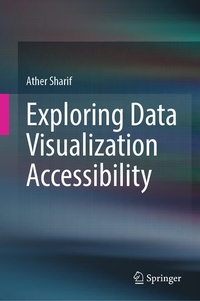
Exploring Data Visualization Accessibility
Description

Data visualizations are increasingly used to communicate essential insights. However, these visualizations are inaccessible to screen-reader users, further exacerbating the digital divide. Evidence shows that creators have minimal knowledge about accessibility. To address these concerns, this book provides foundational and cutting-edge knowledge about visualization accessibility.
Starting with a brief history of data visualizations and shedding light on the disenfranchisement caused by their inaccessibility, the author presents a detailed overview of the modalities used for visualization accessibility, highlighting their advantages and shortcomings. In addition, the book delves into various interaction mechanisms, exploring user agency and closing with future avenues to make visualizations equitably accessible.
Overall, Exploring Data Visualization Accessibility enables students, researchers, and practitioners to learn more about this topic and employ best practices in creating visualizations that can benefit all.
More details
Other editions
Additional editions
Person
Dr. Ather Sharif is a Researcher, Software Engineer, Author, and Disability Advocate. He received his Ph.D. in Computer Science from the University of Washington. His research focuses broadly on human-computer interaction and specifically on the intersection of accessibility, visualization, and customization. The main objective of his research is to make data visualizations accessible to screen-reader users. His work has been published at top-tier academic venues and received several accolades and recognition from several media outlets, including the Philadelphia Inquirer. He is also the Founder of EvoXLabs, an initiative dedicated to bridging the gap between technology and people with disabilities. He has pioneered several initiatives, including the evoHaX Hackathon, Accessible World Conference, and UnlockedMaps. Through his initiatives, he is dedicated to increasing the accessibility of information technology and the full participation of people with disabilities in computing.
Content
What to expect from this book?- Understanding screen-reader users' experiences.- Part 1: Common modalities.- Alternative textual description.- Sonifcation.- Data tables.- Part 2: Non-keyboard-based interaction mechanisms.- Touch-based interaction.- Verbal interaction.- Part 3: Supporting visualization creators.- Current experiences of creators.- Solutions to enhance the experiences of visualization creators.- Part 4: Future directions.- Artifcial intelligence, large-language models, and new technologies.- Equitable information extraction.
