

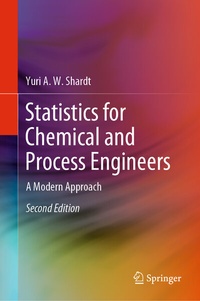
Statistics for Chemical and Process Engineers
Description

A coherent, concise, and comprehensive course in the statistics needed for a modern career in chemical engineering covers all of the concepts required for the American Fundamentals of Engineering Examination.
Statistics for Chemical and Process Engineers (second edition) shows the reader how to develop and test models, design experiments and analyze data in ways easily applicable through readily available software tools like MS Excel® and MATLAB® and is updated for the most recent versions of both. Generalized methods that can be applied irrespective of the tool at hand are a key feature of the text, and it now contains an introduction to the use of state-space methods.
The reader is given a detailed framework for statistical procedures covering:
- data visualization;
- probability;
- linear and nonlinear regression;
- experimental design (including factorial and fractional factorial designs); and
- dynamic process identification.
Main concepts are illustrated with chemical- and process-engineering-relevant examples that can also serve as the bases for checking any subsequent real implementations. Questions are provided (with solutions available for instructors) to confirm the correct use of numerical techniques, and templates for use in MS Excel and MATLAB are also available for download.
With its integrative approach to system identification, regression, and statistical theory, this book provides an excellent means of revision and self-study for chemical and process engineers working in experimental analysis and design in petrochemicals, ceramics, oil and gas, automotive and similar industries, and invaluable instruction to advanced undergraduate and graduate students looking to begin a career in the process industries.
More details
Other editions
Additional editions
Previous edition
Person
Professor Yuri A. W. Shardt is currently the chair of the Department of Automation Engineering in the Faculty of Computer Science and Automation at the Technical University of Ilmenau, working in the fields of big data, including process identification and monitoring with an emphasis on the development and industrial implementation of soft sensors; holistic control, including the development of advanced control strategies for complex industrial process; and the smart world, including implementations such as smart factories, smart home, Industry 4.0, and smart grids. Previously, he worked at the University of Waterloo in the Department of Chemical Engineering and at the University of Duisburg-Essen in the Institute of Control and Complex Systems as an Alexander von Humboldt Fellow. He has written 40 papers appearing in journals such as Automatica, Journal of Process Control, IEEE Transactions on Industrial Electronics, and Industrial and Engineering Chemistry Research on topics ranging from system identification, soft sensor development, to process control. He has presented his research at numerous conferences and taught various courses in the intersection between statistics, chemical engineering, process control, Excel®, and MATLAB®. In addition to his academic work, he has spent considerable time in industry working on implementing various process control solutions
Content
Introduction to Statistics and Data Visualisation.- Theoretical Foundation for Statistical Analysis.- Regression.- Design of Experiments.- Modelling Stochastic Processes with Time Series Analysis.- Modelling Dynamic Processes Using System Identification Methods.- Using MATLAB® for Statistical Analysis.- Using Excel® to do Statistical Analysis.
