

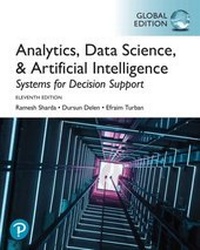
Systems for Analytics, Data Science, & Artificial Intelligence: Systems for Decision Support, Global Edition
Description

For courses in decision support systems, computerized decision-making tools, and management support systems.
Analytics, Data Science, & Artificial Intelligence: Systems for Decision Support is the most comprehensive introduction to technologies collectively called analytics (or business analytics) and the fundamental methods, techniques, and software used to design and develop these systems. Students gain inspiration from examples of organizations that have employed analytics to make decisions, while leveraging the resources of a companion website. With six new chapters, the 11th edition marks a major reorganization reflecting a new focus - analytics and its enabling technologies, including AI, machine-learning, robotics, chatbots, and IoT.
All prices
More details
Other editions
Additional editions
Persons
Ramesh Sharda (MBA, PhD, University of Wisconsin-Madison) is Vice Dean for Research and Graduate Programs, Watson/ConocoPhillips Chair, and Regents Professor of Management Science and Information Systems in the Spears School of Business at Oklahoma State University. His research has been published in major journals in management science and information systems, including Management Science, Operations Research, Information Systems Research, Decision Support Systems, Decision Sciences Journal, EJIS, JMIS, Interfaces, INFORMS Journal on Computing, and ACM Database. Dr. Sharda is a member of the editorial boards of journals such as Decision Support Systems, Decision Sciences, and ACM Database. He has worked on many sponsored research projects with government and industry, and has been a consultant to many organizations. He also serves as the faculty director of Teradata University Network. Dr. Sharda received the 2013 INFORMS Computing Society HG Lifetime Service Award, and was inducted into the Oklahoma Higher Education Hall of Fame in 2016. He is a fellow of INFORMS.
Dursun Delen (PhD, Oklahoma State University) is the Spears and Patterson Chair in Business Analytics, Director of Research for the Center for Health Systems Innovation, and Regents Professor of Management Science and Information Systems in the Spears School of Business at Oklahoma State University. Prior to his academic career, he worked for a privately owned research and consultancy company, Knowledge Based Systems, Inc. in College Station, Texas, as a research scientist for five years, during which time he led a number of decision support and other information systems-related research projects funded by federal agencies such as DoD, NASA, NIST, and DOE. Dr. Delen's research has appeared in major journals, including Decision Sciences, Decision Support Systems, Communications of the ACM, Computers and Operations Research, Computers in Industry, Journal of Production Operations Management, Journal of American Medical Informatics Association, Artificial Intelligence in Medicine, and Expert Systems with Applications. He has published eight books and textbooks and more than 100 peer-reviewed journal articles, and is often invited to deliver keynote addresses at national and international conferences on topics related to business analytics, Big Data, data/text mining, business intelligence, decision support systems, and knowledge management. Dr. Delen served as the general co-chair for the 4th International Conference on Network Computing and Advanced Information Management in Seoul, South Korea, and regularly serves as chair on tracks and mini-tracks at various business analytics and information systems conferences. He is the co-editor-in-chief of the Journal of Business Analytics, the area editor for Big Data and Business Analytics on the Journal of Business Research, and chief editor, senior editor, associate editor, and editorial board member on more than a dozen other journals. His consultancy, research, and teaching interests are in business analytics, data and text mining, health analytics, decision support systems, knowledge management, systems analysis and design, and enterprise modeling.
Efraim Turban (MBA, PhD, University of California, Berkeley) is a visiting scholar at the Pacific Institute for Information System Management, University of Hawaii. Prior to this, he was on the staff of several universities, including City University of Hong Kong; Lehigh University; Florida International University; California State University, Long Beach; Eastern Illinois University; and the University of Southern Cali
Content
- PART I: INTRODUCTION TO ANALYTICS AND AI
- 1. An Overview of Business Analytics, Decision Support Systems, Business Intelligence, Data Science, and Artificial Intelligence
- 2. Artificial Intelligence: Concepts, Drivers, Major Technologies, and Business Applications
- 3. Nature of Data, Statistical Modeling, and Visualization
- PART II: PREDICTIVE ANALYTICS AND MACHINE LEARNING
- 4. Data Mining Process, Methods, and Applications
- 5. Machine learning Techniques for Predictive Analytics
- 6. Deep Learning and Cognitive Computing
- 7. Text Mining, Sentiment Analysis, and Social Analytics
- PART III: PRESCRIPTIVE ANALYTICS AND BIG DATA
- 8. Prescriptive Analytics with Optimization and Simulation
- 9. Big Data, Location Analytics, and Cloud Computing
- PART IV: ROBOTICS, SOCIAL NETWORKS, AI, AND IoT
- 10. Robotics: Industrial and Consumer Applications
- 11. Group Decision Making, Collaborative Systems, and AI Support
- 12. Knowledge Systems: Expert Systems, Recommenders, Chatbots, Virtual Personal Assistants, and Robo Advisors
- 13. The Internet of Things As a Platform for Intelligent Applications
- PART V: CAVEATS OF ANALYTICS AND AI
- 14. Implementation Issues: From Ethics and Privacy to Organizational and Societal Impacts
