

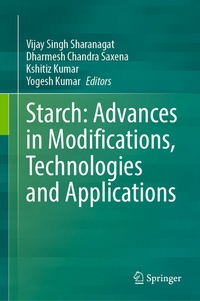
Starch: Advances in Modifications, Technologies and Applications
Description

Starch is one of the major components responsible for the structure of final food products. A recent report by Industrial Starch Market predicts the industrial starch market to reach about 106.64 billion by 2022. The major portion of the starch volume will be contributed by conventional sources like maize, wheat and potato. These native starch sources are well capable to meet the industrial requirements. However, modification of starch brings lot of positive changes in functional and structural properties of starch. As compared to their native counterparts, modified starches are gaining a significant market growth due to their enhanced functionalities and applications. Starch: Advances in Modifications, Technologies and Applications provides comprehensive coverage of the most recent advances in the modification techniques, their impact on functionality of starch and potential application food industries.
Starch is a vital ingredient for food processing industries and it has been covered thoroughly in different books. However, none of the books currently on the market have covered the most recent advances in modification techniques and their derivatives including the functional, engineering, thermo-pasting, rheological, structural and morphological properties of starch. This text comprehensively covers almost all the starch modifications, reviewing the derivatives of modification techniques and compiling all the changes in properties to provide an understanding and perspective of these innovative applications. From the history of starch production to current chemical and physical modifications, this book offers researchers all the information they need on starch modifications in a single source.
More details
Other editions
Additional editions
Persons
Vijay Singh Sharanagat is an Assistant Professor in the Department of Food Engineering at NIFTEM, Sonipat, in Haryana, India
Dharmesh Chandra Saxena is a Professor in the Department of Food Engineering and Technology at SLIET, Longowal in Punjab, India
Kshitiz Kumar is an Assistant Professor in the Department of Food Processing Technology, ADIT, CVM University, Vallabh Vidyanagar in Anand, Gujarat, India
Yogesh Kumar is a Research Scholar in the Department of Food Engineering and Technology, SLIET, Longowal in Punjab, India
Content
Starch : Current Production & consumption trends.- Modification of Starch.- Oxidation of starch.- Hydrolysis of Starch.- 1. Cross linking of starch.- Octenyl succinic anhydride Modification of starch.- Dry Heat Treatment of Starch.- Heat-moisture treatment of starch.- Annealing of Starch.- High Hydrostatic Pressure Treatment of Starch.- Ultrasonication of Starch.- Deep Freezing and Thawing Modification and its impact on starch properties.- Cold Plasma Treatment of starch.- Microwave Irradiation of Starch.- Gamma irradiation of Starch.- Enzymatic modification of starch.- Fermentation Of Starch.- Effect of germination on starch.
