

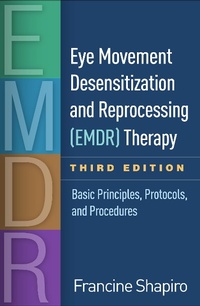
Eye Movement Desensitization and Reprocessing (EMDR) Therapy
Basic Principles, Protocols, and Procedures
3rd Edition
Published on 20. November 2017
568 pages
978-1-4625-3551-4 (ISBN)
Description

The authoritative presentation of Eye Movement Desensitization and Reprocessing (EMDR) therapy, this groundbreaking book--now revised and expanded--has been translated into multiple languages. Originally developed for treatment of posttraumatic stress disorder (PTSD), this evidence-based approach is now also used to treat adults and children with complex trauma, anxiety disorders, depression, addictive behavior problems, and other clinical problems. EMDR originator Francine Shapiro reviews the therapy's theoretical and empirical underpinnings, details the eight phases of treatment, and provides training materials and resources. The book includes vivid vignettes, transcripts, and reproducible forms, which can also be downloaded and printed in a convenient 8 1/2" x 11" size.
New to This Edition
- Over 15 years of important advances in therapy and research, including findings from clinical and neurophysiological studies.
- New and revised protocols and procedures.
- Discusses additional applications, including the treatment of complex trauma, addictions, pain, depression, and moral injury, as well as post-disaster response.
- Appendices with session transcripts, clinical aids, and tools for assessing treatment fidelity and outcomes.
More details
Other editions
Additional editions
Francine Shapiro
Eye Movement Desensitization and Reprocessing (EMDR) Therapy, Third Edition
Basic Principles, Protocols, and Procedures
Book
01/2018
3rd Edition
Guilford Press
€89.50
Shipment within 15-20 days
Person
Francine Shapiro, PhD, until her death in 2019, was Senior Research Fellow Emeritus at the Mental Research Institute in Palo Alto, California; Executive Director of the EMDR Institute in Watsonville, California; and founder and President Emeritus of the Trauma Recovery/EMDR Humanitarian Assistance Programs, a nonprofit organization that coordinates disaster response and pro bono trainings worldwide. The originator and developer of EMDR therapy, Dr. Shapiro was a recipient of the International Sigmund Freud Award for distinguished contribution to psychotherapy, presented by the City of Vienna in conjunction with the World Council for Psychotherapy; the Award for Outstanding Contributions to Practice in Trauma Psychology from Division 56 of the American Psychological Association; and the Distinguished Scientific Achievement in Psychology Award from the California Psychological Association. Dr. Shapiro was designated as one of the "Cadre of Experts" of the American Psychological Association and the Canadian Psychological Association Joint Initiative on Ethnopolitical Warfare and served as advisor to a wide variety of trauma treatment and outreach organizations and journals. She was an invited speaker at psychology conferences worldwide and published more than 90 articles, chapters, and books about EMDR.
Content
1. Background
2. Adaptive Information Processing: The Model as a Working Hypothesis
3. Components of EMDR Therapy and Basic Treatment Effects
4. Phase One: Client History
5. Phases Two and Three: Preparation and Assessment
6. Phases Four to Seven: Desensitization, Installation, Body Scan, and Closure
7. Working with Abreaction and Blocks
8. Phase Eight: Reevaluation and Use of the EMDR Therapy Standard Three-Pronged Protocol
9. Standardized Protocols and Procedures for Special Situations
10. The Cognitive Interweave: A Proactive Strategy for Working with Challenging Clients
11. Selected Populations
12. Theory, Research, and Clinical Implications
References
Appendix A. Clinical Aids
Appendix B. Client Transcripts
Appendix C. Clinical and Outcome Assessments
Appendix D. Research Lists
Appendix E. Client Safety
Appendix F. EMDR Therapy Training Resources
Index
2. Adaptive Information Processing: The Model as a Working Hypothesis
3. Components of EMDR Therapy and Basic Treatment Effects
4. Phase One: Client History
5. Phases Two and Three: Preparation and Assessment
6. Phases Four to Seven: Desensitization, Installation, Body Scan, and Closure
7. Working with Abreaction and Blocks
8. Phase Eight: Reevaluation and Use of the EMDR Therapy Standard Three-Pronged Protocol
9. Standardized Protocols and Procedures for Special Situations
10. The Cognitive Interweave: A Proactive Strategy for Working with Challenging Clients
11. Selected Populations
12. Theory, Research, and Clinical Implications
References
Appendix A. Clinical Aids
Appendix B. Client Transcripts
Appendix C. Clinical and Outcome Assessments
Appendix D. Research Lists
Appendix E. Client Safety
Appendix F. EMDR Therapy Training Resources
Index
