

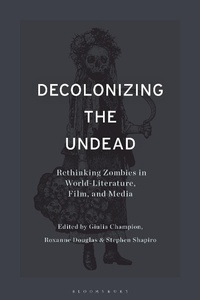
Decolonizing the Undead
Rethinking Zombies in World-Literature, Film, and Media
1st Edition
Published on 25. August 2022
232 pages
978-1-350-27114-2 (ISBN)
Description

Looking beyond Euro-Anglo-US centric zombie narratives, Decolonizing the Undead reconsiders representations and allegories constructed around this figure of the undead, probing its cultural and historical weight across different nations and its significance to postcolonial, decolonial, and neoliberal discourses. Taking stock of zombies as they appear in literature, film, and television from the Caribbean, Latin America, sub-Saharan Africa, India, Japan, and Iraq, this book explores how the undead reflect a plethora of experiences previously obscured by western preoccupations and anxieties. These include embodiment and dismemberment in Haitian revolutionary contexts; resistance and subversion to social realities in the Caribbean and Latin America; symbiosis of cultural, historical traditions with Western popular culture; the undead as feminist figures; as an allegory for migrant workers; as a critique to reconfigure socio-ecological relations between humans and nature; and as a means of voicing the plurality of stories from destroyed cities and war-zones.
Interspersed with contextual explorations of the zombie narrative in American culture (such as zombie walks and the television series The Santa Clarita Diet) contributors examine such writers as Lowell R. Torres, Diego Velázquez Betancourt, Hemendra Kumar Roy, and Manabendra Pal; works like China Mieville's Covehithe, Reza Negarestani's Cycolonopedia, Julio Ortega's novel Adiós, Ayacucho, Ahmed Saadawi's Frankenstein in Baghdad; and films by Alejandro Brugués, Michael James Rowland, Steve McQueen, and many others. Far from just another zombie project, this is a vital study that teases out the important conversations among numerous cultures and nations embodied in this universally recognized figure of the undead.
Interspersed with contextual explorations of the zombie narrative in American culture (such as zombie walks and the television series The Santa Clarita Diet) contributors examine such writers as Lowell R. Torres, Diego Velázquez Betancourt, Hemendra Kumar Roy, and Manabendra Pal; works like China Mieville's Covehithe, Reza Negarestani's Cycolonopedia, Julio Ortega's novel Adiós, Ayacucho, Ahmed Saadawi's Frankenstein in Baghdad; and films by Alejandro Brugués, Michael James Rowland, Steve McQueen, and many others. Far from just another zombie project, this is a vital study that teases out the important conversations among numerous cultures and nations embodied in this universally recognized figure of the undead.
More details
Edition
1. Auflage
Language
English
Place of publication
London
United Kingdom
Publishing group
Bloomsbury Publishing PLC
Target group
Professional and scholarly
College/higher education
ISBN-13
978-1-350-27114-2 (9781350271142)
Copyright in bibliographic data and cover images is held by Nielsen Book Services Limited or by the publishers or by their respective licensors: all rights reserved.
Schweitzer Classification
Other editions
Additional editions
Stephen Shapiro | Giulia Champion | Roxanne Douglas
Decolonizing the Undead
Rethinking Zombies in World-Literature, Film, and Media
Book
04/2024
Bloomsbury Academic
€55.89
Shipment within 15-20 days
Stephen Shapiro | Giulia Champion | Roxanne Douglas
Decolonizing the Undead
Rethinking Zombies in World-Literature, Film, and Media
Book
09/2022
Bloomsbury Academic
€133.70
Shipment within 15-20 days
Persons
Stephen Shapiro is Professor of American Literature at the University of Warwick, UK. He is the author or editor of 17 books, including How to Read Marx's Capital (2008) and The Wire: Race, Class, and Genre (2012).
Giulia Champion is Lecturer in the Interdisciplinary Studies Centre at the University of Essex and Research Assistant in the Centre for Interdisciplinary Methodologies at the University of Warwick, UK. She is the co-editor of Ethical Futures and Global Science Fiction (2020) and "Intersections of Activism and Academia" with the Bulletin of Latin American Research (2022).
Roxanne Douglas is Teaching Fellow in the Department of English & Comparative Literary Studies at the University of Warwick, UK.
Giulia Champion is Lecturer in the Interdisciplinary Studies Centre at the University of Essex and Research Assistant in the Centre for Interdisciplinary Methodologies at the University of Warwick, UK. She is the co-editor of Ethical Futures and Global Science Fiction (2020) and "Intersections of Activism and Academia" with the Bulletin of Latin American Research (2022).
Roxanne Douglas is Teaching Fellow in the Department of English & Comparative Literary Studies at the University of Warwick, UK.
Content
Acknowledgements
List of Contributors
Roxanne Douglas and Giulia Champion - "Introduction: Decolonizing the Zombie"
Part I Thinking Zombies
1. 'Il y a des zombies dans ceci...': Dessalines, Disembodiment, and Early Haitian Literature, Elizabeth Kelly (Florida Polytechnic University, USA)
2. White and Black Zombies: How Race Rewrites the Zombie Narrative, Cécile?Accilien (Kennesaw State University, USA)
3. Decolonizing the Zombie: I Walked with a Zombie's Critique of Centrist Liberalism, Stephen Shapiro (University of Warwick, UK)
Part II Zombie World-System
4. Samurai Zombies: Japan's Undead Past, Frank Jacob (Nord Universitet, Norway)
5. Crude Monsters in the 'Extractive Zone:' The Creaturely and Ecological Zombie, Josephine Taylor (Royal Holloway, University of London, UK)
6. Undead, Undeader, Undeadest: Narrating the Unevenness of Ecological Crisis in Nana Nkweti"s 'It Just Kills You Inside', Fiona Farnsworth (University of Warwick, UK)
7. Zombie Proletkino: Labor, Race and Genre in Pedro Costa's Casa de Lava, Thomas Waller (University of Nottingham, UK)
8. 'It Feels Like I'm Giving My Body Something It Needs in an Intense and Powerful Way:' Netflix, Santa Clarita Diet and the Neoliberal Feminist Encounter with Pleasure Politics, Roxanne Douglas (University of Warwick, UK)
Part III Zombie Decolonial
9. De/Zombification as Decolonial Critique: Beyond Man, Nature and the Posthuman in Folklore and Fiction from South Africa, Rebecca Duncan (Linnaeus University, Sweden)
10. Zombies, Placelessness and Transcultural Entanglement: Ahmad Saadawi's Frankenstein in Baghdad, Netty Mattar (International Islamic University of Malaysia)
11. 'First They Bring the HIV, Then the Zombie':?Portrayal of the West in contemporary Indian Zombie Literature and Cinema", Abhirup Mascharak (Jadavpur University, India)
12. From the Mountain to the Shore: Indigenous Migration, Water Crisis and Revolutionary Zombies from Haiti to Perú, Giulia Champion (University of Essex and University of Warwick, UK)
Decolonizing Zombie Cultural Practice: An Afterword, Stephen Shapiro
Index
List of Contributors
Roxanne Douglas and Giulia Champion - "Introduction: Decolonizing the Zombie"
Part I Thinking Zombies
1. 'Il y a des zombies dans ceci...': Dessalines, Disembodiment, and Early Haitian Literature, Elizabeth Kelly (Florida Polytechnic University, USA)
2. White and Black Zombies: How Race Rewrites the Zombie Narrative, Cécile?Accilien (Kennesaw State University, USA)
3. Decolonizing the Zombie: I Walked with a Zombie's Critique of Centrist Liberalism, Stephen Shapiro (University of Warwick, UK)
Part II Zombie World-System
4. Samurai Zombies: Japan's Undead Past, Frank Jacob (Nord Universitet, Norway)
5. Crude Monsters in the 'Extractive Zone:' The Creaturely and Ecological Zombie, Josephine Taylor (Royal Holloway, University of London, UK)
6. Undead, Undeader, Undeadest: Narrating the Unevenness of Ecological Crisis in Nana Nkweti"s 'It Just Kills You Inside', Fiona Farnsworth (University of Warwick, UK)
7. Zombie Proletkino: Labor, Race and Genre in Pedro Costa's Casa de Lava, Thomas Waller (University of Nottingham, UK)
8. 'It Feels Like I'm Giving My Body Something It Needs in an Intense and Powerful Way:' Netflix, Santa Clarita Diet and the Neoliberal Feminist Encounter with Pleasure Politics, Roxanne Douglas (University of Warwick, UK)
Part III Zombie Decolonial
9. De/Zombification as Decolonial Critique: Beyond Man, Nature and the Posthuman in Folklore and Fiction from South Africa, Rebecca Duncan (Linnaeus University, Sweden)
10. Zombies, Placelessness and Transcultural Entanglement: Ahmad Saadawi's Frankenstein in Baghdad, Netty Mattar (International Islamic University of Malaysia)
11. 'First They Bring the HIV, Then the Zombie':?Portrayal of the West in contemporary Indian Zombie Literature and Cinema", Abhirup Mascharak (Jadavpur University, India)
12. From the Mountain to the Shore: Indigenous Migration, Water Crisis and Revolutionary Zombies from Haiti to Perú, Giulia Champion (University of Essex and University of Warwick, UK)
Decolonizing Zombie Cultural Practice: An Afterword, Stephen Shapiro
Index
