


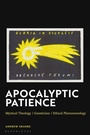
Apocalyptic Patience
Mystical Theology / Gnosticism / Ethical Phenomenology
1st Edition
Published on 11. July 2024
272 pages
978-1-350-41061-9 (ISBN)
Description

Andrew Shanks brings together a grand narrative of theology and continental philosophy to argue that the 'solidarity of the shaken' is the kingdom of God in secular dress.
Shanks engages with the philosophy of Jan Patocka; specifically, his Heretical Essays in the Philosophy of History, which culminate in the concept of the 'solidarity of the shaken'. Such solidarity is quite simply that which empowers the most radically thoughtful openness to others, embattled against even the most repressive closure; a solidarity without any other essential qualification.
Split into three distinct parts, Shanks begins by discussing Patocka's philosophico-centric grand narrative, and drawing wider reference to the pre-philosophic origins of Abrahamic religious tradition. This is followed by an exploration of mystical theology, Christian and Islamic; of its decay into 'mysticism', and its influence on Christian and Jewish gnostic traditions. The final third presents a discussion on ethical phenomenology. Analysing the proponents of a 'pathos of shakenness' such as Kierkegaard, Levinas, Løgstrup, he juxtaposes 19th-century thinkers such as Arendt and Hegel with Heidegger and Strauss as he moves through the century, and eventually to the rise of secular public conscience movement.
Shanks engages with the philosophy of Jan Patocka; specifically, his Heretical Essays in the Philosophy of History, which culminate in the concept of the 'solidarity of the shaken'. Such solidarity is quite simply that which empowers the most radically thoughtful openness to others, embattled against even the most repressive closure; a solidarity without any other essential qualification.
Split into three distinct parts, Shanks begins by discussing Patocka's philosophico-centric grand narrative, and drawing wider reference to the pre-philosophic origins of Abrahamic religious tradition. This is followed by an exploration of mystical theology, Christian and Islamic; of its decay into 'mysticism', and its influence on Christian and Jewish gnostic traditions. The final third presents a discussion on ethical phenomenology. Analysing the proponents of a 'pathos of shakenness' such as Kierkegaard, Levinas, Løgstrup, he juxtaposes 19th-century thinkers such as Arendt and Hegel with Heidegger and Strauss as he moves through the century, and eventually to the rise of secular public conscience movement.
More details
Edition
1. Auflage
Language
English
Place of publication
London
United Kingdom
Publishing group
Bloomsbury Publishing PLC
Target group
Professional and scholarly
Illustrations
10 bw illus
ISBN-13
978-1-350-41061-9 (9781350410619)
Copyright in bibliographic data and cover images is held by Nielsen Book Services Limited or by the publishers or by their respective licensors: all rights reserved.
Schweitzer Classification
Other editions
Additional editions
Book
02/2026
Bloomsbury Academic
€44.30
Shipment within 15-20 days
Book
08/2024
Bloomsbury Academic
€126.48
Shipment within 15-20 days
Person
Andrew Shanks is the former Canon Emeritus of Manchester Cathedral, UK. He also held various academic teaching roles: including at the universities of Lancaster, Leeds, and Manchester. He is the author of twelve books, including Theodicy Beyond the Death of 'God': the Persisting Problem of Evil and Hegel Versus 'Inter-Faith Dialogue': a General Theory of True Xenophilia.
Content
Introduction
PART I: THE TWO SIDES OF THE EQUATION
1. The Solidarity of the Shaken: Jan Patocka's Argument
2. The Kingdom of God: Abrahamic Religion, its Historic Origins in a Dilemma
PART II: RECOIL FROM EVANGELISTIC IMPATIENCE: MYSTICAL THEOLOGY / GNOSTICISM
3. 'Mystical Theology'
4. Decadence of 'Mysticism'
5. 'Gnosticism'
PART III: PHILOSOPHY AND CATHOLICITY: ETHICAL PHENOMENOLOGY
6. Philosophic Meditation on the 'Pathos of Shakenness'
7. Variant Envisionings of Ideal Solidarity, on a Phenomenological Basis
8. Modern 'Anti-Politics': A Phenomenological Sketch
Coda
Bibliography
Index
PART I: THE TWO SIDES OF THE EQUATION
1. The Solidarity of the Shaken: Jan Patocka's Argument
2. The Kingdom of God: Abrahamic Religion, its Historic Origins in a Dilemma
PART II: RECOIL FROM EVANGELISTIC IMPATIENCE: MYSTICAL THEOLOGY / GNOSTICISM
3. 'Mystical Theology'
4. Decadence of 'Mysticism'
5. 'Gnosticism'
PART III: PHILOSOPHY AND CATHOLICITY: ETHICAL PHENOMENOLOGY
6. Philosophic Meditation on the 'Pathos of Shakenness'
7. Variant Envisionings of Ideal Solidarity, on a Phenomenological Basis
8. Modern 'Anti-Politics': A Phenomenological Sketch
Coda
Bibliography
Index
