

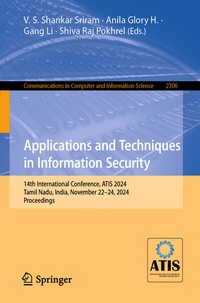
Applications and Techniques in Information Security
Description

This book constitutes the refereed proceedings of the 14th International Conference, on Applications and Techniques in Information Security, ATIS 2024, held in Tamil Nadu, India, November 22-24, 2024.
The 24 full papers presented were carefully reviewed and selected from 149 submissions. The conference focuses on Advancing Quantum Computing and Cryptography; AI-Driven Cybersecurity: The Role of Machine Learning; Advancing Cybersecurity with Deep Learning Techniques; and Securing Connected Systems: IoT, Cloud, and Web Security Strategies.
More details
Other editions
Additional editions
Content
.- Security of Emerging Technologies in Computer Networks.
.- Advancing Quantum Computing and Cryptography .
.- Optical Neural Networks - A Strategy for Secure Quantum Computing.
.- Guarding Against Quantum Threats: A Survey of Post-Quantum Cryptography Standardization, Techniques, and Current Implementations.
.- Cryptographic Distinguishers through Deep Learning for Lightweight Block Ciphers.
.- Detection and Mitigation of Email Phishing.
.- Securing Digital Forensic Data Using Neural Networks, Elephant Herd Optimization and Complex Sequence Techniques.
.- Design of Image Encryption Technique Using MSE Approach.
.- Low Latency Binary Edward Curve Crypto processor for FPGA platforms.
.- Augmenting Security in Edge Devices: FPGA-Based Enhanced LEA Algorithm with S-Box and Chaotic Functions.
.- AI-Driven Cybersecurity: The Role of Machine Learning .
.- Machine Learning Approach for Malware Detection Using Malware Memory Analysis Data.
.- DDOS Attack Detection in Virtual Machine Using Machine Learning Algorithms.
.- An Unsupervised Method for Intrusion Detection using Novel Percentage Split Clustering.
.- HATT-MLPNN: A Hybrid Approach for Cyber-Attack Detection in Industrial Control Systems Using MLPNN and Attention Mechanisms.
.- Silent Threats: Monitoring Insider Risks in Healthcare Sector.
.- Advancing Cybersecurity with Deep Learning Techniques .
.- Enhanced Deep Learning for IIoT Threat Intelligence: Revealing Advanced Persistent Threat Attack Patterns.
.- Adaptive Data-Driven LSTM Model for Sensor Drift Detection in Water Utilities.
.- Enhancing FGSM Attacks with Genetic Algorithms for Robust Adversarial Examples in Remote Sensing Image Classification Systems.
.- GAN-Enhanced Multiclass Malware Classification with Deep Convolutional Networks.
.- Securing Connected Systems: IoT, Cloud, and Web Security Strategies .
.- IOT Based Locker Access System with MFA Remote Authentication.
.- A Secure Authentication Scheme between Edge Devices using HyperGraph Hashing Technique in IoT Environment.
.- Enhancing Access Control and Information Sharing in Cloud IoT with an Effective Blockchain-Based Authority System.
.- Securing Data in MongoDB: A Framework Using Encryption.
.- Handling Sensitive Medical Data - A Differential Privacy enabled Federated Learning Approach.
.- Securing your Web Applications: The Power of Bugbite Vulnerability Scanner.
