

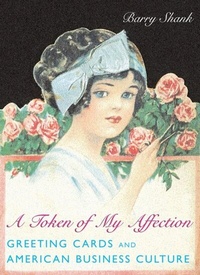
A Token of My Affection
Greeting Cards and American Business Culture
1st Edition
Published on 27. November 2015
368 pages
978-0-231-50925-1 (ISBN)
Description

Each year in the United States, millions of mass-produced greeting cards proclaim their occasional messages: "For My Loving Daughter," "On the Occasion of Your Marriage," and "It's a Boy!" For more than 150 years, greeting cards have tapped into and organized a shared language of love, affection, and kinship, becoming an integral part of American life and culture. Contemporary incarnations of these emotional transactions performed through small bits of decorated paper are often dismissed as vacuous clichés employing worn-out stereotypes. Nevertheless, the relationship of greeting cards to systems of material production is well worth studying and understanding, for the modern greeting card is the product of an industry whose values and aims seem to contradict the sentiments that most cards express. In fact, greeting cards articulate shifting forms of love and affiliation experienced by people whose lives have been shaped by the major economic changes of the late nineteenth and twentieth centuries. A Token of My Affection shows in fascinating detail how the evolution of the greeting card reveals the fundamental power of economic organization to enable and constrain experiences of longing, status, desire, social connectedness, and love and to structure and partially determine the most private, internal, and intimate of feelings.
Beautifully illustrated, A Token of My Affection follows the development of the modern greeting card industry from the 1840s, as a way of recovering that most elusive of things-the emotional subjectivity of another age. Barry Shank charts the evolution of the greeting card from an afterthought to a traditional printing and stationery business in the mid-nineteenth century to a multibillion-dollar industry a hundred years later. He explains what an industry devoted to emotional sincerity means for the lives of all Americans. Blending archival research in business history with a study of surviving artifacts and a literary analysis of a broad range of relevant texts and primary sources, Shank demonstrates the power of business to affect love and the ability of love to find its way in the marketplace of consumer society.
Beautifully illustrated, A Token of My Affection follows the development of the modern greeting card industry from the 1840s, as a way of recovering that most elusive of things-the emotional subjectivity of another age. Barry Shank charts the evolution of the greeting card from an afterthought to a traditional printing and stationery business in the mid-nineteenth century to a multibillion-dollar industry a hundred years later. He explains what an industry devoted to emotional sincerity means for the lives of all Americans. Blending archival research in business history with a study of surviving artifacts and a literary analysis of a broad range of relevant texts and primary sources, Shank demonstrates the power of business to affect love and the ability of love to find its way in the marketplace of consumer society.
More details
Other editions
Additional editions
Book
07/2006
Columbia University Press
€34.72
Article not available at the moment
Book
09/2004
Columbia University Press
€144.84
Article not available at the moment
Person
Barry Shank is professor of comparative studies at The Ohio State University. He is the author of Dissonant Identities: The Rock 'n' Roll Scene in Austin, Texas. His work on popular culture has appeared in such journals as boundary 2, Radical History Review, American Studies, and American Quarterly.
Content
List of Illustrations
Acknowledgments
Introduction: Structured Feelings amid Circulations of the Heart
1. Vicious Sentiments: Nineteenth-Century Valentines and the Sentimental Production of Class Boundaries
2. The Nineteenth-Century Christmas Card: The Chromo-Reproduction of Sentimental Value
3. Corporate Sentiment: The Rise of the Twentieth-Century Greeting Card Industry and the American Culture of Business
4. Condensation, Displacement, and Masquerade: The Dream-Work of Greeting Cards
5. Knitting the Social Lace: The Use of Greeting Cards
6. All This Senseless Rationality: Beyond the End of the Modern Era of Greeting Cards
Notes
Bibliography
Index
Acknowledgments
Introduction: Structured Feelings amid Circulations of the Heart
1. Vicious Sentiments: Nineteenth-Century Valentines and the Sentimental Production of Class Boundaries
2. The Nineteenth-Century Christmas Card: The Chromo-Reproduction of Sentimental Value
3. Corporate Sentiment: The Rise of the Twentieth-Century Greeting Card Industry and the American Culture of Business
4. Condensation, Displacement, and Masquerade: The Dream-Work of Greeting Cards
5. Knitting the Social Lace: The Use of Greeting Cards
6. All This Senseless Rationality: Beyond the End of the Modern Era of Greeting Cards
Notes
Bibliography
Index
