

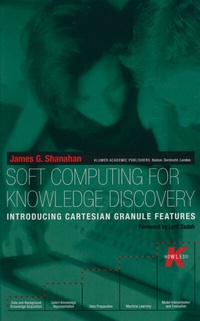
Soft Computing for Knowledge Discovery
Introducing Cartesian Granule Features
Published on 6. December 2012
XXI, 326 pages
978-1-4615-4335-0 (ISBN)
Description

Knowledge discovery is an area of computer science that attempts to uncover interesting and useful patterns in data that permit a computer to perform a task autonomously or assist a human in performing a task more efficiently.
Soft Computing for Knowledge Discovery provides a self-contained and systematic exposition of the key theory and algorithms that form the core of knowledge discovery from a soft computing perspective. It focuses on knowledge representation, machine learning, and the key methodologies that make up the fabric of soft computing - fuzzy set theory, fuzzy logic, evolutionary computing, and various theories of probability (e.g. naïve Bayes and Bayesian networks, Dempster-Shafer theory, mass assignment theory, and others). In addition to describing many state-of-the-art soft computing approaches to knowledge discovery, the author introduces Cartesian granule features and their corresponding learning algorithms as an intuitive approach to knowledge discovery. This new approach embraces the synergistic spirit of soft computing and exploits uncertainty in order to achieve tractability, transparency and generalization. Parallels are drawn between this approach and other well known approaches (such as naive Bayes and decision trees) leading to equivalences under certain conditions.
The approaches presented are further illustrated in a battery of both artificial and real-world problems. Knowledge discovery in real-world problems, such as object recognition in outdoor scenes, medical diagnosis and control, is described in detail. These case studies provide further examples of how to apply the presented concepts and algorithms to practical problems.
The author provides web page access to an online bibliography, datasets, source codes for several algorithms described in the book, and other information.
Soft Computing for Knowledge Discovery is for advanced undergraduates,professionals and researchers in computer science, engineering and business information systems who work or have an interest in the dynamic fields of knowledge discovery and soft computing.
Soft Computing for Knowledge Discovery provides a self-contained and systematic exposition of the key theory and algorithms that form the core of knowledge discovery from a soft computing perspective. It focuses on knowledge representation, machine learning, and the key methodologies that make up the fabric of soft computing - fuzzy set theory, fuzzy logic, evolutionary computing, and various theories of probability (e.g. naïve Bayes and Bayesian networks, Dempster-Shafer theory, mass assignment theory, and others). In addition to describing many state-of-the-art soft computing approaches to knowledge discovery, the author introduces Cartesian granule features and their corresponding learning algorithms as an intuitive approach to knowledge discovery. This new approach embraces the synergistic spirit of soft computing and exploits uncertainty in order to achieve tractability, transparency and generalization. Parallels are drawn between this approach and other well known approaches (such as naive Bayes and decision trees) leading to equivalences under certain conditions.
The approaches presented are further illustrated in a battery of both artificial and real-world problems. Knowledge discovery in real-world problems, such as object recognition in outdoor scenes, medical diagnosis and control, is described in detail. These case studies provide further examples of how to apply the presented concepts and algorithms to practical problems.
The author provides web page access to an online bibliography, datasets, source codes for several algorithms described in the book, and other information.
Soft Computing for Knowledge Discovery is for advanced undergraduates,professionals and researchers in computer science, engineering and business information systems who work or have an interest in the dynamic fields of knowledge discovery and soft computing.
More details
Other editions
Additional editions
Book
11/2012
Springer
€160.49
Shipment within 7-9 days
Content
I.- 1 Knowledge Discovery.- II.- 2 Knowledge Representation.- 3 Fuzzy Set Theory.- 4 Fuzzy Logic.- 5 Probability Theory.- 6 Fril - a Support Logic Programming Environment.- III.- 7 Machine Learning.- IV.- 8 Cartesian Granule Features.- 9 Learning Cartesian Granule Feature Models.- V.- 10 Analysis of Cartesian Granule Feature Models.- 11 Applications.- Appendix: Evolutionary Computation.- Glossary of Main Symbols.
