

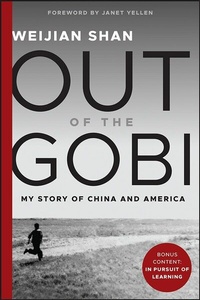
Out of the Gobi
Description

Weijian Shan's Out of the Gobi is a powerful memoir and commentary that will be one of the most important books on China of our time, one with the potential to re-shape how Americans view China, and how the Chinese view life in America.
Shan, a former hard laborer who is now one of Asia's best-known financiers, is thoughtful, observant, eloquent, and brutally honest, making him well-positioned to tell the story of a life that is a microcosm of modern China, and of how, improbably, that life became intertwined with America. Out of the Gobi draws a vivid picture of the raw human energy and the will to succeed against all odds.
Shan only finished elementary school when Mao Zedong's Cultural Revolution tore his country apart. He was a witness to the brutality and absurdity of Mao's policies during one of the most tumultuous eras in China's history. Exiled to the Gobi Desert at age 15 and denied schooling for 10 years, he endured untold hardships without ever giving up his dream for an education. Shan's improbable journey, from the Gobi to the "People's Republic of Berkeley" and far beyond, is a uniquely American success story - told with a splash of humor, deep insight and rich and engaging detail.
This powerful and personal perspective on China and America will inform Americans' view of China, humanizing the country, while providing a rare view of America from the prism of a keen foreign observer who lived the American dream.
Says former Federal Reserve chair Janet Yellen: "Shan's life provides a demonstration of what is possible when China and the United States come together, even by happenstance. It is not only Shan's personal history that makes this book so interesting but also how the stories of China and America merge in just one moment in time to create an inspired individual so unique and driven, and so representative of the true sprits of both countries."
More details
Other editions
Additional editions
Person
Content
Acknowledgments xi
Author's Note xiii
Prologue 1
Chapter 1 Man-Made Famine 5
Chapter 2 School Cut Short 21
Chapter 3 Storm of Revolution 35
Chapter 4 Turmoil Under Heaven 53
Chapter 5 Exiled to the Gobi 77
Chapter 6 Digging for Potatoes 93
Chapter 7 War Is Coming 109
Chapter 8 Repairing the Earth 123
Chapter 9 Battling Frozen Lake 137
Chapter 10 The Longest Night 159
Chapter 11 Unforgettable Movie Night 173
Chapter 12 Barefoot Doctor 185
Chapter 13 Brickmaking the Ancient Way 213
Chapter 14 Petition to Mao 237
Chapter 15 Pigs Don't Fly 249
Chapter 16 Half the Sky 267
Chapter 17 Desert Dreams of College 281
Chapter 18 Last Convulsions of the Revolution 305
Chapter 19 Roads to Rome 331
Chapter 20 Old Gold Mountain 345
Chapter 21 The People's Republic of Berkeley 379
Chapter 22 Ivy League Professor 403
Epilogue 437
Index 445
Preface
In Pursuit of Learning
On January 17, 2019, the day that Out of the Gobi was first published, I appeared on stage at the Asia Society auditorium in New York City. I was joining Tom Friedman, the world-renowned Pulitzer Prize winning New York Times columnist and best-selling author, for a fireside chat to launch my new book. It was a full house, with standing room only.
I opened the evening by thanking the audience. "I'm very honored and humbled by your presence." I paused, before continuing, "Although I know all of you are here for Tom Friedman."
That line drew much laughter.
Before the laughter died down, I added, "Me too."
The audience roared with more laughter.
I am immensely grateful to Tom for traveling with his son all the way from Washington, D.C., to join me on stage. I owe my book's successful launch to him. His generosity and graciousness deeply humbled me.
Much of this book is devoted to my own experiences and those of my peers during China's Cultural Revolution, a decade of turmoil launched by Mao Zedong in 1966 that ended with his death in 1976. At one point in our conversation, Tom asked me: "Do the young people in China know much about the Cultural Revolution?"
"Let me tell you a story," I said in response.
In 2012, the chairman of a Chinese bank persuaded me to become an independent director of his company. Subsequently, the bank made a public announcement of my candidacy. Such a position required the approval of banking regulators.
After reviewing my documents and biographical information, the regulator sent me a request: Please provide the name of your secondary school. I replied that I had never attended secondary school. Then another question came: "Why did you not attend secondary school?"
I suppose the official in charge there was too young to know that during the Cultural Revolution, all schools in China were shut down for as long as 10 years. I was surprised-had his parents or teachers never told him? I couldn't resist being mischievous: "For this question," I wrote back, "please ask the Great Leader Chairman Mao."
Apparently, the regulator didn't appreciate my humor. My directorship was never approved.
The audience laughed again. But to me, it is sad and quite alarming that some in the younger generation-although I have no idea what percentage-don't know about this chapter of China's history.
"Those who cannot remember the past are condemned to repeat it," warned the Spanish philosopher George Santaya. Winston Churchill said something similar.
Indeed, history often repeats itself, remarked Hegel, the German philosopher. "The first time as tragedy, the second time as farce," added Karl Marx, ridiculing Napoleon III's ascension to the throne. Neither Hegel nor Marx insisted that history must repeat itself. But it is always possible, when people fail to learn from it. History itself is full of such examples-just think of how invading Russia was the beginning of the end for both Napoleon and Hitler.
That is why I wrote this book-to hopefully provide lessons from the history that my peers and I lived through. That history reads like a Greek tragicomedy with two parts: the Mao Zedong era and the Deng Xiaoping era.
The Mao era was an unmitigated calamity, marked by frequent political purges, a man-made famine that killed millions, social tumult, violence, and extreme poverty. Mao adopted a Soviet-style political and economic system that even the Soviets thought was too radical. He created an egalitarian society in which everyone was equally poor. His China was diplomatically isolated and economically closed. He left the country in utter ruins when he finally exited the stage.
The Deng era was what the Mao era was not. Mao was for a centrally planned economy modeled after the Soviet Union. Deng was for a market economy. Mao kept China closed. Deng opened up the country. A survivor of Mao's purges, Deng learned a lesson from the disasters of his predecessor's rule. He reined in government excesses and unleashed the "animal spirits" (a term coined by the famous economist John Maynard Keynes) in the population by encouraging private enterprise and entrepreneurship. It was his vision and pragmatism that transformed China from a poverty-stricken backwater to an economic juggernaut and the largest trading nation in the world. And it was his policies that lifted more than a billion Chinese out of poverty. Deng saved China.
Extraordinary lessons can be learned from this history.
Ernest Hemingway popularized the concept of "the Lost Generation," the cohort of Europeans and Americans who reached adulthood at the time of the First World War. They were "lost," I suppose, because the Great War had robbed millions of their lives and untold millions more of a normal life. The trauma of war left many bewildered, disoriented, aimless, and often jobless.
China also has a Lost Generation, one that came of age during the Cultural Revolution. It is the generation I belong to. We were lost because we were deprived of schooling at a young age, for a decade for some and forever for most.
Mao launched the Cultural Revolution with the stated purpose of purifying the country of capitalist ideologies and ridding the government, at all levels, of hidden "class enemies." Mao called upon students and "the masses" of ordinary people to rise up and rebel against the establishment. Society was plunged into great turmoil: schools were shut; teachers were beaten up or killed; intellectuals, or anyone perceived as being one, were denigrated and persecuted. Nearly all economic activity ground to a halt. Eventually, the students themselves were exiled, en masse, to the remote countryside to be "re-educated" through farming and hard labor, with no hope of return. They were referred to as the "educated youth," a comical misnomer as most lacked a basic education.
Around 1969, about 17 million of these "educated youth" were sent off, representing about 10 percent of China's urban population (not to mention millions more young adults from rural areas, where more than 80 percent of China's 800 million people resided). It was the most massive de-urbanization movement in human history.
Books were banned or burned. Reading was frowned upon or prohibited. Ignorance was celebrated as the way of the proletariat. Life was so harsh that after a day of backbreaking hard labor, few wanted to read anyhow. Lives were thus wasted as the years went by.
When the Deng era finally dawned, almost all "educated youth" were allowed to return to their home cities. But without a basic education, most of them struggled to find a decent job or a purpose in life. Just like Hemingway's characters, they were quite lost in a changed world.
I consider myself to be a survivor of the Lost Generation in that I was able to get an education after the ordeal came to an end and to go on to pursue graduate studies in the United States. In the Deng era, such opportunities were open to all. But few were able to seize them.
Deng reinstated the college entrance examination system in 1977, after an 11-year hiatus. All those between the ages of 16 and 36 could apply. That extraordinary 20-year age bracket defines my generation. By my rough and conservative estimate, based on 10 million births per year on average, members of the Lost Generation made up some 200 million people out of China's total population of about 950 million.
Although the exam was open to all, only 5.7 million took it. Of those, just 273,000 were accepted into college. Half a year later, in 1978, another exam was held for those who had missed the first one, adding a further 402,000 freshmen out of 6.1 million applicants.
All told, only five in a thousand in the age group born between 1947 and 1960 managed to eventually receive a college education. By comparison, the proportion of 18-year-olds in China who went on to attend college in 2018 reached 48 percent (about the same as in the United States).
I went to the United States to study in 1980. Statistics show that in that year, only 1,862 students from all of China received scholarships to study abroad. By comparison, there are about 3,000 to 4,000 lightning victims in China each year. A Chinese person was much more likely to be struck by lightning than to qualify for foreign studies at that time.
How did I beat the odds? Was I lucky or privileged? Neither. To start out with, my lot was the same as my entire generation-and worse than some, who benefited from nepotism to get out of the Gobi and other hardship posts through "back doors." The only thing I did differently from most of my peers was never to stop reading. During all those years, whatever books I could lay my hands on, under whatever harsh conditions-too cold, too hot, too tired, too late, too dark, or too dangerous-I read. I persisted for no other reason than to satisfy my insatiable curiosity and to cling to the hope that someday the knowledge could be useful.
"Fortune favors the prepared mind," said Louis Pasteur, the French scientist who discovered the principles of vaccination and pasteurization. Indeed, when the Deng era came and opportunities arose, I was more than ready to seize them, fair and square.
"We cannot choose our...
