

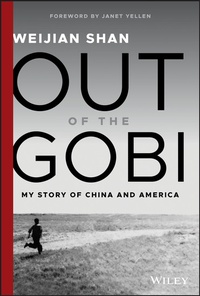
Out of the Gobi
Description

More details
Other editions
New editions
Additional editions
Content
- Intro
- Foreword
- Acknowledgments
- Author's Note
- Prologue
- Chapter 1: Man-Made Famine
- Chapter 2: School Cut Short
- Chapter 3: Storm of Revolution
- Chapter 4: Turmoil Under Heaven
- Chapter 5: Exiled to the Gobi
- Chapter 6: Digging for Potatoes
- Chapter 7: War Is Coming
- Chapter 8: Repairing the Earth
- Chapter 9: Battling Frozen Lake
- Chapter 10: The Longest Night
- Chapter 11: Unforgettable Movie Night
- Chapter 12: Barefoot Doctor
- Chapter 13: Brickmaking the Ancient Way
- Chapter 14: Petition to Mao
- Chapter 15: Pigs Don't Fly
- Chapter 16: Half the Sky
- Chapter 17: Desert Dreams of College
- Chapter 18: Last Convulsions of the Revolution
- Chapter 19: Roads to Rome
- Chapter 20: Old Gold Mountain
- Chapter 21: The People's Republic of Berkeley
- Chapter 22: Ivy League Professor
- Epilogue
- Index
- Supplemental Images
- WILEY END USER LICENSE AGREEMENT
Chapter 1
Man-Made Famine
On March 10, 1945, President Franklin D. Roosevelt wrote a letter to Mao Zedong, the leader of Chinese Communist forces in the war against Japan. "My Dear Mr. Mao," Roosevelt wrote, "I received your letter of November 10, 1944 upon my return from the Yalta Conference and appreciate very much receiving your personal views on developments in China." Roosevelt noted Mao's emphasis on the unity of the Chinese people and expressed his hope that Mao and the Nationalist leader, Chiang Kai-shek, could find a way to work together to defeat the Japanese. Roosevelt concluded by saying: "The friendship of the Chinese people and the people of the United States is, as you say, traditional and deep-rooted, and I am confident that the cooperation of the Chinese and American peoples will greatly contribute to the achievement of victory and lasting peace."
It was rather extraordinary that Roosevelt should have written to Mao at all. At the time, Mao was mainly known as a Communist guerrilla leader with a force far smaller and worse equipped than that of Chiang's Nationalist government; few would have predicted that he would seize national power only four years later. But Mao went out of his way to make overtures to the US president. In 1945, months before the Japanese surrender, Mao offered to visit Roosevelt in Washington, but the offer was spurned by the US ambassador at the time, Patrick J. Hurley, who never delivered Mao's offer to the president.
After the founding of the People's Republic of China (PRC) on October 1, 1949, Chiang Kai-shek's remaining forces fled to the island of Taiwan. Although the United States continued to recognize Chiang's government as the legitimate government of all of China, it seemed that it was not prepared to throw its lot in with the defeated Nationalist government altogether. On January 5, 1950, President Harry Truman announced that the United States would not intervene in the event of an attack on Taiwan by the PRC, indicating that while it remained wary, the United States had not entirely ruled out a relationship with the Communists, who had cooperated effectively with the Americans in the war against Japan.
But if Mao had cherished any hope of a good relationship between his New China and the United States, it was dashed six months later with the outbreak of the Korean War. On June 27, Truman ordered the Seventh Fleet into the Taiwan Strait, declaring that a Communist takeover of the island would constitute a "direct threat to the security of the Pacific area." The United States also imposed a total trade embargo on China. From that point on, Mao's China leaned inexorably into the camp of the Soviet Union. But that friendship proved to be short-lived as well.
In the United States, the political discourse in the 1950s became focused on "who lost China"-as if the US had ever owned it. In an era when McCarthyism dominated the US scene and all the "China hands" in the State Department saw their careers trashed or worse, any relationship with "Red China" was out of the question. The "Red scare" with respect to China would persist long after Senator Joseph McCarthy was discredited and disgraced. It would take 20 years, and a staunch anti-communist Republican president, to break the ice in the US relationship with China.
Meanwhile, the China Mao had conquered remained a country in dire poverty. Outside the major urban areas, it was largely a preindustrial society; by the estimates of British economist Angus Maddison, China's per capita GDP in 1950 was about $450, less than 20 percent that of the United States in 1870 (in 1990 dollars). Mao's New China began economic reconstruction in earnest when peace finally came after the end of the Korean War in 1953. That same year, China adopted its first five-year economic development plan and began a process of rapid industrialization, with the help of the Soviet Union. Between 1953 and 1957, China's GDP grew by about 50 percent, or more than 9 percent a year.
But Mao still thought the pace of growth was too slow. In 1958, he launched the "Great Leap Forward," a social and economic campaign to mobilize the entire nation to massively increase industrial and agricultural production in an effort to catch up with the more developed countries. I turned five in October of that year, and so began my earliest recollections and memories as a young child in China.
* * *
When I first met my late mother-in-law, who was a dentist in a military hospital, she could not find anything good about me except my teeth. To this day, I cannot truly explain why I was blessed with such nice teeth and the smile of an optimist, or why that was my one redeeming feature in her eyes.
I suffered my fair share of malnutrition, occasional starvation, and poor oral hygiene in my formative years, so it is a little bit of a mystery where I got my unusually good teeth. The only reason I can think of is all the vitamin D I got from being exposed to sunlight in the little one-room home in Beijing where I spent my infant years. The window faced south, and filled the room with sunlight and brightness. My first memory is of my mother bringing my newborn brother home from the hospital in 1957, when I was about three and a half years old.
My parents had come to Beijing from Shandong Province when I was about a year old, and we lived in that sun-drenched room until just before my fifth birthday. That year, 1958, we moved to a new home in a walled residential compound located approximately a mile east of Beijing's Tiananmen Square. There were a few residential buildings of different vintages and styles in the compound where, I would guess, 50 to 60 households resided. Our family shared our dwelling with more than 20 households under one tiled roof of a dilapidated, probably 100-year old Chinese-style house that used to be the office of Old China's customs administration. Each household occupied one or two rooms and all the families shared the only two toilets located on each side of the building. There was a relatively new, gray-colored, four- or five-story apartment building on one side of the compound, and there were some buildings that looked like military barracks on the other. At the very far end of the compound was an auditorium, no doubt built for the official function of the old customs administration but now used for occasional movie showings. In the center of the dwellings was an open, irregular-shaped space the size of about three tennis courts with a few old trees growing here and there.
The year 1958 turned out to be eventful and pivotal in the history of the New China. Even though I hardly remember anything of our personal life at home, I vividly remember taking part in what was happening around us. Those episodes and activities were so unusual and so tantalizingly exciting to a child that they left an indelible impression on me.
The Great Leap Forward, a campaign launched that year by China's charismatic leader, Mao Zedong, became a mass movement that touched everyone in the country. The policies of the Great Leap Forward were designed to mobilize China's masses and resources to drastically accelerate China's economic growth, to increase agricultural and industrial production, and to propel China quickly into the ranks of more developed economies. This would pave the way for China to move from the "stage of socialism" to the "stage of communism"-the classless, materially abundant utopia that was Karl Marx's ultimate vision.
Mao effectively aimed to accomplish in a few years what it had taken Europe more than a century to develop. But he was confident. After all, the Communist Party had grown from nothing to become the masters of the world's most populous nation and had won victory after victory against overwhelming odds. China could achieve anything by mobilizing and motivating its masses. His Great Leap Forward would be a people's war to accelerate China's economic development and drastically increase its production of all things. His goal? "To surpass Britain in 15 years and to catch up with America in 20 years" in steel production, considered the main barometer of industrialization.
In 1957, China produced less than a quarter of the steel that Britain did, and less than half as much iron. Surpassing Britain in 15 years was a colossal task. But as a 1958 publication of Beijing's foreign-language press put it, "To the emancipated Chinese people nothing is impossible."
Some people believed that making iron and steel was not so hard. It was suggested that iron and steel could be made anywhere with simple homemade tools and methods. It required no more than a small blast furnace made of bricks and clay, fired by coal and fed with scrap metal.
The small blast furnace I saw, built in the open space of our residential compound, was only a couple of meters tall, in size and shape very much like the smallest camping tents in today's sporting goods stores. Soon there was a frenzied effort to build such homemade blast furnaces everywhere throughout China, in the backyards of homes, in schools and in villages. It was later reported that at least 60 million such blast furnaces had been built. The nationwide campaign, known as "mass...
