

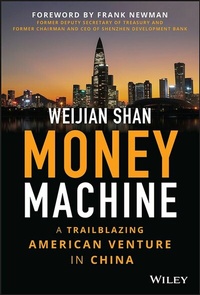
Money Machine
Description

In Money Machine: A Trailblazing American Venture in China, Weijian Shan delivers a compelling account of one of the most significant deals in private equity history: the first and only foreign acquisition of control of a Chinese national bank. Money Machine is the fascinating inside story of the transaction as told by the man who led it, from the intrigues of dealmaking to the complex and uncharted process of securing control by a foreign investor of a Chinese nationwide financial institution, a feat that had never before been attempted, nor has it been repeated.
Shan also describes the astonishingly successful turnaround of the institution under the control of the American firm: the clash of cultures, the growth to strength and profitability, and ultimately, the extraordinarily profitable exit from the investment. In the process, he reveals new insights into how finance operates in China's capital system and how private equity firms can add real value to companies. Readers will also find:
* A peek behind the curtain of a process usually shrouded in secrecy: private equity dealmaking and moneymaking
* The complex negotiations between American private equity executives and Chinese regulators to implement a series of unprecedented changes
* The riveting details of the challenges that had to be overcome to return the bank to growth and profitability
An exceptional firsthand account of truly singular deal-making and money-making, Money Machine will be of interest to investment bankers, investors, financial analysts and anyone who appreciates a suspenseful, true-life story.
More details
Other editions
Additional editions
Person
Content
A Note from the Author xiii
Part I Courtship 1
Chapter 1 An Unexpected Question 3
Chapter 2 A License to Print Money 11
Chapter 3 The Craft of Private Equity 19
Chapter 4 A Special Time and Place 29
Chapter 5 Dancing with the Wolves 41
Chapter 6 Rolling Faster 55
Part II Fight 73
Chapter 7 Tug of War 75
Chapter 8 Behind the Scenes 85
Chapter 9 Roller Coaster 97
Chapter 10 Transition to Nowhere 107
Chapter 11 "Nut Case" 117
Chapter 12 Untying the Knot 127
Part III Transformation 141
Chapter 13 Making History 143
Chapter 14 Righting the Ship 153
Chapter 15 Bank Repairman 169
Chapter 16 Game of Chicken 185
Chapter 17 Window of Opportunity 193
Chapter 18 Mariana Trench to Mount Everest 205
Part IV Exit 215
Chapter 19 Coveted Prize 217
Chapter 20 Flavor of the Day 227
Chapter 21 Financial Tsunami 237
Chapter 22 Stars Align 251
Chapter 23 Turning Point 265
Chapter 24 A Deal That Shakes 277
Epilogue The Kingdom of Freedom 293
Acknowledgments 301
About the Author 303
Index 305
Chapter 1
An Unexpected Question
From aboard the Star Ferry in Victoria Harbor, your view of Hong Kong Island builds, growing more dramatic as the boat makes its short trip across the water. From the Kowloon side, you can make out the bends in the Hong Kong waterfront, a mix of malls and parks, ferry landings and exhibition halls, all on flat land. But as the ferry nears its destination, the eye is drawn skyward, to the forests beyond the waterfront-actual forests of trees and fast-rising jungle, and forests of high-rises that wink and glitter in the shifting light, competing with one another as they reach for the sun. Depending on the time of year, the weather, and where you are in the harbor, those buildings really do seem to scrape against the clouds.
Coming into port with the Star Ferry, you land at Central Pier, where the choice lies at your feet. You will head into one forest or another-the natural or the man-made-on an island that boasts, among other things, one of the densest populations and some of the costliest real estate anywhere on Earth.
On this particular morning in 2002, Hong Kong was sweltering. The spring fog that shrouds Victoria Peak had burned off under a blazing sun. Warm as it was outside, I knew that in those skyscrapers the offices would feel cold. Hong Kong natives have a habit of blasting their air conditioning as if to overcompensate for the heat and humidity outside.
It was Monday, April 1, and I was on my way to my company's offices, which were located by the harborfront at One International Financial Centre in Central, a 688-foot office tower with 39 stories, connected with a sprawling shopping mall below and the Four Seasons Hotel beside it. Once I reached our conference room on the 20th floor, I really was chilled by the air conditioning. Waiting for a meeting to begin, I took in the blue sky dotted with a few white clouds. In the distance, looming behind the vast expanse of numerous low- and high-rises in the city of Kowloon was Lion Rock, whose shape resembles a crouching lion, in the middle of a range of lush green mountains.
It was a lovely day, and I thought for a moment that it might augur well for the city's air quality; for much of the winter, the city had suffered under a haze of smog. But April brings summer weather to Hong Kong, and with it comes a shift in the winds. On this morning you could already sense the change. The haze was gone, and fresh sea air from the south had taken its place.
Perhaps the fine weather would also be a harbinger of things to come in that conference room.
My firm was Newbridge Capital, a private equity investment partnership established in 1994 by Richard C. Blum and David Bonderman. Blum was also the founder and chairman of Richard C. Blum & Associates (later renamed Blum Capital Partners), and Bonderman was the chairman of Texas Pacific Group (later renamed TPG).
My visitor on this April morning was Alex Zhang, a partner at Dorsey & Whitney, an American law firm headquartered in Minneapolis, with a sizable office in Hong Kong. He was a friend of many years, a veteran lawyer in a firm whose partners boasted the likes of former U.S. vice president Walter Mondale. Zhang was handsome, about six feet tall, and to me he looked like Yao Ming, the NBA basketball star, albeit a foot and a half shorter. He was unmarried and 42, but looked younger, and it had occurred to me that he made for a highly eligible bachelor. He graduated from the Institute of International Relations in Beijing and went on to receive law degrees from the China University of Political Science and Law and from the University of Minnesota before he joined Dorsey & Whitney about a dozen years earlier.
Sitting there in our conference room, just the two of us, Zhang came right to the point. "Shan," he asked, "do you think Newbridge Capital is interested in buying a Chinese bank?" The question was unexpected. I felt a shot of workplace adrenaline. He was smiling. I may have smiled in return.
***
This is a book about a bank deal, about how it happened, and the reverberations it sent across China and the world of high finance. More than that, it is the story of a deal that changed everything, not only for the people and institutions involved, but for many who, to this day, may have never heard of Newbridge Capital, the Shenzhen Development Bank, or the people who brought the deal to fruition. It is also very much a story about change in China, and how American private equity investors, at least some of them, have thrived there.
Countless pages have been written and speeches given about "the New China." Depending on one's frame of reference, China was "new" in 1992, again in 2002, in 2012, and so on. At all those moments the analyses and assessments of change have come from all corners. Those of us who have lived and worked in this "new" and growing China perhaps didn't notice the changes the way that outsiders did-much the same way that a parent may not notice a child's growth spurt the way a family friend might. Over the past few decades, China has seemed "new" to anyone who has not been in the country the previous year or so. Today, a first-time visitor will often be told, Oh, you should have been here five years ago-and seen how things were. Such is the nature and pace of change in the country.
But in any historical, tectonic shift, once in a while there are moments that really do shine a light on something more profound-events that with the benefits of reflection and hindsight contribute to a greater understanding of the turns of history.
Certainly I could not have imagined that Zhang's April visit to our office might carry such significance. He was one more intermediary, bringing one more idea, and one can only imagine how many individuals were making a financial pitch in Hong Kong on any given day, trying to sell a concept or a company, or just a new way of doing things. How many people must have been doing exactly that along the Hong Kong harborfront on that very same morning? For all I know, others could have been pitching their ideas in the same skyscraper where Zhang had come to make his case.
And yet, looking back, it is hard to dispute the fact that Zhang's question would change the trajectory of things-for a company, for a major bank, for my colleagues, and for China as well.
"Yes," I told him on that April morning. "We are interested to know more."
***
His question was not as abrupt as it might have sounded. Newbridge Capital was well known in Asia's financial markets. We had received a good deal of press just a few years earlier, after acquiring control of Korea First Bank (KFB) from the government of South Korea. For a time, KFB had been the largest bank in Korea, but during the 1997-1998 Asian Financial Crisis the bank had failed and been nationalized. We had come in soon after, and the ensuing transaction had taken months to negotiate and consummate. Our negotiations with the Korean government had read in the press like some never-ending soap opera, dragging on until the deal was done in January 2000. But the story had ended well for all concerned. (Those interested in learning more should read my book Money Games: The Inside Story of How American Dealmakers Saved Korea's Most Iconic Bank.) The deal had received enough good publicity that Newbridge was perceived in financial circles as a true turnaround specialist and a credible buyer of banks, especially the troubled ones. We seemed to know what to do with them.
So for Zhang to come to Newbridge with that question made sense. As for the question itself, of buying a Chinese bank-well, it had never been done. Foreign investors had taken small stakes in Chinese banks, but no institution, domestic or foreign, had ever bought outright control. That said, in those years, nearly every day brought some development in the Chinese economy that had never happened before.
I listened to Zhang, expressed our general interest, and then I chose my words carefully. There would be much to consider, I knew, but one point was paramount in my mind. "It will depend," I began, "on whether or not we'll be able to control the bank. We wouldn't be interested in being a passive investor."
Newbridge had managed to turn around KFB because we acquired full control. That had allowed us to appoint our own management team, install our own risk-management system, and create a credit culture-a set of beliefs and practices based on the credit and financial conditions of the borrower-that ensured asset quality. Without such control, we would never have been able to turn it around, nor win credibility in the media and financial circles. Chinese banks were a whole other matter. They were notorious for high levels of bad loans. No sophisticated investor would want to take a ride as a passive shareholder with banks of poor-quality assets.
"The bank in question is Shenzhen Development Bank," Zhang said. "Do you know it?"
I knew this much about Shenzhen Development Bank (SDB): It was a nationwide bank based in Shenzhen, a booming city just across the border from Hong Kong. The city had become a kind of poster child for the explosive economic growth in southeastern China. It was also one of 13 joint-stock commercial banks in China. The largest Chinese...
