

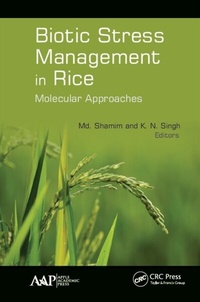
Biotic Stress Management in Rice
Molecular Approaches
1st Edition
Published on 6. July 2017
424 pages
978-1-315-34139-2 (ISBN)
Description

This book, Biotic Stress Management in Rice: Molecular Approaches, addresses biotic stress of rice and its management through molecular approaches. It focuses on the biotechnological aspects of rice with the aim of reducing the fungicide and insecticides and ultimately ensuring safety of rice as a food as well as the environment.
Rice is an important crop in much of the Asia-Pacific region, and there are a number of threats to rice production, including fungal, viral, and bacterial diseases and insect pests, both in temperate and tropical countries, which can cause the significant economic loss. Remarkable efforts are being made by scientists and breeders to raise rice productivity and safety by modifying and manipulating rice plants to survive under different types of stresses. The book provides an understanding of the genetic basis of resistance and susceptibility and goes on to present studies directed to understand the host-plant interaction in rice that have given rise to specialized breeding programs for resistance to diseases and insect-pests. In addition to these advancements in molecular breeding, marker-assisted selection and transgenic approaches open new ways to increase resistance in rice for better production under several biotic stresses. This book covers the most recent advancements and research strategies of molecular breeding, transgenic approaches, and other tools for effective biotic stress management in rice.
This book should find a prominent place on the shelves of new plant breeders, biotechnologists, plant pathologists and entomologists working in academic and commercial rice research programs, and in the libraries of research establishments.
Rice is an important crop in much of the Asia-Pacific region, and there are a number of threats to rice production, including fungal, viral, and bacterial diseases and insect pests, both in temperate and tropical countries, which can cause the significant economic loss. Remarkable efforts are being made by scientists and breeders to raise rice productivity and safety by modifying and manipulating rice plants to survive under different types of stresses. The book provides an understanding of the genetic basis of resistance and susceptibility and goes on to present studies directed to understand the host-plant interaction in rice that have given rise to specialized breeding programs for resistance to diseases and insect-pests. In addition to these advancements in molecular breeding, marker-assisted selection and transgenic approaches open new ways to increase resistance in rice for better production under several biotic stresses. This book covers the most recent advancements and research strategies of molecular breeding, transgenic approaches, and other tools for effective biotic stress management in rice.
This book should find a prominent place on the shelves of new plant breeders, biotechnologists, plant pathologists and entomologists working in academic and commercial rice research programs, and in the libraries of research establishments.
Reviews / Votes
"The major objective of this book is on how researchers make efforts for the improvement of rice crops by using different molecular and biotechnological approaches. For this book, the authors present the recent DNA-based markers, genomic tools, biotechnological techniques and some new bioinformatics tools for some of the most significant biotic stress tolerant genes. Marker-assisted selection application in rice breeding programs like screening resistant plants from a germplasm and genotyping breeding populations are also discussed and give some new information. The discussed transgenic, genomics tools and molecular markers have been proven to work from different studies published recently, from rice germplasm screening, results of fine mapping, and gene pyramiding methods for the impairments of new rice varieties." Prashant Vikram, Associate Scientist, Genetic Resource Program, International Maize and Wheat Improvement Center (CIMMYT), Texcoco, MexicoMore details
Language
English
Place of publication
London
United Kingdom
Publishing group
Taylor & Francis Ltd
Target group
College/higher education
Professional and scholarly
Product notice
Reflowable
Illustrations
23 Tables, black and white; 22 Illustrations, color; 7 Illustrations, black and white
File size
5,62 MB
ISBN-13
978-1-315-34139-2 (9781315341392)
Copyright in bibliographic data and cover images is held by Nielsen Book Services Limited or by the publishers or by their respective licensors: all rights reserved.
Schweitzer Classification
Other editions
Additional editions
Book
03/2021
1st Edition
Apple Academic Press Inc.
€123.29
Shipment within 3-4 weeks
Book
06/2017
1st Edition
Apple Academic Press Inc.
€178.27
Shipment within 3-4 weeks
Persons
Md. Shamim, PhD, is an Assistant Professor cum- Jr.-Scientist in the Department of Molecular Biology and Genetic Engineering at Bihar Agricultural University, Sabour, India. He is the author or co-author of 25 peer-reviewed journal articles, eight book chapters, and two conference papers. He also has written two books. He is editorial board member of several national and international journals. Recently, Dr. Shamim has received the Young Scientist Award (2016) for his research work on biotechnology from the Bioved Research Institute of Agriculture, Technology and Sciences, Allahabad, India. Before joining Bihar Agricultural University, Sabour, Dr. Shamim worked at the Indian Agricultural Research Institute, New Delhi, where he was engaged in heat responsive gene regulation in wheat. Dr. Shamim has also worked at the Indian Institute of Pulses Research, Kanpur, India, on molecular and phylogeny analysis of several Fusarium fungus of pulses, and also performed research with the Biochemistry Department of the Dr. Ram Manohar Lohia Institute on plant protease inhibitor isolation and their characterization. He is a member of the soil microbiology core research group at Bihar Agricultural University (BAU), where he helps with providing appropriate direction and assisting with prioritizing the research work on PGPRs. He has proved himself as an active scientist in the area of biotic stress management in rice, especially in yellow stem borer management by isolating protease inhibitor from jackfruit seeds and sheath blight resistance mechanism in wild rice, cultivated rice and other hosts.
Dr. Shamim acquired a BSc (Biology) degree from Dr. Ram Manohar Lohia Avadh University, Faizabad, India, and received MSc (Biotechnology) and PhD (Agricultural Biotechnology) degrees from Narendra Deva University of Agriculture and Technology, Kumarganj, Faizabad, India, with specialization in biotic stress management in rice through molecular and proteomics tools. Dr. Shamim was awarded Maulana Azad National Fellowship Award from the University Grants Commission, New Delhi, India, during his PhD degree program.
K. N. Singh, PhD, is Professor and Head in the Department of Plant Molecular Biology and Genetic Engineering at Narendra Deva University of Agriculture and Technology Kumaranj, Faizabad, India. He is the author or co-author of 50 peer-reviewed journal articles, 10 book chapters, and four conference papers. He has also written two books. He is editorial board member of many journals. He has worked with The Energy and Resources Institute (TERI), New Delhi, before joining Tamil Nadu Agricultural University as Assistant Professor and then Associate Professor in the Centre for Plant Molecular Biology (CPMB). He was visiting scientist under the Rockefeller Program at IRRI, Philippines. He is fellow of the Indian Society of Agricultural Biochemists and a life member of many national and international societies. He is as an active scientist in the area of biotic stress management in rice, pigeon pea, and sesamum.
Professor Singh matriculated from Bihar School Examination Board with a national scholarship. He did his BSc (Hons.) and MSc from the Science College, Patna, then did MPhil from Jawaharlal Nehru University, New Delhi, in life sciences. He did his PhD from Cambridge University (UK) through the Government of India overseas fellowship program.
Dr. Shamim acquired a BSc (Biology) degree from Dr. Ram Manohar Lohia Avadh University, Faizabad, India, and received MSc (Biotechnology) and PhD (Agricultural Biotechnology) degrees from Narendra Deva University of Agriculture and Technology, Kumarganj, Faizabad, India, with specialization in biotic stress management in rice through molecular and proteomics tools. Dr. Shamim was awarded Maulana Azad National Fellowship Award from the University Grants Commission, New Delhi, India, during his PhD degree program.
K. N. Singh, PhD, is Professor and Head in the Department of Plant Molecular Biology and Genetic Engineering at Narendra Deva University of Agriculture and Technology Kumaranj, Faizabad, India. He is the author or co-author of 50 peer-reviewed journal articles, 10 book chapters, and four conference papers. He has also written two books. He is editorial board member of many journals. He has worked with The Energy and Resources Institute (TERI), New Delhi, before joining Tamil Nadu Agricultural University as Assistant Professor and then Associate Professor in the Centre for Plant Molecular Biology (CPMB). He was visiting scientist under the Rockefeller Program at IRRI, Philippines. He is fellow of the Indian Society of Agricultural Biochemists and a life member of many national and international societies. He is as an active scientist in the area of biotic stress management in rice, pigeon pea, and sesamum.
Professor Singh matriculated from Bihar School Examination Board with a national scholarship. He did his BSc (Hons.) and MSc from the Science College, Patna, then did MPhil from Jawaharlal Nehru University, New Delhi, in life sciences. He did his PhD from Cambridge University (UK) through the Government of India overseas fellowship program.
Content
Molecular Biology of Rice Tungro Viruses and Strategies for Their Control. Molecular Aspects of Bacterial Blight Resistance in Rice: Recent Advancement. Molecular Approaches for Controlling Blast Disease in Rice. Molecular Tools for Controlling of Sheath Blight Disease of Rice and Its Management. Molecular Approaches for Controlling of False Smut Disease of Rice: An Overview. Biological and Biotechnological Approaches to Manage Brown Spot (Helminthosporium oryzae) Disease of Rice. Molecular and Biological Approaches for Management of Root-Knot Disease of Rice Caused Meloidogyne graminicola. Controlling Yellow Stem Borer in Rice by Using Molecular Tools. Molecular Tools for Controlling Rice Leaf Folder (Cnaphalocrocis medinalis). Biological and Molecular Approaches for Biotic Stress Management of Post Harvest Losses in Rice. Molecular Approaches for Multiple Resistance Genes Stacking for Management of Major Rice Diseases. Biotic Stress Management in Rice Through RNA Interference.
