

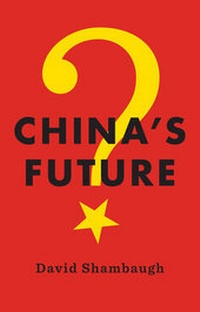
China's Future
Description

Reviews / Votes
"This book is full of thought-provoking, well-argued arguments that are certain to interest China watchers around the world."South China Morning Post "This book is full of thought-provoking, well-argued arguments that are certain to interest China watchers around the world." South China Morning Post "David Shambaugh lays out some bold speculations about possible futures for China that will make even seasoned China hands rethink their assumptions. It is critical reading from one of our most astute observers of that country." Francis Fukuyama, Stanford University"While it is not possible to predict China's future, it is possible to assay the contradictory forces that are propelling it forward. Bringing his years of experience and deep insight to bear, David Shambaugh has met this daunting challenge with great perception, balance and concision." Orville Schell, Arthur Ross Director, Center on US-China Relations, Asia Society "Anyone desiring to understand the debate over China's future underway among China's top leadership can do no better than Shambaugh's concise book." John Garver, Georgia Institute of Technology, "Convincing" Foreign Affairs "This is an extremely important book that deserves a wide readership among government officials, and those in the business community with aspirations to tap into the country's huge market." New Zealand International ReviewMore details
Other editions
Additional editions
Person
Content
2
China's Economy
China's economy is currently confronting both a downturn in its growth rate and a wide variety of structural adjustments. These are simultaneous and secular trends that can be expected to continue over the next decade and perhaps beyond. The questions are: how low will the GDP growth rate go until it reaches a new equilibrium, and how successful will China be in making the needed structural adjustments to facilitate another lengthy period of dynamic growth and creation of a fully developed economy? These interrelated questions will be central to understanding China's economic future. Maintaining high growth rates (of 6 percent or more) may, ironically, reflect relative failure-showing that China remains wedded to its old growth model and hence is not making the necessary structural adjustments to transition to the new growth model. Conversely, lower growth rates (3-5 percent) may indicate successful structural transformations and longer-term developmental stability.
While the performance of the economy will remain central to China's broader future, it is actually the relationship between economics and politics that will be the key. It is very doubtful that China will be able to successfully navigate its way through the complex thicket of needed structural adjustments in the economy without parallel political reforms. A variety of social pressures are also influencing both the economy and the political system, requiring far-reaching social reforms as well (see chapter 3). China's political system was a great facilitator of the first wave of economic reforms post-1978-spurring GDP growth twenty-six-fold over the past thirty-seven years-but now and into the future it may be the greatest single impediment to further decades of reform and growth (unless it changes). China is trying to create a modern economy with a premodern political system. China's economic future requires a very different kind of Chinese party-state than in the past-no longer an administrative, commandist, centralized, extractive, and dictatorial state. Rather, it will require a state that is more reactive, responsive, inclusive, facilitative, compromising, tolerant, transparent, and genuinely decentralized.
Without this fundamental switch in the way the Chinese party-state functions, China's economic reforms will stall and the macro economy will stagnate (relatively). This does not mean that the Chinese economy will crash, although the volatility and overall economic contraction experienced in 2015 caused some analysts to predict a hard landing. GDP growth officially fell to 7 percent during the first half of 2015, while total trade declined 6.9 percent. Some analysts believe GDP growth is actually 1 to 2 percentage points lower. In the years ahead it is not inconceivable that it may fall to 5 percent or less per annum. As noted above, this is not necessarily a bad thing, as it would indicate structural shifts in the economy away from fixed asset investment toward a more variegated growth model. Moreover, given the overall size of China, its population and macro-economic heft, even 3 to 5 percent growth in a $10-$15 trillion (it is $8.9 trillion at present) economy is nothing to sneer at, although a drop to this level would have significant international implications.
Whether expanding or contracting, as the world's second-largest national economy China will continue to have a major impact globally. China currently accounts for 16.4 percent of global GDP; it contributes about 35 percent of global growth; and it accounts for about 11 percent of global trade. China's economic footprint is now truly global, with its businesses investing and operating all over the world.1 The scope and magnitude of China's economy thus has truly global implications. If the Chinese economy catches a cold, as it did during the summer of 2015, the virus quickly spreads internationally. It is thus vital to understand the deeper dynamics of China's economy and where it is headed.
Where Do They Want to Go? The Third Plenum Revisited
The starting point for understanding where the Chinese economy is today and where the government intends for it to go over the next few decades is the blueprint set forth in the Third Plenum documents of November 2013. I discussed this briefly in the previous chapter, but allow me to elaborate further.
The Third Plenum planners had the benefit of being able to draw upon two previous important documents. The first was the Twelfth Five-Year Plan (2011-2015), which included the central objective of moving toward a more diversified and sustainable growth model (although it postponed major decisions).2 The second was the China 2030 report written jointly by the World Bank and the Development Research Center of the State Council and published in 2013.3 This massive 500-page study was initiated by former Premier Wen Jiabao and then-World Bank president Robert Zoellick. Together they envisioned the study as a guiding blueprint for transitioning to a new macro growth and development model. The central focus of the report was the need to spur technological innovation, green development, financial reforms, more egalitarian social policies, better use of factor endowments (land, labor, capital), and deeper integration into the international economic order. Detailed proposals were offered in each of these areas.
The Third Plenum Decision and Explanation were very lengthy exposés, and (as noted in chapter 1) credit should be given to the government for responding to the need for a new comprehensive reform plan.4 Yet, on the whole, the documents were also remarkably vague-probably indicating ongoing and unresolved debates behind the scenes. This is not to say that there are not some places where specific proposals are offered, such as: loosening of the one-child policy; abolition of the "reform through labor" system; the announcement that "markets should play the decisive role in the allocation of resources"; making government budgets more transparent; more fully funding public welfare expenditures; undertaking some financial sector reforms; granting rural farmers greater property rights; creating some new bureaucratic mechanisms such as the State Security Commission, the Leading Group on Comprehensive Deepening of Economic Reform; and hints about a super environmental agency so that there is "a single department in charge of regulating and controlling all land space usage within the country's territory and to uniformly carry out protection and restoration of the mountains, waters, forests, fields, and lakes."
While it did signal the need for a new comprehensive reform path, and it redefined the central government's role in managing the macro economy, the Plenum documents really did very little to signal or specify how to get there (no indication of sequencing or prioritization). This lack of specificity is likely one of the three main contributing factors to the almost complete lack of follow-through in implementation following the Plenum. Another reason is that the Party's anti-corruption campaign has paralyzed the cadre corps, who are not doing their "day jobs" by carrying out the reforms. To the extent that corruption was a facilitator of economic activity (and it was), it has also compromised implementation of reforms. The third reason is that some of the intended reforms threaten deeply vested interests-notably in state-owned enterprises, manufacturing, finance, and local governments-and are thus encountering substantial (and predictable) resistance. In August 2015, a sharply worded article in Beijing's Guangming Daily lamented, "The scale of resistance [to the reforms] is beyond what could be imagined."5 As a result of these factors, much of the Third Plenum reform plan stalled before it even took off.
If there has been progress in the two years since the Plenum it has mainly been in the regulatory realm. The government has issued a raft of regulations in various areas and some notable progress has been made in some spheres.6 The National Budget Law was amended for the first time in twenty years, ostensibly allowing for greater transparency of, and citizen input into, local government budgets. Deregulation and streamlining of a wide range of central, provincial, and local administrative regulations has been a priority, with a large number of previously needed government approvals abolished. The State Council has cancelled administrative approvals on 246 items. This is very positive as it keeps with the Third Plenum pledge to "allow the market to play the decisive factor in the economy," and also reduces opportunities for bribes and rent-seeking by officials. The National Development and Reform Commission (NDRC), which previously exercised a stranglehold over economic planning, is being downsized and perhaps even broken up. It is also a main target of the anti-corruption campaign. An explicit bank deposit insurance system has been created for the first time, and pilot programs for issuance of local bonds have been set up in ten provinces and cities. The Shanghai Free Trade Zone has been established, with others probably to follow. New initiatives to further develop inland and western regions of the country have been launched, including the unveiling of the "One Belt, One Road" project to build infrastructure across...
