

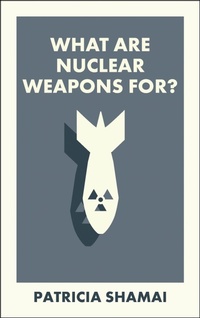
What Are Nuclear Weapons For?
1st Edition
Published on 25. November 2025
184 pages
978-1-5292-3418-3 (ISBN)
Description

Peacekeepers, effective deterrent or potential cause of ultimate disaster? Understanding what nuclear weapons are for has never been more essential.
This book traces the history of nuclear weapons from their first use in 1945 when they brought the Second World War to an end, through the Cold War when they gave rise to peace movements and disarmament efforts to the ominous nuclear landscape today.
Shamai shows how nuclear weapons have, to date, been a deterrent by raising the stakes of war and thereby reducing the chances of certain kinds of conflict. But, she warns, this is not a permanent situation - its continuation depends on the world's reaction to this threat and ongoing vigilance.
This book traces the history of nuclear weapons from their first use in 1945 when they brought the Second World War to an end, through the Cold War when they gave rise to peace movements and disarmament efforts to the ominous nuclear landscape today.
Shamai shows how nuclear weapons have, to date, been a deterrent by raising the stakes of war and thereby reducing the chances of certain kinds of conflict. But, she warns, this is not a permanent situation - its continuation depends on the world's reaction to this threat and ongoing vigilance.
Reviews / Votes
"An accurate history and nuanced analysis of nuclear weapons' impact on global politics - accessible and insightful for experts and non-experts alike." Carlotta Minnella, European University Institute"Understanding nuclear weapons is absolutely essential if we are to prevent their future use. This book does an excellent job of bringing clarity to an increasingly difficult problem." Andrew Futter, University of Leicester "Shamai's exhaustive, balanced and timely analysis reminds us that the most destructive weapons ever built may still be what keeps peace alive." Lana Obradovic, University of Nebraska Omaha "A rich and thought-provoking read on a subject that 80 years on from the atomic bombings of Hiroshima and Nagasaki, remains as relevant as ever." Nicola Leveringhaus, King's College London
"A must-read for those who research and study deterrence! Patricia Shamai provides us with a detailed historical account of nuclear weapon use and reputation." Michelle Black, University of Nebraska Omaha
More details
Series
Edition
First Edition
Language
English
Place of publication
Bristol
United Kingdom
Target group
College/higher education
Illustrations
6 s/w Abbildungen
6 Illustrations, black and white
File size
1,86 MB
ISBN-13
978-1-5292-3418-3 (9781529234183)
Copyright in bibliographic data and cover images is held by Nielsen Book Services Limited or by the publishers or by their respective licensors: all rights reserved.
Schweitzer Classification
Other editions
Additional editions
Patricia Shamai
What Are Nuclear Weapons For?
Book
approx. 11/2025
1st Edition
Bristol University Press
€13.50
Not yet published
Person
Patricia Shamai is Principal Lecturer in International Relations and Associate Head of School in the Faculty of Humanities and Social Sciences at the University of Portsmouth. Her research addresses the norms associated with nuclear, chemical and biological weapons. She has previously worked with the UK Ministry of Defence, NATO specialists and US government experts to support dialogue and collaboration to address deterrence in a twenty-first-century context.
Content
Preface
1. Introduction
2. Origins
3. The Cold War
4. Taboos and Stigmas
5. Non-Proliferation, Arms Control and Popular Protest
6. After the Cold War
7. 9/11 and the Nuclear Threat
8. Conclusion
Notes
Further Reading
1. Introduction
2. Origins
3. The Cold War
4. Taboos and Stigmas
5. Non-Proliferation, Arms Control and Popular Protest
6. After the Cold War
7. 9/11 and the Nuclear Threat
8. Conclusion
Notes
Further Reading
