

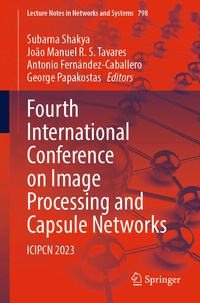
Fourth International Conference on Image Processing and Capsule Networks
ICIPCN 2023
1st Edition
Published on 17. November 2023
XXVI, 737 pages
978-981-99-7093-3 (ISBN)
Description

This book includes high-quality research papers presented at the Fourth International Conference on Image Processing and Capsule Networks (ICIPCN 2023), which is held in Bangkok, Thailand, during 10-11 August 2023. This book provides a collection of the state-of-the-art research attempts to tackle the challenges in image and signal processing from various novel and potential research perspectives. The book investigates feature extraction techniques, image enhancement methods, reconstruction models, object detection methods, recommendation models, deep and temporal feature analysis, intelligent decision support systems, and autonomous image detection models. In addition to this, the book also looks into the potential opportunities to monitor and control the global pandemic situations.
More details
Series
Language
English
Place of publication
Singapore
Singapore
Publishing group
Springer Singapore
Target group
Professional and scholarly
Product notice
Reflowable
Illustrations
XXVI, 737 p. 369 illus., 317 illus. in color.
File size
25,22 MB
ISBN-13
978-981-99-7093-3 (9789819970933)
DOI
10.1007/978-981-99-7093-3
Schweitzer Classification
Other editions
Additional editions
Subarna Shakya | João Manuel R. S. Tavares | Antonio Fernández-Caballero
Fourth International Conference on Image Processing and Capsule Networks
ICIPCN 2023
Book
11/2023
Springer
€246.09
Shipment within 3-4 weeks
Persons
Dr. Prof. Subarna Shakya is currently a professor of Computer Engineering, Department of Electronics and Computer Engineering, Central Campus, Institute of Engineering, Pulchowk, Tribhuvan University, Coordinator (IOE), LEADER Project (Links in Europe and Asia for Engineering, eDucation, Enterprise, and Research Exchanges), ERASMUS MUNDUS. He received M.Sc. and Ph.D. degrees in Computer Engineering from the Lviv Polytechnic National University, Ukraine, 1996 and 2000. respectively. His research area includes e-government system, computer systems and simulation, distributed and cloud computing, software engineering and information system, computer architecture, information security for e-government, and multimedia system.
João Manuel R. S. Tavares graduated in Mechanical Engineering at the Universidade do Porto, Portugal, in 1992. He also earned his M.Sc. degree and Ph.D. degree in Electrical and Computer Engineering from the Universidade do Porto in1995 and 2001 and attained his Habilitation in Mechanical Engineering in 2015. He is a senior researcher at the Instituto de Ciência e Inovação em Engenharia Mecânica e Engenharia Industrial (INEGI) and an associate professor at the Department of Mechanical Engineering (DEMec) of the Faculdade de Engenharia da Universidade do Porto (FEUP).João Tavares is a co-editor of more than 55 books and co-author of more than 50 book chapters, 650 articles in international and national journals and conferences, and 3 international and 3 national patents. He has been a committee member of several international and national journals and conferences, is co-founder and co-editor of the book series "Lecture Notes in Computational Vision and Biomechanics" published by Springer, founder and editor-in-chief of the journal "Computer Methods in Biomechanics and Biomedical Engineering: Imaging and Visualization" published by Taylor & Francis, editor-in-chief of the journal "Computer Methods in Biomechanics and Biomedical Engineering" published by Taylor & Francis, and co-founder and co-chair of the international conference series: CompIMAGE, ECCOMAS VipIMAGE, ICCEBS and BioDental. Additionally, he has been a (co-)supervisor of several M.Sc. and Ph.D. thesis and supervisor of several post-doc projects and has participated in many scientific projects both as researcher and as scientific coordinator.
Antonio Fernández-Caballero received his Master in Computer Science from the School of Computer Science at the Technical University of Madrid, Spain, and he received his Ph.D. from the Department of Artificial Intelligence of the National University for Distance Education, Spain. He is a full professor at the University of Castilla-La Mancha, Albacete, Spain. His interests enforce him to be part of the membership in National Society Networks AERFAI (Spanish Association of Pattern Recognition and Image Analysis), RTNAC (National Natural and Artificial Computation Network), RedAF (Physical Agents Network), AIPO (Association of Human-Computer Interaction) and Spanish Technology Platform on Robotics (Hisparob) and European networks euCognition (The European Network for the Advancement of Artificial Cognitive Systems), and SIMILAR (The European taskforce Creating human-machine interfaces SIMILAR to human-human communication).
George A. Papakostas received the Diploma degree in electrical and computer engineering in 1999 and the M.Sc. and Ph.D. degrees in electrical and computer engineering in 2002 and 2007, respectively, from the Democritus University of Thrace (DUTH), Greece. From 2007 to 2010, he served as an adjunct lecturer with the Department of Production Engineering and Management, DUTH. He currently serves as an adjunct assistant professor with the Department of Computer and Informatics Engineering, Technological Educational Institution, Eastern Macedonia and Thrace, Greece. In 2012, he was elected as a full professorin the aforementioned Department of Computer and Informatics Engineering. He has co-authored more than 70 publications in indexed journals, international conferences, and book chapters. His research interests include pattern recognition, computer/machine vision, computational intelligence, machine learning, feature extraction, evolutionary optimization, and signal and image processing.
João Manuel R. S. Tavares graduated in Mechanical Engineering at the Universidade do Porto, Portugal, in 1992. He also earned his M.Sc. degree and Ph.D. degree in Electrical and Computer Engineering from the Universidade do Porto in1995 and 2001 and attained his Habilitation in Mechanical Engineering in 2015. He is a senior researcher at the Instituto de Ciência e Inovação em Engenharia Mecânica e Engenharia Industrial (INEGI) and an associate professor at the Department of Mechanical Engineering (DEMec) of the Faculdade de Engenharia da Universidade do Porto (FEUP).João Tavares is a co-editor of more than 55 books and co-author of more than 50 book chapters, 650 articles in international and national journals and conferences, and 3 international and 3 national patents. He has been a committee member of several international and national journals and conferences, is co-founder and co-editor of the book series "Lecture Notes in Computational Vision and Biomechanics" published by Springer, founder and editor-in-chief of the journal "Computer Methods in Biomechanics and Biomedical Engineering: Imaging and Visualization" published by Taylor & Francis, editor-in-chief of the journal "Computer Methods in Biomechanics and Biomedical Engineering" published by Taylor & Francis, and co-founder and co-chair of the international conference series: CompIMAGE, ECCOMAS VipIMAGE, ICCEBS and BioDental. Additionally, he has been a (co-)supervisor of several M.Sc. and Ph.D. thesis and supervisor of several post-doc projects and has participated in many scientific projects both as researcher and as scientific coordinator.
Antonio Fernández-Caballero received his Master in Computer Science from the School of Computer Science at the Technical University of Madrid, Spain, and he received his Ph.D. from the Department of Artificial Intelligence of the National University for Distance Education, Spain. He is a full professor at the University of Castilla-La Mancha, Albacete, Spain. His interests enforce him to be part of the membership in National Society Networks AERFAI (Spanish Association of Pattern Recognition and Image Analysis), RTNAC (National Natural and Artificial Computation Network), RedAF (Physical Agents Network), AIPO (Association of Human-Computer Interaction) and Spanish Technology Platform on Robotics (Hisparob) and European networks euCognition (The European Network for the Advancement of Artificial Cognitive Systems), and SIMILAR (The European taskforce Creating human-machine interfaces SIMILAR to human-human communication).
George A. Papakostas received the Diploma degree in electrical and computer engineering in 1999 and the M.Sc. and Ph.D. degrees in electrical and computer engineering in 2002 and 2007, respectively, from the Democritus University of Thrace (DUTH), Greece. From 2007 to 2010, he served as an adjunct lecturer with the Department of Production Engineering and Management, DUTH. He currently serves as an adjunct assistant professor with the Department of Computer and Informatics Engineering, Technological Educational Institution, Eastern Macedonia and Thrace, Greece. In 2012, he was elected as a full professorin the aforementioned Department of Computer and Informatics Engineering. He has co-authored more than 70 publications in indexed journals, international conferences, and book chapters. His research interests include pattern recognition, computer/machine vision, computational intelligence, machine learning, feature extraction, evolutionary optimization, and signal and image processing.
Content
Modern Challenges & Limitations in Medical Science using Capsule Networks: A Comprehensive Review.- Studies on movie soundtracks over the last five years.- Blind Source Separation of EEG Signals using Wavelet and EMD Decomposition.- Image Extraction Approaches for Density Count Measurement in Obstruction Renography Using Radiotracer 99mTc-DTPA.- Deep Short-Term Long Memory Technique For Respiratory Lung Disease Prediction.- Utilizing Satellite Imagery For Flood Monitoring In Urban Regions.- Optimizing Permutations in Biclustering Algorithms.- Extracting Graphs from Plant Leaf Venations using Image Processing.- Multispectral fusion of multi-sensor image data using PCNN for performance evaluation in sensor networks.- U-Net based segmentation of coronary arteries in invasive coronary angiography.- Change Detection for Multispectral Remote Sensing Images Using Deep Learning.- Explainable AI for Black Sigatoka Detection.- ModifiedU-Net and CRF for image segmentation of crop images.- Securing Data in the Cloud: The Application of Fuzzy Identity Biometric Encryption for Enhanced Privacy and Authentication.- Quantum Convolutional Neural Network for Agricultural Mechanization and Plant Disease Detection.- Innovative Method for Alzheimer's Disease Detection Using Convolutional Neural Networks.- Segmentation of White Matter Lesions in MRI Images using Optimization-based Deep Neural Network.- A New Multi-Level Hazy Image and Video Dataset for Benchmark of Dehazing Methods.- Creative AI using DeepDream.- Tuberculosis Bacteria Detection Using Deep Learning Techniques.- An enhanced real-time system for wrong-way and over speed violation detection using deep learning.- U-Net based Denoising Autoencoder Network for de-speckling in fetal ultrasound images.- Galo Lexical Tone Recognition Using Machine Learning Approach
