

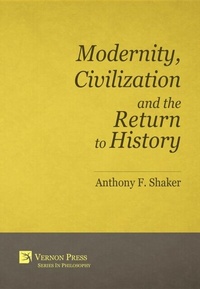
Modernity, Civilization and the Return to History
Description

The modern concept and study of civilization have their roots, not in western Europe, but in the spirit of scientific investigation associated with a self-conscious Islamicate civilization. What we call modernity cannot be fathomed without this historical connection. We owe every major branch of science known today to the broad tradition of systematic inquiry that belongs to a "region of being"-as Heidegger would say-whose theoretical, practical and institutional dimensions the philosophy of that civilization played an unprecedented role in creating.
This book focuses primarily on the philosophical underpinnings of questions relating to civilization, personhood and identity. Contemporary society and thinking in western Europe introduced new elements to these questions that have altered how collective and personal identities are conceived and experienced. In the age of "globalization," expressions of identity (individual, social and cultural) survive precariously outside their former boundaries, just when humanity faces perhaps its greatest challenges-environmental degradation, policy inertia, interstate bellicosity, and a growing culture of tribalism. Yet, the world has been globalized for at least a millennium, a fact dimmed by the threadbare but still widespread belief that modernity is a product of something called the West.
One is thus justified in asking, as many people do today, if humanity has not lost its initiative. This is more a philosophical than an empirical question. There can be no initiative without the human agency that flows from identity and personhood-i.e., the way we, the acting subject, live and deliberate about our affairs. Given the heavy scrutiny under which the modern concept of identity has come, Dr. Shaker has dug deeper, bringing to bear a wealth of original sources from both German thought and ¿ikmah (Islamicate philosophy), the latter based on material previously unavailable to scholars. Posing the age-old question of identity anew in the light of these two traditions, whose special historical roles are assured, may help clear the confusion surrounding modernity and, hopefully, our place in human civilization.
Proximity to Scholasticism, and therefore Islamicate philosophy, lent German thought up to Heidegger a unique ability to dialogue with other thought traditions. Two fecund elements common to Heidegger, Qunawi and Mulla ¿adra are of special importance: Logos (utterance, speech) as the structural embodiment at once of the primary meaning (essential reality) of a thing and of divine manifestation; and the idea of unity-in-difference, which ¿adra finally formulated as the substantial movement of existence. But behind this complexity is the abiding question of who Man is, which cannot be answered by theory alone.
Heidegger, who occupies a good portion of this study, questioned the modern ontology at a time of social collapse and deep spiritual crisis not unlike ours. Yet, that period also saw the greatest breakthroughs in modern physics and social science. The concluding chapters take up, more specifically, identity renewal in Western literature and Muslim "reformism." The renewal theme reflects a point of convergence between the Eurocentric worldview, in which modernism has its secular aesthetics roots, and a current originating in Ibn Taymiyyah's reductionist epistemology and skeptical fundamentalism. It expresses a hopeless longing for origin in a historically pristine "golden age," an obvious deformation of philosophy's millennial concern with the commanding, creative oneness of the Being of beings.
More details
Other editions
Additional editions
Content
INTRODUCTION-An Epoch's End
PART I-HISTORY AND IDENTITY 1. The structural transformation of self-identity 2. The unfolding of the truth question 3. Intuition and anniyyah (haecceity, anitas)
PART II-¿ADR AL-DIN QUNAWI: THE LANGUAGE OF REALITY 4. Speech and the rational faculty 5. Speech dynamics and the origin of human community 6. Inflection and subordination in the language of existence 7. The question of origin 8. The proliferation of thought and its implications for society
PART III-MODERNITY AND MODERNISM 9. The ends of philosophy 10. The aesthetic origin of modernism 11. Modernity or Westernization?
PART IV-HISTORY AND CIVILIZATION 12. Reasoning about history 13. The myth of the historical subject 14. The medieval roots of exceptionalism 15. Enlightened civilization: social identity and the ethical question 16. The ruse of the technical impulse 17. The ¿ikmah conception of life 18. The existential principles of systematic science
PART V-BEYOND THE AESTHETIC OF THE INTELLECT 19. Intellect as act 20. The principle of existentiating triplicity (tathlith) 21. The life of the intellect 22. The finality of personhood
PART VI-PATHS TRAVELLED 23. Renewal in a culture of collapse: Art and literature in the 1920s 24. Islam the unfinished civilization 25. The radical redundancy of Ibn Taymiyyah
CONCLUSION
BIBLIOGRAPHY INDEX/GLOSSARY
