

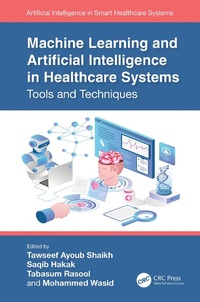
Machine Learning and Artificial Intelligence in Healthcare Systems
Tools and Techniques
1st Edition
Published on 3. January 2023
356 pages
978-1-000-83090-3 (ISBN)
Description

This book provides applications of machine learning in healthcare systems and seeks to close the gap between engineering and medicine by combining design and problem-solving skills of engineering with health sciences to advance healthcare treatment.
Machine Learning and Artificial Intelligence in Healthcare Systems: Tools and Techniques discusses AI-based smart paradigms for reliable prediction of infectious disease dynamics; such paradigms can help prevent disease transmission. It highlights the different aspects of using extended reality for diverse healthcare applications and aggregates the current state of research. The book offers intelligent models of the smart recommender system for personal well-being services and computer-aided drug discovery and design methods. Case studies illustrating the business processes that underlie the use of big data and health analytics to improve healthcare delivery are center stage. Innovative techniques used for extracting user social behavior (known as sentiment analysis for healthcare-related purposes) round out the diverse array of topics this reference book covers.
Contributions from experts in the field, this book is useful to healthcare professionals, researchers, and students of industrial engineering, systems engineering, biomedical, computer science, electronics, and communications engineering.
Machine Learning and Artificial Intelligence in Healthcare Systems: Tools and Techniques discusses AI-based smart paradigms for reliable prediction of infectious disease dynamics; such paradigms can help prevent disease transmission. It highlights the different aspects of using extended reality for diverse healthcare applications and aggregates the current state of research. The book offers intelligent models of the smart recommender system for personal well-being services and computer-aided drug discovery and design methods. Case studies illustrating the business processes that underlie the use of big data and health analytics to improve healthcare delivery are center stage. Innovative techniques used for extracting user social behavior (known as sentiment analysis for healthcare-related purposes) round out the diverse array of topics this reference book covers.
Contributions from experts in the field, this book is useful to healthcare professionals, researchers, and students of industrial engineering, systems engineering, biomedical, computer science, electronics, and communications engineering.
More details
Series
Edition
1. Auflage
Language
English
Place of publication
London
United Kingdom
Publishing group
Taylor & Francis Ltd
Target group
College/higher education
Professional and scholarly
Illustrations
17 Line drawings, color; 15 Line drawings, black and white; 114 Halftones, color; 9 Halftones, black and white; 127 Illustrations, color; 28 Illustrations, black and white
ISBN-13
978-1-000-83090-3 (9781000830903)
Copyright in bibliographic data and cover images is held by Nielsen Book Services Limited or by the publishers or by their respective licensors: all rights reserved.
Schweitzer Classification
Other editions
Additional editions
Tawseef Ayoub Shaikh | Saqib Hakak | Tabasum Rasool
Machine Learning and Artificial Intelligence in Healthcare Systems
Tools and Techniques
Book
12/2024
1st Edition
CRC Press
€97.98
Article not available at the moment
Tawseef Ayoub Shaikh | Saqib Hakak | Tabasum Rasool
Machine Learning and Artificial Intelligence in Healthcare Systems
Tools and Techniques
Book
03/2024
1st Edition
CRC Press
€75.70
The article will not be published
Tawseef Ayoub Shaikh | Saqib Hakak | Tabasum Rasool
Machine Learning and Artificial Intelligence in Healthcare Systems
Tools and Techniques
Book
02/2023
1st Edition
CRC Press
€232.50
Shipment within 10-20 days
Persons
Dr. Tawseef Ayoub Shaikh is an Assistant Professor in the Computer Science Engineering Department, Baba Ghulam Shah Badshah University (BGSBU), Rajouri, India. He earned his Doctorate from Zakir Hussain College of Engineering and Technology (ZHECT), Aligarh Muslim University (AMU), Aligarh, India. Before this, he earned his M-Tech from Guru Nanak Dev University (GNDU) Amritsar India and B-tech in Computer Engineering from Islamic University of Science and Technology (IUST) Jammu and Kashmir, India. He has five years of teaching and eight years of research experience and has published more than 33 journal/conference papers and book chapters which are indexed in reputed indexing bodies such as SCI, SCIE, WoS, and Scopus. Dr. Shaikh has qualified national-level exams in Computer Science Engineering like UGC-NET, JKSLET, and GATE. He has been granted and completed four fully funded government projects by MHRD, NPIU, and GoI. His areas of expertise include Machine Learning, Medical Data Analysis, Artificial Intelligence, Healthcare Informatics, Deep Learning, Soft Computing.
Dr. Saqib Hakak is an Assistant Professor at Canadian Institute for Cybersecurity, Faculty of Computer Science University of New Brunswick, Fredericton, NB, Canada. He has completed his Post Doctorate Research at Canadian Institute for Cybersecurity, University of New Brunswick, Fredericton, in the IBM Project "Endpoint Threat Analytic: A people-oriented Cybersecurity", from Feb 2019 - Aug 2019. He has five years of teaching and eight years of research experience. He has published more than 33 journal/conference papers and book chapters which are indexed in reputed indexing bodies such as SCI, SCIE, WoS, and Scopus. He has three years of industrial experience in Radio Frequency Engineer (Telecom sector), Ericson India Pvt Limited, J&K circle (May 2011 - May 2012), Log analysis using TEMS KIT and analyzing parameters such as RSCP, TX power, EcNo. Dr. Hakak is the journal reviewer of reputed journals such as IEEE Transactions on Intelligent Transportation Systems, Future Generation Computer Systems, IEEE ACCESS, Mechanical Systems, and Signal Processing, etc. His areas of expertise are Natural language processing (NLP), Machine learning, Data Analyses, Data science for Security Applications, Medical data Analysis.
Dr. Tabasum Rasool is a Research Associate (RA) at the Division of Interdisciplinary Sciences, Indian Institute of Science (IISc) Banglore. She is a Doctorate from the National Institute of Technology (NIT), Srinagar, and has published over ten papers in reputed journals/conferences and book chapters which are indexed in reputed indexing bodies such as SCI, SCIE, WoS, and Scopus. She has 9 years of research experience. Her areas of expertise include Machine Learning, Fuzzy Computing, Genetic Optimization Techniques, and Water Source Management.
Dr. Mohammed Wasid is an Assistant Professor in the Department of Computer Science & Engineering, Govt. Engineering College, Bharatpur, Rajasthan. He earned his Doctorate from Zakir Hussain College of Engineering and Technology (ZHECT), Aligarh Muslim University (AMU), Aligarh, India. He has five years of teaching experience and eight years of research experience. He has published more than 25 papers in journals/conferences and book chapters which are all indexed in reputed bodies such as SCI, SCIE, WoS, and Scopus. Dr. Wasid has qualified national-level exams in Computer Science Engineering like UGC-NET and GATE. He has been granted and completed three fully funded government projects by MHRD, NPIU, and GoI. His areas of expertise include Machine Learning, Recommendation Systems, Soft Computing, and Pattern Recognition.
Dr. Saqib Hakak is an Assistant Professor at Canadian Institute for Cybersecurity, Faculty of Computer Science University of New Brunswick, Fredericton, NB, Canada. He has completed his Post Doctorate Research at Canadian Institute for Cybersecurity, University of New Brunswick, Fredericton, in the IBM Project "Endpoint Threat Analytic: A people-oriented Cybersecurity", from Feb 2019 - Aug 2019. He has five years of teaching and eight years of research experience. He has published more than 33 journal/conference papers and book chapters which are indexed in reputed indexing bodies such as SCI, SCIE, WoS, and Scopus. He has three years of industrial experience in Radio Frequency Engineer (Telecom sector), Ericson India Pvt Limited, J&K circle (May 2011 - May 2012), Log analysis using TEMS KIT and analyzing parameters such as RSCP, TX power, EcNo. Dr. Hakak is the journal reviewer of reputed journals such as IEEE Transactions on Intelligent Transportation Systems, Future Generation Computer Systems, IEEE ACCESS, Mechanical Systems, and Signal Processing, etc. His areas of expertise are Natural language processing (NLP), Machine learning, Data Analyses, Data science for Security Applications, Medical data Analysis.
Dr. Tabasum Rasool is a Research Associate (RA) at the Division of Interdisciplinary Sciences, Indian Institute of Science (IISc) Banglore. She is a Doctorate from the National Institute of Technology (NIT), Srinagar, and has published over ten papers in reputed journals/conferences and book chapters which are indexed in reputed indexing bodies such as SCI, SCIE, WoS, and Scopus. She has 9 years of research experience. Her areas of expertise include Machine Learning, Fuzzy Computing, Genetic Optimization Techniques, and Water Source Management.
Dr. Mohammed Wasid is an Assistant Professor in the Department of Computer Science & Engineering, Govt. Engineering College, Bharatpur, Rajasthan. He earned his Doctorate from Zakir Hussain College of Engineering and Technology (ZHECT), Aligarh Muslim University (AMU), Aligarh, India. He has five years of teaching experience and eight years of research experience. He has published more than 25 papers in journals/conferences and book chapters which are all indexed in reputed bodies such as SCI, SCIE, WoS, and Scopus. Dr. Wasid has qualified national-level exams in Computer Science Engineering like UGC-NET and GATE. He has been granted and completed three fully funded government projects by MHRD, NPIU, and GoI. His areas of expertise include Machine Learning, Recommendation Systems, Soft Computing, and Pattern Recognition.
Content
1. Artificial Intelligence Challenges, Principles, and Applications in Smart Healthcare Systems. 2. Systematic View and Impact of Artificial Intelligence in Smart Healthcare Systems, principles, challenges and Applications. 3. Application of Machine Learning Techniques in COVID-19 Epidemiology: A Glimpse. 4. Automated Seven-Level Skin Cancer Staging Diagnosis in Dermoscopic images using Deep Learning. 5. Ensemble Classifier Based Predictive Model for Type-2 Diabetes Mellitus Prediction. 6. Machine Learning Approaches for Analysis in Smart Healthcare Informatics. 7. Smart Approaches for Diagnosis of Brain Disorders using Artificial Intelligence. 8. Bridging the Gap Between Technology and Medicine: Approaches of Artificial Intelligence in Healthcare. 9. Brain Tumor Classification using Transfer Learning. 10. Advanced Bayesian Estimation Of Weibull In Early Stage Eye Loss Prediction In Diabetic Retinopathy. 11. Automated Sleep Staging Using Single-Channel EEG SIgnal based on Machine Learning Approaches. 12. Machine Learning Based Intelligent Assistant for Smart Healthcare. 13. AI-Enabled Sentiment Analysis on COVID-19 Vaccination: A Twitter based study. 14. An Early Diagnosis of Lung Nodule Using CT Images based on Hybrid Machine Learning techniques. 15. Early Detection of Alzheimer's Disease Assisted by AI-Powered Human-Robot Communication.
