

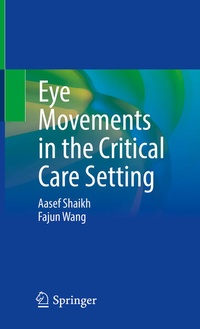
Eye Movements in the Critical Care Setting
Description

This book describes the abnormal eye movements encountered in the critical care unit in everyday practice and elaborates on the mechanism and clinical significance behind them.
Beginning with a thorough grounding of the basic anatomy and physiology ocular motor system and how they move the eyeballs; chapters explore the pathological descriptions of all the signs that a practicing neurologist, ophthalmologist, or emergency medicine specialist might see in other ICU's, as well as the diagnostic and prognostic evidence to answer the consult questions. Further chapters describe the abnormal ocular movements seen in the Neuro-ICU,
Eye Movements in the Critical Care Setting is a comprehensive resource on eye movement in the critical care setting, and a useful guide for the neurologist, ophthalmologist, and emergency medical specialist and residents alike.
More details
Other editions
Additional editions
Persons
Aasef G. Shaikh, MD, PHD
Department of Neurology
Daroff Dell'Osso Ocular Motility Laboratory
University Hospitals Cleveland Medical Center
Louis Stokes Veteran Affairs Medical CenterCase Western Reserve University
Cleveland, Ohio
Fajun Wang, MD
Department of NeurologyUniversity Hospitals Cleveland Medical Center
Louis Stokes Veteran Affairs Medical Center
Case Western Reserve University
Cleveland, OhioContent
Basic anatomy and physiology of ocular motor system.- Eye movement disorders in critically ill patients.-Gaze disorders.- Roving eye movements.-Ocular dipping.-Inverse ocular dipping.-Medication-induced opsoclonus.- Medication-induced nystagmus.- Saccades disorders.-Saccadic slowing in encephalopathy.-Medication-induced saccadic slowing.- Vestibulo-ocular reflex (VOR) disorders.- VOR impairments in cooling.- VOR impairments in encephalopathy.- Eye movement disorders leading to Neuro-ICU admissions.- Eye movements in cerebellar lesions leading to ICU admission.- Eye movements in medullary lesions leading to ICU admission.- Eye movements in pontine lesions leading to ICU admission.- Eye movements in midbrain lesions leading to ICU admission.- Eye movements in cerebral cortex lesions leading to ICU admission.- Myasthenia gravis crisis.- Guillain-Barre syndrome (Miller-Fischer variant).- Eye movements in epilepsy.- Medication-induced abnormal eye movements.- Epileptic eye movements.- Abnormal eye movements in autoimmune disorders.
