

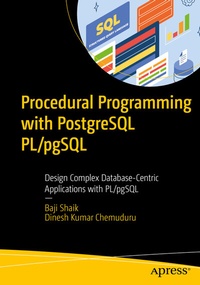
Procedural Programming with PostgreSQL PL/pgSQL
Description

Learn the fundamentals of PL/PGSQL, the programming language of PostgreSQL which is most robust Open Source Relational Database. This book provides practical insights into developing database code objects such as functions and procedures, with a focus on effectively handling strings, numbers, and arrays to achieve desired outcomes, and transaction management.
The unique approach to handling Triggers in PostgreSQL ensures that both functionality and performance are maintained without compromise. You'll gain proficiency in writing inline/anonymous server-side code within the limitations, along with learning essential debugging and profiling techniques. Additionally, the book delves into statistical analysis of PL/PGSQL code and offers valuable knowledge on managing exceptions while writing code blocks.
Finally, you'll explore the installation and configuration of extensions to enhance the performance of stored procedures and functions.
What You'll Learn
- Understand the PL/PGSQL concepts
- Learn to debug, profile, and optimize PL/PGSQL code
- Study linting PL/PGSQL code
- Review transaction management within PL/PGSQL code
- Work with developer friendly features like operators, casts, and aggregators
Who Is This Book For
App developers, database migration consultants, and database administrators.
More details
Other editions
Additional editions
Persons
Baji Shaik is a Senior Database Consultant with AWS Professional Services. He was introduced to databases in 2011 and over the years have worked with Oracle, PostgreSQL, Postgres Advance Server, RedShift, and Greenplum. His background spans a wide depth and breadth of expertise and experience in SQL/NoSQL database technologies. He is a Database Migration Expert and has developed many successful database solutions addressing challenging business requirements for moving databases from on-premises to Amazon RDS and Aurora PostgreSQL/MySQL and worked on tuning the RDS/Aurora PostgreSQL/MySQL databases to perform up to the mark. He is an author, having written several books on PostgreSQL. A few of his recent works include "PostgreSQL Configuration", "Beginning PostgreSQL on the Cloud", and "PostgreSQL Development Essentials". Furthermore, he has delivered several conferences, and workshop sessions and published many blogs within the AWS blog community.
Dinesh Chemuduru
is working as Principal Architect (OSS). He also worked at AWS as a database consultant and he has done many database migrations successfully. He contributed to a few Open Source solutions and built extensions around PostgreSQL. He loves to code in Flutter/Golang/C++ and deploys them into Kubernetes.
