

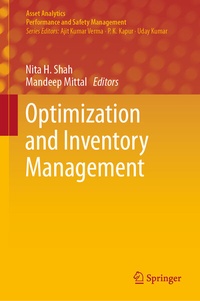
Optimization and Inventory Management
Description

This book discusses inventory models for determining optimal ordering policies using various optimization techniques, genetic algorithms, and data mining concepts. It also provides sensitivity analyses for the models' robustness. It presents a collection of mathematical models that deal with real industry scenarios. All mathematical model solutions are provided with the help of various optimization techniques to determine optimal ordering policy.
The book offers a range of perspectives on the implementation of optimization techniques, inflation, trade credit financing, fuzzy systems, human error, learning in production, inspection, green supply chains, closed supply chains, reworks, game theory approaches, genetic algorithms, and data mining, as well as research on big data applications for inventory management and control. Starting from deterministic inventory models, the book moves towards advanced inventory models.
The content is divided into eight major sections: inventory control and management - inventory models with trade credit financing for imperfect quality items; environmental impact on ordering policies; impact of learning on the supply chain models; EOQ models considering warehousing; optimal ordering policies with data mining and PSO techniques; supply chain models in fuzzy environments; optimal production models for multi-items and multi-retailers; and a marketing model to understand buying behaviour. Given its scope, the book offers a valuable resource for practitioners, instructors, students and researchers alike. It also offers essential insights to help retailers/managers improve business functions and make more accurate and realistic decisions.
More details
Other editions
Additional editions
Persons
Mandeep Mittal is an Assistant Professor at the Department of Mathematics, Amity Institute of Applied Sciences, Amity University, Noida, India. After completing his Master's in Applied Mathematics at the Indian Institute of Technology (IIT) Roorkee, he obtained his Ph.D. from the University of Delhi, India. He subsequently completed his postdoctoral research at Hanyang University, South Korea. He has one book and more than 50 papers in international journals and conference proceedings to his credit. He received the Best Faculty Award from Amity School of Engineering and Technology, New Delhi, for the year 2016-2017. In addition, he is currently serving on the editorial boards of the journals Revista Investigacion Operacional, Journal of Control and Systems Engineering, and Journal of Advances in Management Sciences and Information Systems.
