

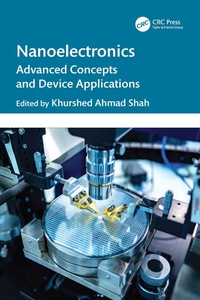
Nanoelectronics
Advanced Concepts and Device Applications
Published on 21. October 2025
256 pages
978-1-040-42861-0 (ISBN)
Description

The book covers the latest advancements in the field of nanoelectronics, interaction of light with matter, optical properties, surface plasmons, nanophotonic and plasmonic applications, nanomaterials engineering in nanoelectronics, fabrication techniques, and applications. It presents the structure properties and device applications of carbon nanotubes, graphene, and silicene. The book further includes topics on perovskites and applications, quantum dots for optoelectronic, sensing devices, computing applications, and advanced applications in diagnostic and therapeutic tools.
This book:
* Introduces topics on quantum phenomenon in nanoelectronics, transistors in modern computing, spintronic devices, flexible and wearable electronics, and case studies and includes topics on development of hybrid material of one- dimensional (1D) and 2D carbon in nanomedicine, computed tomography, ultrasound, and stapled peptides drug.
* Presents physical and electrical properties of nanoscale materials, applications of carbon nanotubes such as batteries, supercapacitors, biosensors, photodetectors, and field emission sources and topics on the surface plasmon resonance, nanolasers, nanoantennas, photonic crystals, and luminescent materials.
* Discusses quantum dots, quantum electronic devices, nanosensors, quantum computing, device applications of perovskite materials, spintronics, drug delivery, and gene therapy applications and the scaling laws in nanoelectronics, materials for nano- FET, high- speed computing, and advanced nanoscale FET architectures,
* Highlights recent developments in the field of nanoscale devices based on graphene and silicene such as biosensing and gas sensing, thermoelectric devices, and optoelectronic applications.
* Explains the basic quantum theory, pizoelectricity in zinc oxide quantum dots, and nanosensing, includes the topics on data- storage and quantum logic gates.
It is primarily written for senior undergraduates, graduate students, and academic researchers in the fields including physics, computers, nanoelectronics, electrical engineering, electronics and communications engineering, nanoscience, and nanotechnology.
This book:
* Introduces topics on quantum phenomenon in nanoelectronics, transistors in modern computing, spintronic devices, flexible and wearable electronics, and case studies and includes topics on development of hybrid material of one- dimensional (1D) and 2D carbon in nanomedicine, computed tomography, ultrasound, and stapled peptides drug.
* Presents physical and electrical properties of nanoscale materials, applications of carbon nanotubes such as batteries, supercapacitors, biosensors, photodetectors, and field emission sources and topics on the surface plasmon resonance, nanolasers, nanoantennas, photonic crystals, and luminescent materials.
* Discusses quantum dots, quantum electronic devices, nanosensors, quantum computing, device applications of perovskite materials, spintronics, drug delivery, and gene therapy applications and the scaling laws in nanoelectronics, materials for nano- FET, high- speed computing, and advanced nanoscale FET architectures,
* Highlights recent developments in the field of nanoscale devices based on graphene and silicene such as biosensing and gas sensing, thermoelectric devices, and optoelectronic applications.
* Explains the basic quantum theory, pizoelectricity in zinc oxide quantum dots, and nanosensing, includes the topics on data- storage and quantum logic gates.
It is primarily written for senior undergraduates, graduate students, and academic researchers in the fields including physics, computers, nanoelectronics, electrical engineering, electronics and communications engineering, nanoscience, and nanotechnology.
More details
Language
English
Place of publication
London
United Kingdom
Publishing group
Taylor & Francis Ltd
Target group
College/higher education
Illustrations
6 Tables, black and white; 31 Line drawings, black and white; 6 Halftones, black and white; 37 Illustrations, black and white
File size
25,62 MB
ISBN-13
978-1-040-42861-0 (9781040428610)
Copyright in bibliographic data and cover images is held by Nielsen Book Services Limited or by the publishers or by their respective licensors: all rights reserved.
Schweitzer Classification
Other editions
Additional editions
Book
10/2025
1st Edition
CRC Press
€133.30
Shipment within 10-20 days
Person
Khurshed Ahmad Shah is currently working as Associate Professor, PG Department of Physics, Sri Pratap College, School of Sciences, Cluster University Srinagar, Srinagar, Jammu and Kashmir, India. He obtained his doctorate in Physics from Jamia Millia Islamia, Central University, New Delhi, India, and Master of Science and Master of Philosophy through University of Kashmir, Srinagar, India. With over 15 years of teaching experience, Dr. Shah has effectively integrated technology into his instruction, utilizing the internet and developing customized algorithms to enhance student understanding. As Head of the Physics Department for over eight years, he initiated student visits to national research institutions and organized modern laboratory facilities, including an IT lab and a darkroom lab. His efforts in science outreach extend to school and college students through his special lectures on nanoscience, hands-on nanomaterial preparation sessions, and scientific model projects, nurturing future leaders in science and technology.
Dr. Shah has successfully led seven sponsored research projects as Principal Investigator, mobilizing over Rs. 2.0 crore in research funding. His efforts have culminated in the establishment of two research laboratories poised to produce hundreds of future Ph.D. scholars. He has published extensively in high-impact journals, supervised Ph.D. candidates, and organized numerous conferences, workshops, and seminars, enriching both academia and the broader scientific community.
Dr. Shah's groundbreaking work in carbon material synthesis has led to the development of novel catalysts and carbon nanotubes with enhanced properties suited for device applications. Notably, he introduced an innovative formula for determining the nature of carbon nanotubes, a formidable challenge in this field, and reviewed crucial elements of carbon nanotube synthesis, an article that has garnered over 700 citations. His advancements in modeling and simulation have led to the design of nanoscale sensors, heterostructures, and photodetectors based on one-dimensional (1D) and 2D materials, with promising applications in the electronics industry. Furthermore, in collaboration with IIT Ropar, Dr. Shah secured an Indian patent for a single-process method to produce four carbon nanostructures from walnut shell, including carbon quantum dots and graphene derivatives.
Dr. Shah co-authored six books and four book chapters in reputed international publications. In addition, Dr. Shah is a lead editor of book titled Nanoscale Electronic Device Applications of Carbon Nanotubes, Graphene, Silicene, and Molybedinum Disulphide, to be published soon by CRC Press. Besides, Dr. Shah is an editorial board member and reviewer of many scientific journals of leading publishing houses. Dr. Shah's involvement with the National Service Scheme (NSS) has had a profound impact, inspiring students to engage in community services like sanitation drives, wildlife protection, biomass management, and COVID-19 awareness. He has also actively promoted scientific temperament in Jammu and Kashmir (J&K), coordinating a wide array of science and technology events, from essay competitions to interactive sessions with prominent scientists, reaching over thousands of participants and earning him an appreciation letter from the J&K Science Technology and Innovation Council.
Dr. Shah's academic affiliations further underscore his professional standing. He became a Fellow of the prestigious Institute of Physics, London, in 2023 and holds memberships in esteemed organizations such as the American Physical Society and the International Association of Advanced Materials, Sweden. He was also inducted as a member of NASI in 2021. Further he has worked as Secretary, NPTG and QEP groups of Institute of Physics, London, UK. Among his numerous accolades are the Visiting Scientist Fellowships from Howard University and the Indian National Science Academy, as well as four fellowships from JNCASR, Bangalore, where he had the privilege of collaborating with Bharat Ratna Prof. C.N.R. Rao. Additionally, Dr. Shah's awards include the J&K State Young Scientist Fellowship, State Innovative Science Teacher Award, and the Jawaharlal Memorial Fellowship for Doctoral Studies, where he ranked first nationally.
Dr. Shah has successfully led seven sponsored research projects as Principal Investigator, mobilizing over Rs. 2.0 crore in research funding. His efforts have culminated in the establishment of two research laboratories poised to produce hundreds of future Ph.D. scholars. He has published extensively in high-impact journals, supervised Ph.D. candidates, and organized numerous conferences, workshops, and seminars, enriching both academia and the broader scientific community.
Dr. Shah's groundbreaking work in carbon material synthesis has led to the development of novel catalysts and carbon nanotubes with enhanced properties suited for device applications. Notably, he introduced an innovative formula for determining the nature of carbon nanotubes, a formidable challenge in this field, and reviewed crucial elements of carbon nanotube synthesis, an article that has garnered over 700 citations. His advancements in modeling and simulation have led to the design of nanoscale sensors, heterostructures, and photodetectors based on one-dimensional (1D) and 2D materials, with promising applications in the electronics industry. Furthermore, in collaboration with IIT Ropar, Dr. Shah secured an Indian patent for a single-process method to produce four carbon nanostructures from walnut shell, including carbon quantum dots and graphene derivatives.
Dr. Shah co-authored six books and four book chapters in reputed international publications. In addition, Dr. Shah is a lead editor of book titled Nanoscale Electronic Device Applications of Carbon Nanotubes, Graphene, Silicene, and Molybedinum Disulphide, to be published soon by CRC Press. Besides, Dr. Shah is an editorial board member and reviewer of many scientific journals of leading publishing houses. Dr. Shah's involvement with the National Service Scheme (NSS) has had a profound impact, inspiring students to engage in community services like sanitation drives, wildlife protection, biomass management, and COVID-19 awareness. He has also actively promoted scientific temperament in Jammu and Kashmir (J&K), coordinating a wide array of science and technology events, from essay competitions to interactive sessions with prominent scientists, reaching over thousands of participants and earning him an appreciation letter from the J&K Science Technology and Innovation Council.
Dr. Shah's academic affiliations further underscore his professional standing. He became a Fellow of the prestigious Institute of Physics, London, in 2023 and holds memberships in esteemed organizations such as the American Physical Society and the International Association of Advanced Materials, Sweden. He was also inducted as a member of NASI in 2021. Further he has worked as Secretary, NPTG and QEP groups of Institute of Physics, London, UK. Among his numerous accolades are the Visiting Scientist Fellowships from Howard University and the Indian National Science Academy, as well as four fellowships from JNCASR, Bangalore, where he had the privilege of collaborating with Bharat Ratna Prof. C.N.R. Rao. Additionally, Dr. Shah's awards include the J&K State Young Scientist Fellowship, State Innovative Science Teacher Award, and the Jawaharlal Memorial Fellowship for Doctoral Studies, where he ranked first nationally.
Content
1. Introductory Aspects of Nanoelectronics and Applications. 2. Nanoelectronics: Exploring the Building Blocks of Future Technologies. 3. Physical and Electrical Properties of Nanomaterials. 4. Carbon Nanotube: Structure, Properties and Device Applications. 5. Graphene and Device Applications. 6. Silicene and its Derivatives: Structure, Properties, Modifications, and Emerging Applications. 7. Perovskites in Optoelectronics: Revolutionary Materials for Next-Generation Devices. 8. Advanced Computational Studies of Quantum Dots for Optoelectronic, Sensing and Computing Applications. 9. Advanced Applications of Nanomaterials in Diagnostic and Therapeutic Tools. 10. Field-Effect Transistors: Advances, Challenges, and Future Prospects.
