

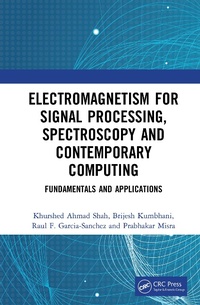
Electromagnetism for Signal Processing, Spectroscopy and Contemporary Computing
Fundamentals and Applications
1st Edition
Published on 11. October 2021
250 pages
978-1-000-45707-0 (ISBN)
Description

This comprehensive textbook will help readers to acquire a thorough understanding of the fundamentals of electromagnetism and its applications in various areas including spectroscopy, signal processing and contemporary computation.
The text introduces the principles and applications of electricity, magnetism, and electromagnetic theory, which serve as foundations for communication systems, spectroscopy, and modern computing. It is followed by a discussion of the digital systems and their importance in computing, differences between digital signal transmission and wireless media, visualization techniques and useful simulation and computational techniques, together with advances in quantum computing.
Aimed at senior undergraduate and graduate students in the fields of physics, electrical engineering, electronics and communication engineering, this textbook:
Provides fundamentals of electromagnetism and its applications in a single volume.
Discusses digital signal processing and wireless communication in depth.
Covers advanced applications of electromagnetism in communication, spectroscopy, and computing.
Discusses computer modeling & simulation, artificial intelligence, and quantum computing.
The text introduces the principles and applications of electricity, magnetism, and electromagnetic theory, which serve as foundations for communication systems, spectroscopy, and modern computing. It is followed by a discussion of the digital systems and their importance in computing, differences between digital signal transmission and wireless media, visualization techniques and useful simulation and computational techniques, together with advances in quantum computing.
Aimed at senior undergraduate and graduate students in the fields of physics, electrical engineering, electronics and communication engineering, this textbook:
Provides fundamentals of electromagnetism and its applications in a single volume.
Discusses digital signal processing and wireless communication in depth.
Covers advanced applications of electromagnetism in communication, spectroscopy, and computing.
Discusses computer modeling & simulation, artificial intelligence, and quantum computing.
More details
Edition
1. Auflage
Language
English
Place of publication
London
United Kingdom
Publishing group
Taylor & Francis Ltd
Target group
College/higher education
Illustrations
15 Tables, black and white; 96 Line drawings, black and white; 14 Halftones, black and white; 110 Illustrations, black and white
ISBN-13
978-1-000-45707-0 (9781000457070)
Copyright in bibliographic data and cover images is held by Nielsen Book Services Limited or by the publishers or by their respective licensors: all rights reserved.
Schweitzer Classification
Other editions
Additional editions
Khurshed Ahmad Shah | Brijesh Kumbhani | Raul F. Garcia-Sanchez
Electromagnetism for Signal Processing, Spectroscopy and Contemporary Computing
Fundamentals and Applications
Book
10/2024
1st Edition
CRC Press
€71.40
Shipment within 10-20 days
Khurshed Ahmad Shah | Brijesh Kumbhani | Raul F. Garcia-Sanchez
Electromagnetism for Signal Processing, Spectroscopy and Contemporary Computing
Fundamentals and Applications
Book
10/2021
1st Edition
CRC Press
€171.00
Shipment within 15-20 days
Persons
Dr. Khurshed Ahmad Shah is currently working as Assistant Professor, Department of Nanotechnology, University of Kashmir Srinagar, Jammu and Kashmir, India. He did his doctorate in physics from Jamia Millia Islamia, Central University, New Delhi, India, and Master of Science and Master of Philosophy through University of Kashmir, Srinagar, India. Till date He has published fourty five research papers in national and international refereed journals/conference proceedings including publications in IEEE, Elsevier, Wiley, IOP and Springer Journals and communicated ten research articles to different refereed journals. Dr. Shah has co-authored four books including book entitled Nanotechnology: The Science of Small with M/S John Wiley and Sons/Wiley, India and another book entitled Nanoscale Electronics Devices and Their Applications with CRC Press, 6000 Broken Sound Parkway NW, Suite 300, Boca Raton, United States. Besides, He has presented his research work in many national and international conferences and guided research scholars. He has broad research interests in the areas of synthesis and characterization of 0D, 1D, and 2D materials and their applications, modeling and simulation of nanoscale electronic devices, sensors and water purification. Heis an editorial board member and reviewer of many scientific journals and member of many scientific and academic associations including American Physical Society (USA), Institute of Physics (London United Kingdom), Materials Research Society (India), Semiconductor Society (India), IEEE (United States), and International Association of Advanced Materials (Sweden).
Dr. Shah has successfully handled three major research projects as Principal Investigator funded by national level funding agencies. He has received many awards andmain awards include Indian National Science Academy (INSA) Visiting Scientist Fellowship (2019), State Innovative Science Teacher Award-2013, Jawaharlal Memorial Fellowship for Doctorial Studies-2006 and topped at the national level, Young Scientist Fellowship-2010, and three (03) Jawaharlal Nehru Center for Advanced Scientific Research, Bangalore, India, Visiting Scientist Fellowships.
Dr. Brijesh Kumbhani received the PhD degree from the Department of Electronics and Electrical Engineering (EEE), Indian Institute of Technology Guwahati in 2015. He completed his BE degree in Electronics and Communication Engineering (ECE) from Dharmsinh Desai University (DDU), Nadiad, India, in 2010. Since June 2016, he is working as an Assistant Professor at Indian Institute of Technology Ropar. He has worked as an Assistant Professor at Indian Institute of Information Technology Kota (July 2015 - June 2016). He is recipient ofIETE S. K. Mitra Memorial Award. His research interests are in the areas of MIMO wireless communication, cloud radio access networks (CRAN) and UWB communication systems. He has delivered talks on recent advances in wireless communications at various national level workshops and symposia. He is a senior member of IEEE, USA and overseas member of IEICE, Japan.
Dr. Raul Garcia-Sanchez is currently a Media Specialist in the Department of Physics & Astronomy at Howard University in Washington, DC, USA. Earlier, he has been a Lecturer of Physics (2016-20) at Howard University. He obtained his Ph.D. in Physics from Howard University in 2016. He also has a B.S. in Computer Science and Mathematics minor. His research interests include Laser Spectroscopy and Computer Modeling of Nanomaterials and the effects of experimental conditions, such as temperature, humidity, toxic gas exposure, on the Raman Spectroscopy of Metal Oxide Gas Sensors. His computer programming skills have enabled him to also work in the area of Artificial Intelligence and Machine Learning, especially as it relates to modeling and simulation related to large databases. His background makes him particularly suitable for interdisciplinary research of all types that combine physics with computer science, chemistry, mathematics and even social sciences.
Dr. Prabhakar Misra is currently a Professor of Physics and Director of the Laser Spectroscopy Laboratory in the Department of Physics & Astronomy at Howard University in Washington, DC, USA. He earned a Ph.D. in Physics (1986) from The Ohio State University, Columbus, OH, and an M.S. in Physics (1981) from Carnegie Mellon University, Pittsburgh, PA. Earlier, in India, he had studied at the University of Calcutta, receiving his B.Sc. degree (Honors in Physics, 1975) and M.Sc. degree (Physics, 1978). His research expertise encompasses Experimental Atomic & Molecular Physics and Condensed Matter Physics, especially the twin areas of Raman spectroscopy of nanomaterials and laser spectroscopy of free radicals. Dr. Misra serves as Advisor to the Society of Physics Students (SPS) Chapter at Howard University and has advised and mentored more than 35 undergraduate students, 13 Ph.D. graduate students and 7 postdoctoral research associates, who have been part of his research group in the Laser Spectroscopy Laboratory. Prof. Misra has edited 3 books and is the author/coauthor of more than 215 research abstracts, conference proceedings and refereed journal publications. He is a visiting scientist at the NASA Goddard Space Flight Center in Greenbelt, Maryland, USA (2010-present), and a research affiliate at START, a Department of Homeland Security (DHS) Center of Excellence at the University of Maryland, College Park, MD, USA (2014-present). He is a past recipient of the NASA Administrator's Fellowship award (1999-2001) and the Fulbright Scholar Award (2004-05) and was elected a Fellow of The American Physical Society (APS) in 2015. The citation of Dr. Misra's APS Fellowship Certificate presented in 2015 by the Division of Condensed Matter Physics reads "For sustained contributions to the spectroscopy of the condensed phases and commitment and exemplary mentoring of underrepresented students." He is a recipient of the 2018 NASA Robert H. Goddard Team Award for Exceptional Achievement for Science. The NASA citation certificate given on May 16, 2019, reads "For exceptional applications of space environmental science to exploration endeavors."
Dr. Shah has successfully handled three major research projects as Principal Investigator funded by national level funding agencies. He has received many awards andmain awards include Indian National Science Academy (INSA) Visiting Scientist Fellowship (2019), State Innovative Science Teacher Award-2013, Jawaharlal Memorial Fellowship for Doctorial Studies-2006 and topped at the national level, Young Scientist Fellowship-2010, and three (03) Jawaharlal Nehru Center for Advanced Scientific Research, Bangalore, India, Visiting Scientist Fellowships.
Dr. Brijesh Kumbhani received the PhD degree from the Department of Electronics and Electrical Engineering (EEE), Indian Institute of Technology Guwahati in 2015. He completed his BE degree in Electronics and Communication Engineering (ECE) from Dharmsinh Desai University (DDU), Nadiad, India, in 2010. Since June 2016, he is working as an Assistant Professor at Indian Institute of Technology Ropar. He has worked as an Assistant Professor at Indian Institute of Information Technology Kota (July 2015 - June 2016). He is recipient ofIETE S. K. Mitra Memorial Award. His research interests are in the areas of MIMO wireless communication, cloud radio access networks (CRAN) and UWB communication systems. He has delivered talks on recent advances in wireless communications at various national level workshops and symposia. He is a senior member of IEEE, USA and overseas member of IEICE, Japan.
Dr. Raul Garcia-Sanchez is currently a Media Specialist in the Department of Physics & Astronomy at Howard University in Washington, DC, USA. Earlier, he has been a Lecturer of Physics (2016-20) at Howard University. He obtained his Ph.D. in Physics from Howard University in 2016. He also has a B.S. in Computer Science and Mathematics minor. His research interests include Laser Spectroscopy and Computer Modeling of Nanomaterials and the effects of experimental conditions, such as temperature, humidity, toxic gas exposure, on the Raman Spectroscopy of Metal Oxide Gas Sensors. His computer programming skills have enabled him to also work in the area of Artificial Intelligence and Machine Learning, especially as it relates to modeling and simulation related to large databases. His background makes him particularly suitable for interdisciplinary research of all types that combine physics with computer science, chemistry, mathematics and even social sciences.
Dr. Prabhakar Misra is currently a Professor of Physics and Director of the Laser Spectroscopy Laboratory in the Department of Physics & Astronomy at Howard University in Washington, DC, USA. He earned a Ph.D. in Physics (1986) from The Ohio State University, Columbus, OH, and an M.S. in Physics (1981) from Carnegie Mellon University, Pittsburgh, PA. Earlier, in India, he had studied at the University of Calcutta, receiving his B.Sc. degree (Honors in Physics, 1975) and M.Sc. degree (Physics, 1978). His research expertise encompasses Experimental Atomic & Molecular Physics and Condensed Matter Physics, especially the twin areas of Raman spectroscopy of nanomaterials and laser spectroscopy of free radicals. Dr. Misra serves as Advisor to the Society of Physics Students (SPS) Chapter at Howard University and has advised and mentored more than 35 undergraduate students, 13 Ph.D. graduate students and 7 postdoctoral research associates, who have been part of his research group in the Laser Spectroscopy Laboratory. Prof. Misra has edited 3 books and is the author/coauthor of more than 215 research abstracts, conference proceedings and refereed journal publications. He is a visiting scientist at the NASA Goddard Space Flight Center in Greenbelt, Maryland, USA (2010-present), and a research affiliate at START, a Department of Homeland Security (DHS) Center of Excellence at the University of Maryland, College Park, MD, USA (2014-present). He is a past recipient of the NASA Administrator's Fellowship award (1999-2001) and the Fulbright Scholar Award (2004-05) and was elected a Fellow of The American Physical Society (APS) in 2015. The citation of Dr. Misra's APS Fellowship Certificate presented in 2015 by the Division of Condensed Matter Physics reads "For sustained contributions to the spectroscopy of the condensed phases and commitment and exemplary mentoring of underrepresented students." He is a recipient of the 2018 NASA Robert H. Goddard Team Award for Exceptional Achievement for Science. The NASA citation certificate given on May 16, 2019, reads "For exceptional applications of space environmental science to exploration endeavors."
Content
1. Fundamentals of Electromagnetism. 2. Electromagnetic Theory. 3. Analog Communication Systems. 4. Sampling and Analog to Digital Conversion. 5. Digital Communication Systems. 6. Electromagnetism and Spectroscopy. 7. Computer Modelling & Simulation, Artificial Intelligence and Quantum Computing. 8. Appendix A.1: Fourier transform. 9. Appendix A.2: Orthogonal and orthonormal signals.
