

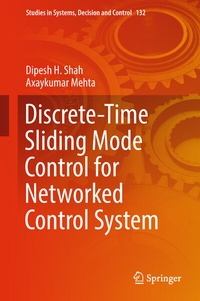
Discrete-Time Sliding Mode Control for Networked Control System
Description

This book presents novel algorithms for designing Discrete-Time Sliding Mode Controllers (DSMCs) for Networked Control Systems (NCSs) with both types of fractional delays namely deterministic delay and random delay along with different packet loss conditions such as single packet loss and multiple packet loss that occur within the sampling period. Firstly, the switching type and non-switching type algorithms developed for the deterministic type fractional delay where the delay is compensated using Thiran's approximation technique. A modified discrete-time sliding surface is proposed to derive the discrete-time sliding mode control algorithms. The algorithm is further extended for the random fractional delay with single packet loss and multiple packet loss situations. The random fractional delay is modelled using Poisson's distribution function and packet loss is modelled by means of Bernoulli's function. The condition for closed loop stability in all above situations are derived using the Lyapunov function. Lastly, the efficacy of the proposed DSMC algorithms are demonstrated by extensive simulations and also experimentally validated on a servo system.
More details
Other editions
Additional editions
Persons
Axaykumar Mehta , born in Bharuch, Gujarat, India in 1975, completed his B.E. Electrical (1996), M.Tech. (2002) and Ph.D. (2009) degrees from Gujarat University, Ahmedabad, IIT Kharagpur and IIT Bombay, respectively. He worked at various faculty positions at various colleges of Gujarat state for teaching under graduate and post graduate courses during 1996 to 2011. He acted as a Professor and Director of the Gujarat Power Engineering and Research Institute, Mehsana, Gujarat, India from 2012 to 2014. Currently, he is an Associate Professor at the Institute of Infrastructure Technology Research and Management, Ahmedabad, Gujarat. He was also associated as an Associate Faculty at the Indian Institute of Technology, Gandhinagar from 2010 to 2011. He is also recipient of Research Grant on 'Control and Diagnosis of Multi-agent Systems' from University of Cagliari, Italy 2015-16. His major research interests are Non-linear Sliding Mode Control and Observers, Sliding Mode Control Applications in Electrical Engineering, and Networked Control Systems. He has published 50 research papers in peer-reviewed international journals and conferences of repute. He is also author for 2 monographs and have published 2 patents with Indian patent office. He is a Senior Member of the IEEE, Life Member of the Institution of Engineers (India), and Life Member of the Indian Society for Technical Education and Member of Systems Society of India (SSI). He was conferred the 2014 Best Paper Award by Gujarat Technological University, Ahmedabad.
Dipesh H. Shah received his B.E. and M.E. in Instrumentation and Control from Gujarat University, Ahmedabad in 2007 and 2010, respectively. He has published 10 research papers in international journals and presented several papers at national and international conferences. He is currently pursuing his Ph.D. on Networked Control Systems at Gujarat Technological University, Ahmedabad and working as an Assistant Professorat the Instrumentation and Control Department of Sardar Vallabhbhai Patel Institute of Technology, Vasad, Gujarat.
