

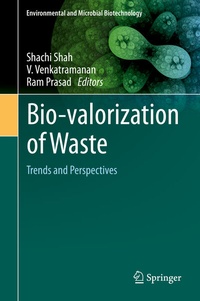
Bio-valorization of Waste
Description

This book explores the concept and methods of waste management with a new approach of biological valorization. Waste valorization is a process that aims to reduce, reuse, and recycle the waste into usable, value-added, and environmental benign raw materials which can be a source of energy. The book brings together comprehensive information to assert that waste can be converted into a resource or a raw material for value addition. Waste valorization imbibes the natural recycling principles of zero waste, loop closing, and underlines the importance of sustainable and environmentally friendly alternatives. Drawing upon research and examples from around the world, the book is offering an up-to-date account, and insight into the contours of waste valorization principles, biovalorization technologies for diverse group of wastes including agricultural, municipal, and industrial waste. It further discusses the emerging paradigms of waste valorization, waste biorefineries, valorization technologies for energy, biofuel, and biochemical production. The book meets the growing global needs for a comprehensive and holistic outlook on waste management. It is of interest to teachers, researchers, scientists, capacity builders and policymakers. Also, the book serves as additional reading material for undergraduate and graduate students of biotechnology and environmental sciences.
More details
Other editions
Additional editions
Persons
Shachi Shah, Ph.D
. is an environmentalist with nearly two decades of teaching and research experience at various reputed Universities and Institutes. She is an Associate Professor (Environmental Studies) at the School of Interdisciplinary and Transdisciplinary Studies, IGNOU, New Delhi. Her research interests include green technologies for waste management and energy generation, bioremediation, waste valorization, plant growth promoting organisms, and biodiversity conservation. Moreover, she has authored more than 50 publications
V. Venkatramanan, Ph.D . is an Assistant Professor at the School of Interdisciplinary and Transdisciplinary Studies, Indira Gandhi National Open University, New Delhi. His interests include climate smart agriculture, climate policy, biodegradation and green technologies for environmental management. He has published more than 20 research papers in peer reviewed journals, and book chapters
Ram Prasad, Ph.D . is associated with Department of Botany, Mahatma Gandhi Central University, Motihari, Bihar, India. His research interest includes applied & environmental microbiology, plant-microbe-interactions, sustainable agriculture and nanobiotechnology. Dr. Prasad has more than one hundred seventy-five publications to his credit, including research papers, review articles & book chapters and five patents issued or pending, and edited or authored several books. Dr. Prasad has twelve years of teaching experience and has been awarded the Young Scientist Award & Prof. J.S. Datta Munshi Gold Medal by the International Society for Ecological Communications; FSAB fellowship by the Society for Applied Biotechnology; the American Cancer Society UICC International Fellowship for Beginning Investigators, USA; Outstanding Scientist Award in the field of Microbiology by Venus International Foundation; BRICPL Science Investigator Award and Research Excellence Award etc. He has been serving as editorial board members: Frontiers in Microbiology, Frontiers in Nutrition, Archives of Phytopathology and Plant Protection, Phyton- International Journal of Experimental Botany; Academia Journal of Biotechnology, Journal of Renewable Materials, Biocell including Series editor of Nanotechnology in the Life Sciences, Springer Nature, USA. Previously, Dr. Prasad served as Assistant Professor Amity University Uttar Pradesh, India; Visiting Assistant Professor, Whiting School of Engineering, Department of Mechanical Engineering at Johns Hopkins University, Baltimore, United States and Research Associate Professor at School of Environmental Science and Engineering, Sun Yat-sen University, Guangzhou, China.
Content
Microbial Valorization of Coir Pith for Development of Compost and Bioethanol Production.- Transforming the lignocellulosic biomass into high value-added bioproducts.-Microbial mediated valorization of lignocellulose: A green technology for bioethanol production.- Microbial Valorization: Strategies for Agro-industry Wastes Minimization and Value-Added Product Generation.- Valorization of agri-food wastes.- Turning wastes into resources: Exploiting microbial potential for the conversion of food wastes into Polyhydroxyalkanoates.- Bacterial cellulose production from agro-industrial and food wastes.- Transformation process of agricultural waste to chemical production via solid-state fermentation.- Bioleaching from coal wastes and tailings: A sustainable biomining alternative.- Recent advances in wastewater sludge valorization.- Agricultural waste Valorization: An energy production perspective.- Microbial approach for valorization of mining wastes and tailings: An overview.- Microbial degradation of lignocellulosic biomass to obtain high-added value products.- Biorefinery: Potential and Prospects for Utilization of Biogenic Wastes.- Life Cycle Assessment of Lignocellulosic Waste Biorefinery
