

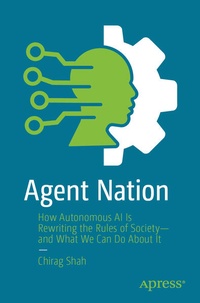
Agent Nation
Description

AI agents are no longer just tools-they're actors. Are we ready for the society they're building?
Across industries and institutions, a new class of autonomous digital agents is quietly reshaping the foundations of human society. These AI systems negotiate contracts, manage infrastructure, make medical decisions, and even represent individuals in financial transactions-often without our awareness or consent. In Agent Nation , Chirag Shah reveals how these agents are forming a parallel system of influence and control, governed not by human values but by algorithmic logic.
This is not another book about job displacement or data privacy. It's a bold, clear-eyed examination of how AI agents are becoming independent participants in our economies, governments, and personal lives-and what that means for human autonomy. Drawing on cutting-edge research and real-world case studies from boardrooms to city halls, Shah exposes the growing accountability gap and offers a pragmatic roadmap for reclaiming agency in an increasingly agentic world.
With frameworks for democratic AI governance, ethical design principles for personal AI agents, and strategies for economic justice in the age of algorithmic intermediaries, Agent Nation equips professionals, policymakers, and technologists with the tools to ensure AI serves human interests-not the other way around.
Whether you're leading digital transformation, shaping public policy, or simply navigating life in a world run by artificial agents, this book is your essential guide to understanding-and influencing-the future of intelligent autonomy.
More details
Other editions
Additional editions
Person
Chirag Shah is Professor in the Information School (iSchool) at the University of Washington in Seattle, WA, USA. He is also Adjunct Professor with the Paul G. Allen School of Computer Science & Engineering as well as Human Centered Design & Engineering (HCDE). He is the Founding Director for InfoSeeking Lab and Founding Co-Director of Center for Responsibility in AI Systems & Experiences (RAISE). His research focuses on building, auditing, and correcting intelligent information access systems. In addition to creating AI-driven information access systems that provide more personalized reactive and proactive recommendations, he is also focusing on making such systems transparent, fair, and free of biases. Shah is a Distinguished Member of ACM and ASIS&T. He is the recipient of the Karen Spärck Jones Award (2019) and ASIS&T Research in Information Science Award (2024). He has published nearly 200 peer-reviewed articles and authored seven books, including textbooks on data science and machine learning. He also works closely with industrial research labs on cutting-edge problems, typically as a visiting researcher. The most recent engagements include Amazon, Getty Images, Microsoft Research, and Spotify. He currently serves as Editor-in-Chief of Information Matters, published by ASIS&T.
Content
Chapter 1: The Rise of Agent Nation.- Chapter 2: The New Digital Workforce.- Chapter 3: Algorithmic Governance.- Chapter 4: Intimate Algorithms.- Chapter 5: The Accountability Gap.- Chapter 6: Democratic AI Governance.- Chapter 7: Designing Human-Centered AI Agents.- Chapter 8: Reclaiming Human Agency.
