

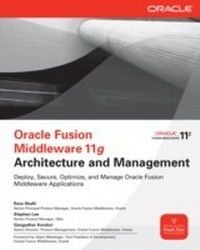
Oracle Fusion Middleware 11g Architecture and Management
1st Edition
Published on 6. June 2011
455 pages
978-0-07-175418-7 (ISBN)
Available for download
Description

Master All Aspects of Oracle Fusion Middleware Management Govern a unified platform for agile, intelligent business applications using the detailed information contained in this Oracle Press book. Oracle Fusion Middleware 11g Architecture and Management explains the entire suite of Oracle Fusion Middleware components and lays out core use cases, best practices, and step-by-step administrative instructions. Discover how to provision servers and clusters, configure Web services, manage portals, and optimize the performance of the full stack of Oracle Fusion Middleware components. Monitoring, diagnosing, and security are also covered in this definitive resource. Understand key architectural concepts behind Oracle Fusion Middleware 11g Create and deploy Oracle WebLogic Server domains and clusters Set up and manage applications built using Oracle Application Development Framework Maximize the value of your Oracle SOA Suite environments Manage portals and Enterprise 2.0 services from Oracle WebCenter Secure deployments with Oracle Platform Security Services and Oracle Identity Management Understand Oracle Exalogic and Oracle Virtual Assembly Builder
More details
Other editions
Additional editions
Reza Shafii | Stephen Lee | Gangadhar Konduri
Oracle Fusion Middleware 11g Architecture and Management
Book
07/2011
Osborne/McGraw-Hill
€58.00
Article not available at the moment
Content
- Cover Page
- Oracle Fusion Middleware 11g Architecture and Management
- Copyright Page
- Dedication
- About the Authors
- Contents at a Glance
- Contents
- FOREWORD
- ACKNOWLEDGMENTS
- INTRODUCTION
- PART I Oracle Fusion Middleware Architecture and Management
- 1 Fusion Middleware Primer
- Enterprise Applications and Middleware
- Oracle Fusion Middleware Products
- Integrated Development Environments and Frameworks
- Application Grid
- Identity Management
- Service-Oriented Architecture
- User Experience
- Content Management, Data Integration, and Business Intelligence
- Conclusion
- 2 Oracle WebLogic Server
- Introducing Oracle WebLogic Server
- Servers, Clusters, and Domains
- Installation and Domain Artifacts
- Server Startup and Node Manager
- Application Containers and Deployment
- Application Containers
- Application Deployment
- Shared Libraries
- Deployment Modes
- Deployment Plans
- Management Capabilities
- Domain Creation and Templates
- WebLogic Java Management Extensions MBeans Servers
- WebLogic Server Scripting Tool
- Authentication and Authorization Services
- Embedded LDAP
- Security Providers
- Users, Groups, Roles, and Authorization Policies
- JDBC Services
- Real Application Clusters Integration
- JMS Services
- JMS Servers
- JMS Modules
- WebLogic Server Request Management
- Connection and Port Management
- Work Managers
- Chapter Use Case
- Use Case Description
- Understanding the Application and Its Environment
- Designing the Evaluation Environment
- Conclusion
- 3 Fusion Middleware Common Infrastructure
- Introduction to Fusion Middleware Common Infrastructure
- System Components, Instances, and Farms
- Oracle Process Manager and Notification
- Installation and Configuration Artifacts
- Enterprise Manager Fusion Middleware Control
- Enterprise Manager Core Functionality and Architecture
- Metadata Repository Services
- Metadata Management
- Deployment Model
- Runtime Architecture
- Oracle Web Services Manager
- Policy Management
- Runtime Architecture
- Chapter Use Case
- Use Case Description
- Creating the Extended Application Domain
- Fronting the Application with Oracle HTTP Server
- Securing the Application Web Service with Oracle Web Services Manager
- Conclusion
- 4 Oracle Fusion Middleware Platform Security Services and Identity Management 127
- Introduction to Oracle Platform Security Services
- Architecture Overview
- Identities, Identity Store, and Authentication Providers
- Policies and the Policy Store
- Credentials and the Credential Store
- User & Role API
- Audit Framework
- Oracle Security Developer Tools
- OPSS Policy Model and Authorization Policy Manager
- Introduction to Oracle Identity Management
- Oracle Internet Directory
- Oracle Directory Server Enterprise Edition
- Oracle Virtual Directory
- Oracle Access Manager
- Oracle Identity Federation
- Oracle Enterprise Single Sign-On
- Oracle Adaptive Access Manager
- Oracle Entitlements Server
- Oracle Identity Manager
- Oracle Identity Analytics
- Chapter Use Case
- Configuring the Identity Store
- Using the User & Role API
- Configure Single Sign-On with Oracle Access Manager
- Managing Credential Store
- Configuring Component Audit
- Conclusion
- 5 Oracle Service-Oriented Architecture Suite
- Introducing Oracle SOA Suite
- The Case for a SOA Platform
- SOA Suite Components
- SOA Infrastructure
- Composite Container
- Service Component Architecture (SCA) Primer
- Composite Life Cycle
- Deploying Composites
- Composite Services and References
- Composite Management
- Oracle Business Activity Monitoring
- Oracle BAM Components and Architecture
- Oracle BAM Management
- User Messaging Service
- Chapter Use Case
- Use Case Description
- Provisioning the Appropriate Users, Groups, and Roles
- Provisioning the SOA Composite
- Configuring Oracle BAM
- Conclusion
- 6 Oracle Application Development Framework
- Introducing ADF
- Architecture
- View Layer
- Controller Layer
- ADF Binding Layer
- ADF Business Components
- ADF Metadata and Customizations
- Administering ADF Applications
- Deploying ADF Applications
- Configuring ADF Applications
- Upgrading Applications and Best Practices
- Chapter Use Case
- Use Case Description
- Conclusion
- 7 Oracle WebCenter
- Introducing Oracle WebCenter
- WebCenter Installation
- WebCenter Composer
- WebCenter Composer Management
- WebCenter Enterprise 2.0 Services
- Administering Enterprise 2.0 Services
- Test-to-Production Migration of Enterprise 2.0 Services
- WebCenter Portal Technology
- Administering Portlet Producer Connections
- Portlet Customization and Personalization
- Test-to-Production Migration of Portal Applications
- WebCenter Portal Metadata
- Advanced Features
- WebCenter Spaces
- Administering Oracle WebCenter Spaces
- Chapter Use Case
- Use Case Description
- Conclusion
- PART II Deploying and Managing Enterprise Applications on Fusion Middleware
- 8 Deploying Fusion Middleware Enterprise Applications
- Review of the Pricing Application
- Creating the Single-Node Topology
- Overall Flow of Events for the Creation of the Environment
- Installing the Fusion Middleware Software
- Configuring the Initial Environment
- Extending a Cluster for Scalability
- Extending the WebLogic Server Pricing Cluster
- Configuring the Clients
- Conclusion
- 9 Securing Fusion Middleware Enterprise Applications
- Securing the Pricing Application
- Overall Flow of Events for Securing the Deployment
- Securing Physical Host
- Securing Communication with SSL
- Keystore and Wallet Management
- Configuring SSL for the Web Tier
- Configuring SSL for Oracle Platform Security Services with Oracle Internet Directory
- Other SSL Considerations
- Securing Oracle Platform Security Services Access to Oracle Internet Directory
- Configuring Single Sign-On
- Installing WebGate
- Creating and Registering a WebGate Instance
- Securing Web Services
- Configuring Audit
- Installing the Audit Schema
- Configuring the Audit Repository
- Configuring the Audit Policy
- Setting Up Business Intelligence Publisher
- Conclusion
- 10 Optimizing Fusion Middleware Enterprise Applications
- Performance Optimization
- Structure of Remaining Sections
- Optimizing the Java Virtual Machine and WebLogic Server
- The Java Virtual Machine
- WebLogic Server
- Optimizing the Pricing Application's Java Virtual Machine and WebLogic Server Configurations
- Optimizing the Fusion Middleware Shared Infrastructure
- Oracle Web Services Manager
- Metadata Repository Services
- Optimizing the Layered Fusion Middleware Components
- SOA Suite
- Application Development Framework
- WebCenter
- Conclusion
- 11 Monitoring and Diagnosing Fusion Middleware Enterprise Applications
- Understanding Fusion Middleware Logging
- WebLogic Server Logging Infrastructure
- Oracle Diagnostics Logging
- Using the WebLogic Diagnostics Framework
- Diagnostics Images
- Diagnostics Modules
- Administration Console Monitoring
- Configuring and Using Node Manager
- Configuring Node Manager within the Pricing Application Environment
- Conclusion
- 12 Virtualizing Fusion Middleware Enterprise Applications
- Oracle Virtual Machine
- Pricing Application on Oracle Virtual Machine
- JRockit and WebLogic Server Virtual Edition
- JRockit Virtual Edition
- WebLogic Server Virtual Edition
- Pricing Application on JRockit VE
- Oracle Virtual Assembly Builder
- Oracle Exalogic
- Exalogic Hardware
- Exalogic Software
- Exalogic Virtualization Platform
- Conclusion
- Index

