

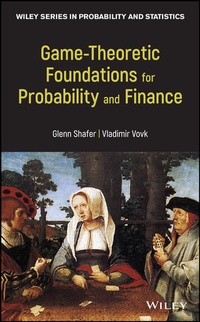
Game-Theoretic Foundations for Probability and Finance
Description

Game-theoretic probability and finance come of age
Glenn Shafer and Vladimir Vovk's Probability and Finance, published in 2001, showed that perfect-information games can be used to define mathematical probability. Based on fifteen years of further research, Game-Theoretic Foundations for Probability and Finance presents a mature view of the foundational role game theory can play. Its account of probability theory opens the way to new methods of prediction and testing and makes many statistical methods more transparent and widely usable. Its contributions to finance theory include purely game-theoretic accounts of Ito's stochastic calculus, the capital asset pricing model, the equity premium, and portfolio theory.
Game-Theoretic Foundations for Probability and Finance is a book of research. It is also a teaching resource. Each chapter is supplemented with carefully designed exercises and notes relating the new theory to its historical context.
Praise from early readers
"Ever since Kolmogorov's Grundbegriffe, the standard mathematical treatment of probability theory has been measure-theoretic. In this ground-breaking work, Shafer and Vovk give a game-theoretic foundation instead. While being just as rigorous, the game-theoretic approach allows for vast and useful generalizations of classical measure-theoretic results, while also giving rise to new, radical ideas for prediction, statistics and mathematical finance without stochastic assumptions. The authors set out their theory in great detail, resulting in what is definitely one of the most important books on the foundations of probability to have appeared in the last few decades." - Peter Grünwald, CWI and University of Leiden
"Shafer and Vovk have thoroughly re-written their 2001 book on the game-theoretic foundations for probability and for finance. They have included an account of the tremendous growth that has occurred since, in the game-theoretic and pathwise approaches to stochastic analysis and in their applications to continuous-time finance. This new book will undoubtedly spur a better understanding of the foundations of these very important fields, and we should all be grateful to its authors." - Ioannis Karatzas, Columbia University
More details
Other editions
Additional editions
Persons
Glenn Shafer is University Professor at Rutgers University.
Vladimir Vovk is Professor in the Department of Computer Science at Royal Holloway, University of London.
Shafer and Vovk are the authors of Probability and Finance: It's Only a Game, published by Wiley and co-authors of Algorithmic Learning in a Random World. Shafer's other previous books include A Mathematical Theory of Evidence and The Art of Causal Conjecture.
Content
Preface xi
Acknowledgments xv
Part I Examples in Discrete Time 1
1 Borel's Law of Large Numbers 5
1.1 A Protocol for Testing Forecasts 6
1.2 A Game-Theoretic Generalization of Borel's Theorem 8
1.3 Binary Outcomes 16
1.4 Slackenings and Supermartingales 18
1.5 Calibration 19
1.6 The Computation of Strategies 21
1.7 Exercises 21
1.8 Context 24
2 Bernoulli's and De Moivre's Theorems 31
2.1 Game-Theoretic Expected Value and Probability 33
2.2 Bernoulli's Theorem for Bounded Forecasting 37
2.3 A Central Limit Theorem 39
2.4 Global Upper Expected Values for Bounded Forecasting 45
2.5 Exercises 46
2.6 Context 49
3 Some Basic Supermartingales 55
3.1 Kolmogorov's Martingale 56
3.2 Doléans's Supermartingale 56
3.3 Hoeffding's Supermartingale 58
3.4 Bernstein's Supermartingale 63
3.5 Exercises 66
3.6 Context 67
4 Kolmogorov's Law of Large Numbers 69
4.1 Stating Kolmogorov's Law 70
4.2 Supermartingale Convergence Theorem 73
4.3 How Skeptic Forces Convergence 80
4.4 How Reality Forces Divergence 81
4.5 Forcing Games 82
4.6 Exercises 86
4.7 Context 89
5 The Law of the Iterated Logarithm 93
5.1 Validity of the Iterated-Logarithm Bound 94
5.2 Sharpness of the Iterated-Logarithm Bound 99
5.3 Additional Recent Game-Theoretic Results 100
5.4 Connections with Large Deviation Inequalities 104
5.5 Exercises 104
5.6 Context 106
Part II Abstract Theory in Discrete Time 109
6 Betting on a Single Outcome 111
6.1 Upper and Lower Expectations 113
6.2 Upper and Lower Probabilities 115
6.3 Upper Expectations with Smaller Domains 118
6.4 Offers 121
6.5 Dropping the Continuity Axiom 125
6.6 Exercises 127
6.7 Context 131
7 Abstract Testing Protocols 135
7.1 Terminology and Notation 136
7.2 Supermartingales 136
7.3 Global Upper Expected Values 142
7.4 Lindeberg's Central Limit Theorem for Martingales 145
7.5 General Abstract Testing Protocols 146
7.6 Making the Results of Part I Abstract 151
7.7 Exercises 153
7.8 Context 155
8 Zero-One Laws 157
8.1 Lévy's Zero-One Law 158
8.2 Global Upper Expectation 160
8.3 Global Upper and Lower Probabilities 162
8.4 Global Expected Values and Probabilities 163
8.5 Other Zero-One Laws 165
8.6 Exercises 169
8.7 Context 170
9 Relation to Measure-Theoretic Probability 175
9.1 Ville's Theorem 176
9.2 Measure-Theoretic Representation of Upper Expectations 180
9.3 Embedding Game-Theoretic Martingales in Probability Spaces 189
9.4 Exercises 191
9.5 Context 192
Part III Applications in Discrete Time 195
10 Using Testing Protocols in Science and Technology 197
10.1 Signals in Open Protocols 198
10.2 Cournot's Principle 201
10.3 Daltonism 202
10.4 Least Squares 207
10.5 Parametric Statistics with Signals 212
10.6 Quantum Mechanics 215
10.7 Jeffreys's Law 217
10.8 Exercises 225
10.9 Context 226
11 Calibrating Lookbacks and p-Values 229
11.1 Lookback Calibrators 230
11.2 Lookback Protocols 235
11.3 Lookback Compromises 241
11.4 Lookbacks in Financial Markets 242
11.5 Calibrating p-Values 245
11.6 Exercises 248
11.7 Context 250
12 Defensive Forecasting 253
12.1 Defeating Strategies for Skeptic 255
12.2 Calibrated Forecasts 259
12.3 Proving the Calibration Theorems 264
12.4 Using Calibrated Forecasts for Decision Making 270
12.5 Proving the Decision Theorems 274
12.6 From Theory to Algorithm 286
12.7 Discontinuous Strategies for Skeptic 291
12.8 Exercises 295
12.9 Context 299
Part IV Game-Theoretic Finance 305
13 Emergence of Randomness in Idealized Financial Markets 309
13.1 Capital Processes and Instant Enforcement 310
13.2 Emergence of Brownian Randomness 312
13.3 Emergence of Brownian Expectation 320
13.4 Applications of Dubins-Schwarz 325
13.5 Getting Rich Quick with the Axiom of Choice 331
13.6 Exercises 333
13.7 Context 334
14 A Game-Theoretic Itô Calculus 339
14.1 Martingale Spaces 340
14.2 Conservatism of Continuous Martingales 348
14.3 Itô Integration 350
14.4 Covariation and Quadratic Variation 355
14.5 Itô's Formula 357
14.6 Doléans Exponential and Logarithm 358
14.7 Game-Theoretic Expectation and Probability 360
14.8 Game-Theoretic Dubins-Schwarz Theorem 361
14.9 Coherence 362
14.10 Exercises 363
14.11 Context 365
15 Numeraires in Market Spaces 371
15.1 Market Spaces 372
15.2 Martingale Theory in Market Spaces 375
15.3 Girsanov's Theorem 376
15.4 Exercises 382
15.5 Context 382
16 Equity Premium and CAPM 385
16.1 Three Fundamental Continuous I-Martingales 387
16.2 Equity Premium 389
16.3 Capital Asset Pricing Model 391
16.4 Theoretical Performance Deficit 395
16.5 Sharpe Ratio 396
16.6 Exercises 397
16.7 Context 398
17 Game-Theoretic Portfolio Theory 403
17.1 Stroock-Varadhan Martingales 405
17.2 Boosting Stroock-Varadhan Martingales 407
17.3 Outperforming the Market with Dubins-Schwarz 413
17.4 Jeffreys's Law in Finance 414
17.5 Exercises 415
17.6 Context 416
Terminology and Notation 419
List of Symbols 425
References 429
Index 455
Preface
Probability theory has always been closely associated with gambling. In the 1650s, Blaise Pascal and Christian Huygens based probability's concept of expectation on reasoning about gambles. Countless mathematicians since have looked to gambling for their intuition about probability. But the formal mathematics of probability has long leaned in a different direction. In his correspondence with Pascal, often cited as the origin of probability theory, Pierre Fermat favored combinatorial reasoning over Pascal's reasoning about gambles, and such combinatorial reasoning became dominant in Jacob Bernoulli's monumental Ars Conjectandi and its aftermath. In the twentieth century, the combinatorial foundation for probability evolved into a rigorous and sophisticated measure-theoretic foundation, put in durable form by Andrei Kolmogorov and Joseph Doob.
The twentieth century also saw the emergence of a mathematical theory of games, just as rigorous as measure theory, albeit less austere. In the 1930s, Jean Ville gave a game-theoretic interpretation of the key concept of probability 0. In the 1970s, Claus Peter Schnorr and Leonid Levin developed Ville's fundamental insight, introducing universal game-theoretic strategies for testing randomness. But no attempt was made in the twentieth century to use game theory as a foundation for the modern mathematics of probability.
Probability and Finance: It's Only a Game, published in 2001, started to fill this gap. It gave game-theoretic proofs of probability's most classical limit theorems (the laws of large numbers, the law of the iterated logarithm, and the central limit theorem), and it extended this game-theoretic analysis to continuous-time diffusion processes using nonstandard analysis. It applied the methods thus developed to finance, discussing how the availability of a variance swap in a securities market might allow other options to be priced without probabilistic assumptions and studying a purely game-theoretic hypothesis of market efficiency.
The present book was originally conceived of as a second edition of Probability and Finance, but as the new title suggests, it is a very different book, reflecting the healthy growth of game-theoretic probability since 2001. As in the earlier book, we show that game-theoretic and measure-theoretic probability provide equivalent descriptions of coin tossing, the archetype of probability theory, while generalizing this archetype in different directions. Now we show that the two descriptions are equivalent on a larger central core, including all discrete-time stochastic processes that have only finitely many outcomes on each round, and we present an even broader array of new ideas.
We can identify seven important new ideas that have come out of game-theoretic probability. Some of these already appeared, at least in part, in Probability and Finance, but most are developed further here or are entirely new.
- Strategies for testing. Theorems showing that certain events have small or zero probability are made constructive; they are proven by constructing gambling strategies that multiply the capital they risk by a large or infinite factor if the events happen. In Probability and Finance, we constructed such strategies for the law of large numbers and several other limit theorems. Now we add to the list the most fundamental limit theorem of probability - Lévy's zero-one law. The topic of strategies for testing remains our most prominent theme, dominating Part I and Chapters 7 and 8 in Part II.
- Limited betting opportunities. The betting rates suggested by a scientific theory or the investment opportunities in a financial market may fall short of defining a probability distribution for future developments or even for what will happen next. Sometimes a scientist or statistician tests a theory that asserts expected values for some variables but not for every function of those variables. Sometimes an investor in a market can buy a particular payoff but cannot sell it at the same price and cannot buy arbitrary options on it. Limited betting opportunities were emphasized by a number of twentieth-century authors, including Peter Williams and Peter Walley. As we explained in Probability and Finance, we can combine Williams and Walley's picture of limited betting opportunities in individual situations with Pascal and Ville's insights into strategies for combining bets across situations to obtain interesting and powerful generalizations of classical results. These include theorems that are one-sided in some sense (see Sections 2.4 and 5.1).
- Strategies for reality. Most of our theorems concern what can be accomplished by a bettor playing against an opponent who determines outcomes. Our games are determined; one of the players has a winning strategy. In Probability and Finance, we exploited this determinacy and an argument of Kolmogorov's to show that in the game for Kolmogorov's law of large numbers, the opponent has a strategy that wins when Kolmogorov's hypotheses are not satisfied. In this book we construct such a strategy explicitly and discuss other interesting strategies for the opponent (see Sections 4.4, and 4.7).
- Open protocols for science. Scientific models are usually open to influences that are not themselves predicted by the models in any way. These influences are variously represented; they may be treated as human decisions, as signals, or even as constants. Because our theorems concern what one player can accomplish regardless of how the other players move, the fact that these signals or "independent variables" can be used by the players as they appear in the course of play does not impair the theorems' validity and actually enhances their applicability to scientific problems (see Chapter 10 ).
- Insuring against loss of evidence. The bettor can modify his own strategy or adapt bets made by another bettor so as to avoid a total loss of apparently strong evidence as play proceeds further. The same methods provide a way of calibrating the p-values from classical hypothesis testing so as to correct for the failure to set an initial fixed significance level. These ideas have been developed since the publication of Probability and Finance (see Chapter 11 ).
- Defensive forecasting. In addition to the player who bets and the player who determines outcomes, our games can involve a third player who forecasts the outcomes. The problem of forecasting is the problem of devising strategies for this player, and we can tackle it in interesting ways once we learn what strategies for the bettor win when the match between forecasts and outcomes is too poor. This idea, which came to our attention only after the publication of Probability and Finance, is developed in Chapter 12.
- Continuous-time game-theoretic finance. Measure-theoretic finance assumes that prices of securities in a financial market follow some probabilistic model such as geometric Brownian motion. We obtain many insights, some already provided by measure-theoretic finance and some not, without any probabilistic model, using only the actual prices in the market. This is now much clearer than in Probability and Finance, as we use tools from standard analysis that are more familiar than the nonstandard methods we used there. We have abandoned our hypothesis concerning the effectiveness of variance swaps in stabilizing markets, now fearing that the trading of such instruments could soon make them nearly as liquid and consequently treacherous as the underlying securities. But we provide game-theoretic accounts of a wider class of financial phenomena and models, including the capital asset pricing model (), the equity premium puzzle, and portfolio theory (see Part IV).
The book has four parts.
- Part I, Examples in Discrete Time, uses concrete protocols to explain how game-theoretic probability generalizes classical discrete-time limit theorems. Most of these results were already reported in Probability and Finance in 2001, but our exposition has changed substantially. We seldom repeat word for word what we wrote in the earlier book, and we occasionally refer the reader to the earlier book for detailed arguments that are not central to our theme.
- Part II, Abstract Theory in Discrete Time, treats game-theoretic probability in an abstract way, mostly developed since 2001. It is relatively self-contained, and readers familiar with measure-theoretic probability will find it accessible without the introduction provided by Part I.
- Part III, Applications in Discrete Time, uses Part II's theory to treat important applications of game-theoretic probability, including two promising applications that have developed since 2001: calibration of lookbacks and p-values, and defensive forecasting.
- Part IV, Game-Theoretic Finance, studies continuous-time game-theoretic probability and its application to finance. It requires different definitions from the discrete-time theory and hence is also relatively self-contained. Its first chapter uses a simple concrete protocol to derive game-theoretic versions of the Dubins-Schwarz theorem and related results, while the remaining chapters use an abstract and more powerful protocol to develop a...
