

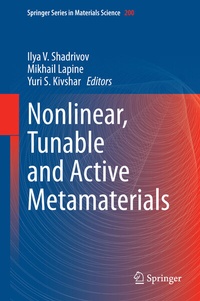
Nonlinear, Tunable and Active Metamaterials
Description

More details
Other editions
Additional editions
Persons
Ilya V. Shadrivov received his B.Sc. and M.Sc. in Radiophysics from the Nizhny Novgorod University, Nizhny Novgorod, Russia. He received the Ph.D. degree in Physics from the Australian National University, Canberra, Australia, in 2005. He is currently a Queen Elizabeth Fellow at the Nonlinear Physics Centre in the Research School of Physical Sciences and a Panel Member of the Optical Society of America 'Spotlight in Optics.
Mikhail Lapine received a Diploma (M.Sc., with honours) in biophysics from Moscow State University in 1997, and a PhD (summa cum laude) in physics from Osnabrück University in 2004. Upon working for a few years in biophysics and biochemistry at Moscow State University, Russia (1996-1999) and Osnabrück University, Germany (1999-2001), he turned to theoretical electrodynamics with a specific interest to effective medium treatment of metamaterials as well as development of nonlinear, tunable and reconfigurable metamaterials and worked on these topics at Osnabrück University (2001-2004; 2008), Helsinki University of Technology (2005-2007) and the University of Seville (2008-2010). He was also a visiting researcher at the Australian National University (2009; 2010-2011) and St.Petersburg National Research University ITMO (2011) and joined the University of Sydney in 2012. In 2007, Dr. Mikhail Lapine initiated an international journal Metamaterials (Elsevier) and since then acts as the Editor for this journal. He also serves as a reviewer for a number of journals in physics.
Yuri S. Kivshar received his Ph.D. degree in 1984 from the USSR Academy of Science and was at the Institute for Low Temperature Physics and Engineering, Kharkov, Ukraine. From 1988 to 1993, he worked at different research centres in USA, France, Spain and Germany. In 1993, he accepted an appointment at the Research School of Physical Sciences and Engineering of the Australian National University where presently he is Professor and Head of the NonlinearPhysics Center. Professor Yuri Kivshar was a recipient of Medal and Award of the Ukrainian Academy of Science, 1989, International Pnevmatikos Prize in Nonlinear Physics, 1995, Pawsey Medal and Lylde Medal, 2007, of the Australian Academy of Science, 1998 and Boas Medal of the Australian Institute of Physics, 2005. He is Fellow of Optical Society of America, American Physical Society and elected Fellow of the Australian Academy of Sciences. In 1999-2004, he served as an Associate Editor of the Physical Review E (second non-American in the APS history). Yuri Kivshar published more than 800 research papers and his interests include nonlinear guided waves, solitons, nonlinear atom optics, photonic crystals and nonlinear waves.
