

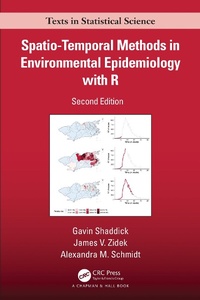
Spatio-Temporal Methods in Environmental Epidemiology with R
2nd Edition
Published on 12. December 2023
458 pages
978-1-003-80802-2 (ISBN)
Description

Spatio-Temporal Methods in Environmental Epidemiology with R, like its First Edition, explores the interface between environmental epidemiology and spatio-temporal modeling. It links recent developments in spatio-temporal theory with epidemiological applications. Drawing on real-life problems, it shows how recent advances in methodology can assess the health risks associated with environmental hazards. The book's clear guidelines enable the implementation of the methodology and estimation of risks in practice.
New additions to the Second Edition include: a thorough exploration of the underlying concepts behind knowledge discovery through data; a new chapter on extracting information from data using R and the tidyverse; additional material on methods for Bayesian computation, including the use of NIMBLE and Stan; new methods for performing spatio-temporal analysis and an updated chapter containing further topics. Throughout the book there are new examples, and the presentation of R code for examples has been extended. Along with these additions, the book now has a GitHub site (https://spacetime-environ.github.io/stepi2) that contains data, code and further worked examples.
Features:
* Explores the interface between environmental epidemiology and spatio--temporal modeling
* Incorporates examples that show how spatio-temporal methodology can inform societal concerns about the effects of environmental hazards on health
* Uses a Bayesian foundation on which to build an integrated approach to spatio-temporal modeling and environmental epidemiology
* Discusses data analysis and topics such as data visualization, mapping, wrangling and analysis
* Shows how to design networks for monitoring hazardous environmental processes and the ill effects of preferential sampling
* Through the listing and application of code, shows the power of R, tidyverse, NIMBLE and Stan and other modern tools in performing complex data analysis and modeling
Representing a continuing important direction in environmental epidemiology, this book - in full color throughout - underscores the increasing need to consider dependencies in both space and time when modeling epidemiological data. Readers will learn how to identify and model patterns in spatio-temporal data and how to exploit dependencies over space and time to reduce bias and inefficiency when estimating risks to health.
New additions to the Second Edition include: a thorough exploration of the underlying concepts behind knowledge discovery through data; a new chapter on extracting information from data using R and the tidyverse; additional material on methods for Bayesian computation, including the use of NIMBLE and Stan; new methods for performing spatio-temporal analysis and an updated chapter containing further topics. Throughout the book there are new examples, and the presentation of R code for examples has been extended. Along with these additions, the book now has a GitHub site (https://spacetime-environ.github.io/stepi2) that contains data, code and further worked examples.
Features:
* Explores the interface between environmental epidemiology and spatio--temporal modeling
* Incorporates examples that show how spatio-temporal methodology can inform societal concerns about the effects of environmental hazards on health
* Uses a Bayesian foundation on which to build an integrated approach to spatio-temporal modeling and environmental epidemiology
* Discusses data analysis and topics such as data visualization, mapping, wrangling and analysis
* Shows how to design networks for monitoring hazardous environmental processes and the ill effects of preferential sampling
* Through the listing and application of code, shows the power of R, tidyverse, NIMBLE and Stan and other modern tools in performing complex data analysis and modeling
Representing a continuing important direction in environmental epidemiology, this book - in full color throughout - underscores the increasing need to consider dependencies in both space and time when modeling epidemiological data. Readers will learn how to identify and model patterns in spatio-temporal data and how to exploit dependencies over space and time to reduce bias and inefficiency when estimating risks to health.
More details
Series
Edition
2nd edition
Language
English
Place of publication
London
United Kingdom
Publishing group
Taylor & Francis Ebooks
Target group
College/higher education
Illustrations
17 Tables, black and white; 56 Line drawings, color; 56 Illustrations, color
ISBN-13
978-1-003-80802-2 (9781003808022)
Copyright in bibliographic data and cover images is held by Nielsen Book Services Limited or by the publishers or by their respective licensors: all rights reserved.
Schweitzer Classification
Other editions
Additional editions
Gavin Shaddick | James V. Zidek | Alexandra M. Schmidt
Spatio-Temporal Methods in Environmental Epidemiology with R
Book
12/2023
2nd Edition
Chapman & Hall/CRC
€181.00
Shipment within 10-20 days
Persons
Professor Gavin Shaddick is the Executive Dean of the School of Engineering, Mathematical and Physical Sciences and a Professor of Data Science and Statistics at Royal Holloway, University of London and a Turing Fellow at The Alan Turing Institute. His research interests lie at the interface of statistics, AI, epidemiology and environmental science. He is a member of the UK government's Committee on the Medical Effects of Air Pollutants (COMEAP) and the sub-group on Quantification of Air Pollution Risk (QUARK). He leads the World Health Organization's Data Integration Taskforce for Global Air Quality and led the development of the Data Integration Model for Air Quality (DIMAQ) that is used to calculate a number of air pollution related to United Nations Sustainable Development Goals indicators.
Professor James V. Zidek is Professor Emeritus at the University of British Columbia. He received his M.Sc. and Ph.D. from the University of Alberta and Stanford University, both in Statistics. His research interests include the foundations of environmetrics, notably on the design of environmental monitoring networks, and spatio-temporal modelling of environmental processes. His contributions to statistics have been recognized by a number of awards including Fellowships of the ASA and IMI, the Gold Medal of the Statistical Society of Canada and Fellowship in the Royal Society of Canada, one of that country's highest honors for a scientist.
Professor Alex Schmidt has joined the Shaddick-Zidek team of co-authors. She is Professor of Biostatistics at McGill University. She is distinguished for her work in the theory of spatio-temporal modelling and more recently for that in biostatistics as well as epidemiology. In recognition of that work, she received awards from The International Environmetrics Society (TIES) and the American Statistical Association's Section on Statistics and the Environment (ENVR-ASA). She was the 2015 President of the International Society for Bayesian Analysis and Chair of the Local Organizing Committee for the 2022 ISBA meeting. Her current topics of research include non-normal models for spatio-temporal processes and the analysis of joint epidemics of dengue, Zika and chikungunya in Latin America.
Professor James V. Zidek is Professor Emeritus at the University of British Columbia. He received his M.Sc. and Ph.D. from the University of Alberta and Stanford University, both in Statistics. His research interests include the foundations of environmetrics, notably on the design of environmental monitoring networks, and spatio-temporal modelling of environmental processes. His contributions to statistics have been recognized by a number of awards including Fellowships of the ASA and IMI, the Gold Medal of the Statistical Society of Canada and Fellowship in the Royal Society of Canada, one of that country's highest honors for a scientist.
Professor Alex Schmidt has joined the Shaddick-Zidek team of co-authors. She is Professor of Biostatistics at McGill University. She is distinguished for her work in the theory of spatio-temporal modelling and more recently for that in biostatistics as well as epidemiology. In recognition of that work, she received awards from The International Environmetrics Society (TIES) and the American Statistical Association's Section on Statistics and the Environment (ENVR-ASA). She was the 2015 President of the International Society for Bayesian Analysis and Chair of the Local Organizing Committee for the 2022 ISBA meeting. Her current topics of research include non-normal models for spatio-temporal processes and the analysis of joint epidemics of dengue, Zika and chikungunya in Latin America.
Content
1. An overview of spatio-temporal epidemiology and knowledge discovery. 2. An introduction to modelling health risks and impacts. 3. The importance of uncertainty: assessment and quantification. 4. Extracting information from data. 5. Embracing uncertainty: the Bayesian approach. 6. Approaches to Bayesian computation. 7. Strategies for modelling. 8. The challenges of working with real-world data. 9. Spatial modelling: areal data. 10. Spatial modelling: point-referenced data. 11. Modelling temporal data: time series analysis and forecasting. 12. Bringing it all together: modelling exposures over space and time. 13. Causality: issues and challenges. 14. The quality of data: the importance of network design. 15. Further topics in spatio-temporal modelling.
