

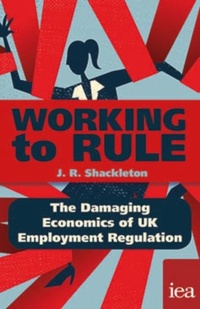
Working to Rule
The Damaging Economics of UKEmploymentRegulation
1st Edition
Published on 19. May 2017
284 pages
978-0-255-36744-8 (ISBN)
Description

Employment regulation has been growing rapidly. This has not exclusively, or even mainly, come from the European Union. Recent UK governments have added such significant new measures as the National Living Wage, workplace pensions and the Apprenticeship Levy. The costs of such regulation are frequently assumed - by both advocates and opponents - to fall on business profits. This isn't so, except in the very short run. They are instead transferred in part to consumers, but mainly to employees themselves. Mandated benefits - longer holidays or extended maternity leave - mean reduced pay growth and fewer job opportunities. Anti-discrimination laws lead to fewer openings for disadvantaged groups, while employment protection legislation worsens job prospects for the young. Excessive regulation acts as a barrier to entry, shielding incumbents and deterring the foundation of new enterprises. Attempts to restrict new types of employment in the 'gig' economy are counterproductive, serving 'insiders' at the expense of 'outsiders'. This book combines a history of employment laws with detailed analysis of the troublesome effects of various interventions. The author argues for a fundamental rethink. Some basic labour market regulation may still be necessary, but far less than we currently have.
More details
Other editions
Additional editions
Book
05/2017
Institute of Economic Affairs
€21.50
Shipment within 10-20 days
Person
J. R. Shackleton is Professor of Economics at the University of Buckingham and Research and Editorial Fellow at the Institute of Economic Affairs. He edits the journal Economic Affairs.
Content
- Intro
- Table?1 Main areas of current UK labour market regulation
- Table?2 Key EU employment directives
- Table?3 Hours worked, selected countries 2014
- Table?4 Full-time employees usually working more than 48 hours a week by occupation, Q4 2013
- Table?5 Regulated occupations in the EU27*
- Table?6 OECD Employment Protection Indicators, selected countries 2013
- Table?7 Level and rate of people on zero-hours contracts, by industry October to December 2015
- Table?8 Increased employment regulation since 2010
- Figure?1 Demand, supply and 'equilibrium' in the labour market
- Figure?2 Claims accepted by Employment Tribunals
- Figure?3 The impact of a mandated benefit
- Figure?4 The National Minimum Wage (£ per hour) over time
- Figure?5 Adult National Minimum Wage Rate as percentage of median hourly earnings*
- Figure?6 Adult minimum wage as % of median hourly earnings by region/nation (April 2015)
- Figure?7 UK gender pay gap for median gross hourly earnings (excluding overtime) April 1997 to 2016
- Figure?8 Percentage of graduate programme recruits who are women, 2015
- Figure?9 Long-term international migration, UK, 1970 to 2014
- Figure?10 Share of self-employed workers in total employment and self-employed hours in total hours
- Figure?11 Number of firms by employment size in France
- Box?1 The Living Wage Foundation
- Box?2 Income and wealth inequality
- Box?3 Tradable quotas
- The author
- Foreword
- Summary
- Tables, figures and boxes
- PART 1
- Ideas
- 1 Introduction
- The problem
- Outline of this book
- 2 How labour markets work, and why people want to regulate them
- Demand, supply and labour market equilibrium
- Contracts
- 'Market failure'
- 'Government failure'
- Conclusion
- PART 2
- Employment Regulation: The Big Picture
- 3 A historical perspective on UK labour market regulation
- The Early Modern period
- The nineteenth century
- The early twentieth century
- World War II and its aftermath
- Newer forms of regulation
- Conclusion
- 4 Employment regulation in the UK today: extensive and costly
- Tribunals
- Costs of regulatory compliance
- But who really bears the cost?
- Conclusion
- 5 The European Union dimension
- The EU's reach
- European law and the labour market
- European political economy
- But will repatriation of powers over the labour market make very much difference?
- Conclusion
- PART 3
- Employment Regulation in Detail
- 6 Protecting workers, families and consumers?
- Health and safety at work
- Working time regulations
- 'Family-friendly' policies
- Employment of children
- Occupational regulation
- Conclusion
- 7 Other people's pay (1)
- The National Minimum Wage and the National Living Wage
- Pensions auto-enrolment
- Conclusions
- 8 Other people's pay (2)
- High pay
- The gender pay gap
- Conclusions
- 9 Discrimination in employment
- Evidence of discrimination today
- Economic analysis of discrimination
- Policy principles
- Policy in practice
- The expanding category of discrimination
- Conclusion
- 10 Regulating labour supply: unions, migration and apprenticeships
- Trade unions and the economy
- Immigration controls
- The Apprenticeship Levy
- Conclusions
- 11 Protecting jobs?
- Economic rationale
- Employment protection in the UK and elsewhere
- Some possible effects of EPL
- Evidence
- Alternatives to standard employment
- Conclusions
- PART 4
- Conclusions
- 12 What now?
- Barriers to deregulation
- Modest measures of deregulation
- A more radical approach
- References
- About the IEA
