

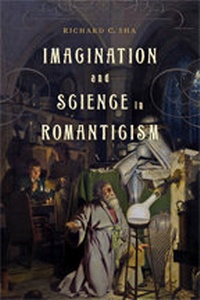
Imagination and Science in Romanticism
Published on 26. September 2018
344 pages
978-1-4214-2579-5 (ISBN)
Description

How did the idea of the imagination impact Romantic literature and science?
2018 Winner, Jean-Pierre Barricelli Book Prize, The International Conference on Romanticism
Richard C. Sha argues that scientific understandings of the imagination indelibly shaped literary Romanticism. Challenging the idea that the imagination found a home only on the side of the literary, as a mental vehicle for transcending the worldly materials of the sciences, Sha shows how imagination helped to operationalize both scientific and literary discovery. Essentially, the imagination forced writers to consider the difference between what was possible and impossible while thinking about how that difference could be known.
Sha examines how the imagination functioned within physics and chemistry in Percy Bysshe Shelley's Prometheus Unbound, neurology in Blake's Vala, or The Four Zoas, physiology in Coleridge's Biographia Literaria, and obstetrics and embryology in Mary Shelley's Frankenstein. He also demonstrates how the imagination was called upon to do aesthetic and scientific work using primary examples taken from the work of scientists and philosophers Davy, Dalton, Faraday, Priestley, Kant, Mary Somerville, Oersted, Marcet, Smellie, Swedenborg, Blumenbach, Buffon, Erasmus Darwin, and Von Baer, among others.
Sha concludes that both fields benefited from thinking about how imagination could cooperate with reason-but that this partnership was impossible unless imagination's penchant for fantasy could be contained.
2018 Winner, Jean-Pierre Barricelli Book Prize, The International Conference on Romanticism
Richard C. Sha argues that scientific understandings of the imagination indelibly shaped literary Romanticism. Challenging the idea that the imagination found a home only on the side of the literary, as a mental vehicle for transcending the worldly materials of the sciences, Sha shows how imagination helped to operationalize both scientific and literary discovery. Essentially, the imagination forced writers to consider the difference between what was possible and impossible while thinking about how that difference could be known.
Sha examines how the imagination functioned within physics and chemistry in Percy Bysshe Shelley's Prometheus Unbound, neurology in Blake's Vala, or The Four Zoas, physiology in Coleridge's Biographia Literaria, and obstetrics and embryology in Mary Shelley's Frankenstein. He also demonstrates how the imagination was called upon to do aesthetic and scientific work using primary examples taken from the work of scientists and philosophers Davy, Dalton, Faraday, Priestley, Kant, Mary Somerville, Oersted, Marcet, Smellie, Swedenborg, Blumenbach, Buffon, Erasmus Darwin, and Von Baer, among others.
Sha concludes that both fields benefited from thinking about how imagination could cooperate with reason-but that this partnership was impossible unless imagination's penchant for fantasy could be contained.
More details
Language
English
Place of publication
Baltimore
United States
Target group
Professional and scholarly
Illustrations
3 s/w Photographien bzw. Rasterbilder
3 Halftones, black and white
File size
2,40 MB
ISBN-13
978-1-4214-2579-5 (9781421425795)
DOI
10.1353/book.59664
Copyright in bibliographic data and cover images is held by Nielsen Book Services Limited or by the publishers or by their respective licensors: all rights reserved.
Schweitzer Classification
Other editions
Additional editions
Richard C. Sha
Imagination and Science in Romanticism
Book
04/2021
Johns Hopkins University Press
€42.70
Shipment within 10-20 days
Richard C. Sha
Imagination and Science in Romanticism
Book
09/2018
Johns Hopkins University Press
€64.00
Shipment within 10-20 days
Person
Richard C. Sha is a professor of literature at American University, where he is a member of the Center for Behavioral Neuroscience. He is the author of Perverse Romanticism: Aesthetics and Sexuality in Britain, 1750-1832 and the coeditor of Romanticism and the Emotions.
Content
Acknowledgments
Introduction
Chapter One. Imagining Dynamic Matter: Percy Shelley, Prometheus Unbound, and the Chemistry and Physics of Matter
Chapter Two. William Blake and the Neurological Imagination: Romantic Science, Nerves, and the Emergent Self
Chapter Three. The Physiological Imagination: Coleridge's Biographia
Chapter Four. Obstetrics and Embryology: Science and Imagination in Frankenstein
Notes
Works Cited
Index
Introduction
Chapter One. Imagining Dynamic Matter: Percy Shelley, Prometheus Unbound, and the Chemistry and Physics of Matter
Chapter Two. William Blake and the Neurological Imagination: Romantic Science, Nerves, and the Emergent Self
Chapter Three. The Physiological Imagination: Coleridge's Biographia
Chapter Four. Obstetrics and Embryology: Science and Imagination in Frankenstein
Notes
Works Cited
Index
