

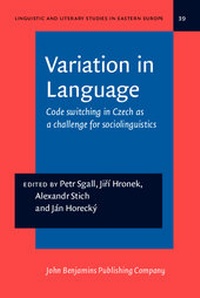
Variation in Language
Code switching in Czech as a challenge for sociolinguistics
1st Edition
Published on 1. July 1992
XII, 370 pages
978-90-272-7735-0 (ISBN)
Description

Czech, a clear case of a language having a Standard and a strong central vernacular with intensive shifting between them, offers many points of general interest to sociolinguists. This volume is divided in 5 chapters and opens with a general discussion of language varieties. 'The Two Central Language Formations in Czech' gives a summary description of the Czech central vernacular. This is followed by a chapter on 'The Origin and Opposition of Standard and Common Czech' and in the next chapter code switching between Standard and Common Czech is discussed. The concluding chapter presents starting points for a theoretical description of a national language with intralingual variation and a preliminary formulation of perspectives on the stratification of Czech.
More details
Other editions
Additional editions
Petr Sgall | Jiri Hronek | Alexandr Stich
Variation in Language
Code switching in Czech as a challenge for sociolinguistics
Book
07/1992
John Benjamins Publishing Co
€132.50
Shipment within 10-15 days
Content
- VARIATION IN LANGUAGE CODE SWITCHING IN CZECH AS A CHALLENGE FOR SOCIOLINGUISTICS
- Editorial page
- Title page
- Copyright page
- PREFACE
- ACKNOWLEDGEMENTS
- Table of contents
- 1. STYLES,VARIETIES, AND LANGUAGE FORMATIONS
- 1.1 INTRODUCTORY REMARKS
- 1.2 A BASIC SCALE OF VARIATION
- 1.3 KINDS AND LAYERS OF VARIATION
- 1.3.1 Main approaches to variation
- 1.3.2 Diglossia
- 1.3.3 Code-switching without bilingualism
- 1.3.4 Speaker's attitudes
- 1.3.5 Mutual impact of codes
- 1.3.6 Core and periphery of national language
- 1.3.7 Attitudes and activities of linguists
- 1.4 STYLE AND LANGUAGE FORMATION
- 1.5 THEORETICAL ASPECTS
- 2. THE TWO CENTRAL LANGUAGE FORMATIONS IN CZECH
- 2.1. THE HISTORY OF THE QUESTION
- 2.1.1 First inquiry into Common Czech
- 2.1.2 Discussions on democratization
- 2.1.3 The present state
- 2.2 PHONEMICS
- 2.2.1 The two scales
- 2.2.2 The main items typical of CC sound patterns
- 2.2.3 Peripheral items of CC phonemics
- 2.2.4 Concluding remarks
- 2.3 MORPHEMICS
- 2.3.1 General Remarks
- 2.3.2 Declension
- (A) Nouns
- (A.1) Masculine
- (A.2) Feminine
- (A.3) Neuter
- (B.1) Adjectives
- (B.2) Pronouns
- (i) Demonstrative
- (ii) Possessive
- (iii) Personal
- (iv) Anaphorical
- (B.3) Numerals
- 2.3.3 Conjugation
- (i) Class 1 (paradigms nese, bere, maze, pece, umre) and general features
- (ii) Class 2 (tiskne, mine, zacne)
- (iii) Class 3 (kupuje, kreje)
- (iv) Class 4 (prosi, trpí, sázi)
- (v) Class 5 (delá)
- 2.3.4 Degrees of comparison
- 2.4 SYNTAX
- 2.4.1 Means and their functions in spoken discourse
- 2.4.2 Syntactic means
- 2.4.3 Syntactic functions and morphological meanings
- 2.4.4 Closing remarks
- 2.5 Lexicon
- 2.5.1 General observations
- 2.5.2 Phonemic shape of CC words
- 2.5.3 Lexically-stylistic variability
- 2.5.4 Relationships between SC and CC words
- 2.5.5 Types of CC word formation
- 3. THE ORIGIN OF THE OPPOSITION OF STANDARD AND COMMON CZECH
- 3.1. CONDITIONS DURING NATIONAL REVIVAL
- 3.2 REASONS FOR THE CHOICE OF THE ARCHAIC STANDARD
- 3.3 THE EXISTENCE OF OTHER POSSIBILITIES
- 4. CODE SWITCHING BETWEEN STANDARD AND COMMON CZECH
- 4.1 CODE SWITCHING AND SPEAKERS1 ATTITUDE
- 4.1.1 Results of empirical research
- 4.1.2 Factors of choice of expressions
- 4.2 COMMON CZECH IN PUBLIC USE
- 4.3 LINGUISTS' ATTITUDES TOWARDS THE CODE SWITCHING
- 5. CONCLUSIONS AND PERSPECTIVES
- 5.1 SOME TASKS OF SOCIOLINGUISTICS
- 5.2 REQUIREMENTS ON LINGUISTIC THEORY
- 5.3 PERSPECTIVES ON THE STRATIFICATION OF CZECH
- 5.3.1 Perspectives of the impact of CC
- 5.3.2 Starting points for a prognosis
- 5.3.3 CC lexical units in standard discourse
- 5.3.4 Perspectives of phonemic and grammatical items
- 5.3.5 Some specific cases
- 5.3.6 A summary of the prognosis and of the linguists" role
- NOTES TO CHAPTER 1
- NOTES TO CHAPTER 2
- NOTES TO CHAPTER 3
- NOTES TO CHAPTER 4
- NOTES TO CHAPTER 5
- APPENDIX
- REFERENCES
- INDEX OF NAMES
- INDEX OF SUBJECTS
- LIST OF ABBREVIATIONS
