

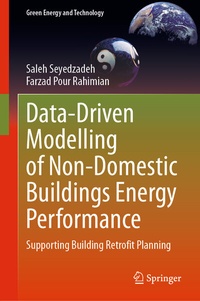
Data-Driven Modelling of Non-Domestic Buildings Energy Performance
Description

This book outlines the data-driven modelling of building energy performance to support retrofit decision-making. It explains how to determine the appropriate machine learning (ML) model, explores the selection and expansion of a reasonable dataset and discusses the extraction of relevant features and maximisation of model accuracy.
This book develops a framework for the quick selection of a ML model based on the data and application. It also proposes a method for optimising ML models for forecasting buildings energy loads by employing multi-objective optimisation with evolutionary algorithms. The book then develops an energy performance prediction model for non-domestic buildings using ML techniques, as well as utilising a case study to lay out the process of model development. Finally, the book outlines a framework to choose suitable artificial intelligence methods for modelling building energy performances.
This book is of use to both academics and practising energy engineers, as it provides theoretical and practical advice relating to data-driven modelling for energy retrofitting of non-domestic buildings.
More details
Other editions
Additional editions
Persons
Saleh Seyedzadeh is Research Associate at the Department of Architecture, University of Strathclyde, UK. His experience includes research, teaching and industrial practice, in the fields of computer science, electrical and electronic engineering and data science. These roles extend to reviewing for several top-ranked journals in the field of data science, energy systems, etc. Saleh published over 50 high-quality indexed articles, and his current H-index is 12. Saleh has engaged in numerous national and international projects funded by Ministry of Science, Technology and Innovation (Malaysia), Data Lab, Advanced Forming Research Centre, EPSRC (UK), as well as EU Horizon2020. His expertise includes supervised and unsupervised machine learning methods and AI evolutionary algorithms, real-time construction monitoring by integrating BIM, VR and image processing technologies.
Farzad Pour Rahimian is Reader in Digital Engineering and Manufacturing, with expertise in the mainstream areas of BIM, VR/AR integration and AI/ML-based optimization. His research has been published in more than 125 high-impact research outputs and has been cited for more than 1200 times. He has successfully led several research projects funded by Innovate UK, Arts and Humanities Research Council (AHRC), Construction Scotland Innovation Centre (CSIC), Scottish Funding Council (SFC), Data Lab and Advanced Forming Research Centre (AFRC). His research has received several prestigious awards and recognitions from national and international committees. He is also a key member of various high-impact committees at national and international levels, including International Council for Building (CIB) and building SMART International. Farzad has been involved in various top-quality journals' editorship as Editor, Co-Editor, Guest Editor and an editorial advisory board member. He is now Editor-in-Chief of Emerald journal of Smart and Sustainable Built Environment (ISSN: 2046-6099, Emerging Sources Citation Index, CiteScoreTracker 2019: 1.70).
Content
Introduction.- Building Energy Performance Assessment.- Machine Learning for Building Energy Forecasting.- Building Retrofit Planning.- Machine Learning Models for Prediction of Building Energy Performance.- Building Energy Data Driven Model Improved by Multi-Objective Optimisation.- Modelling Energy Performance of Non-Domestic Buildings.
