

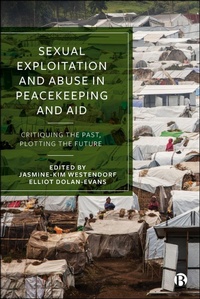
Sexual Exploitation and Abuse in Peacekeeping and Aid
Critiquing the Past, Plotting the Future
Bristol University Press
1st Edition
Published on 29. July 2024
250 pages
978-1-5292-3842-6 (ISBN)
Description

In 2003, the UN adopted a zero-tolerance policy on sexual exploitation and abuse by peacekeepers and aid workers. The policy arrived amid a series of scandals revealing sexual misconduct perpetrated against the very people peacekeeping and humanitarian missions were meant to protect.
This edited collection, including contributions from academics and practitioners, highlights the challenges of preventing and responding to abuse in peacekeeping and aid work, and the unintended consequences of current approaches. It lays bare the structures of power, coloniality and racism that underpin abuse and hinder accountability while charting a path for future action.
This eye-opening book will appeal to academics and students of the politics and practice of peacekeeping and humanitarianism, and to practitioners, policy makers and those working within the field.
This edited collection, including contributions from academics and practitioners, highlights the challenges of preventing and responding to abuse in peacekeeping and aid work, and the unintended consequences of current approaches. It lays bare the structures of power, coloniality and racism that underpin abuse and hinder accountability while charting a path for future action.
This eye-opening book will appeal to academics and students of the politics and practice of peacekeeping and humanitarianism, and to practitioners, policy makers and those working within the field.
Reviews / Votes
"An impressive group of grittily knowledgeable contributors reveal the hard feminist lessons learned over the last 30 years of transforming UN and humanitarian organizations: lessons about stubbornly patriarchal institutional cultures, about implementation failures when gender inequity persists at the operational ground level and, crucially, why justice for women and girls in crisis zones is the sine qua non for sustainable peace." Cynthia Enloe, Clark University "This collection is essential reading for those of us working on questions of gender, power and violence in humanitarian and peacekeeping contexts. The volume challenges conventional boundaries and forges connections between scholars and practitioners." Lucy Hall, University of AmsterdamMore details
Edition
First Edition
Language
English
Place of publication
Bristol
United Kingdom
Target group
Professional and scholarly
Illustrations
4 s/w Abbildungen, 1 s/w Tabelle
1 Tables, black and white; 4 Illustrations, black and white
File size
1,56 MB
ISBN-13
978-1-5292-3842-6 (9781529238426)
Copyright in bibliographic data and cover images is held by Nielsen Book Services Limited or by the publishers or by their respective licensors: all rights reserved.
Schweitzer Classification
Other editions
Additional editions
Sexual Exploitation and Abuse in Peacekeeping and Aid
Critiquing the Past, Plotting the Future
Book
07/2024
1st Edition
Bristol University Press
€47.00
Shipment within 3-4 weeks
Sexual Exploitation and Abuse in Peacekeeping and Aid
Critiquing the Past, Plotting the Future
Book
07/2024
1st Edition
Bristol University Press
€129.50
Shipment within 3-4 weeks
Persons
Jasmine-Kim Westendorf is Associate Professor of International Relations at La Trobe University. She has written two books and numerous articles in top journals. She has extensive experience in conflict resolution and prevention of sexual exploitation and abuse, and has held visiting professorships at several institutions.
Elliot Dolan-Evans is Lecturer in Law and International Relations at Monash University.
Elliot Dolan-Evans is Lecturer in Law and International Relations at Monash University.
Content
Introduction: Two Decades of Dealing with Sexual Exploitation and Abuse in Peacekeeping and Aid - Jasmine-Kim Westendorf and Elliot Dolan-Evans
PART I: Where We've Been: The Origins and Scope of Protection from Sexual Exploitation and Abuse
1. Reflections on 20-Plus Years of Protection from SEA Work - Sarah Martin
2. United Nations Police as a Double-Edged Sword for SEA Accountability - Ai Kihara-Hunt
3. Victims' Rights and Remedial Action - Sabrina White and Leah Nyambeki
4. Sexual Violence against Peacekeepers and Aid Workers - Phoebe Donnelly and Dyan Mazurana
PART II: How It's Going: Implementing and Institutionalizing Protection from Sexual Exploitation and Abuse
5. Missing the Mark in PSEA - Asmita Naik and Jasmine-Kim Westendorf
6. The Imperative of Prioritizing Victims' Rights - Jane Connors
6A. United Nations Victims' Rights Statement
7. Accountability Advocates: Representing Victims - Sabrina White
8. Masculinities and Institutional Blind Spots - Jasmine-Kim Westendorf
9. Power, Consent and Peacekeeping Economies - Kathleen M. Jennings
10. Gender, Race, Sexuality and PSEA - Junru Bian, Megan Daigle, Sarah Martin and Henri Myrttinen
11. 'We Don't Have a Word for That': Issues in Translating PSEA Communication - Emily Elderfield and Ellie Kemp
12. From 'Cultural Sensitivity' to 'Structural Sensitivity' - Nour Abu-Assab
PART III: Looking Forward: Where to from Here?
13. Agency and Affect in PSEA: Understanding Agency through a Transnational Intersectional Lens - Nof Nasser-Eddin
14. Empowered Aid: Transforming Gender and Power Dynamics in the Distribution of Humanitarian Aid - Alina Potts
15. Rethinking PSEA: Reflections for Policy Makers - Jasmine-Kim Westendorf
PART I: Where We've Been: The Origins and Scope of Protection from Sexual Exploitation and Abuse
1. Reflections on 20-Plus Years of Protection from SEA Work - Sarah Martin
2. United Nations Police as a Double-Edged Sword for SEA Accountability - Ai Kihara-Hunt
3. Victims' Rights and Remedial Action - Sabrina White and Leah Nyambeki
4. Sexual Violence against Peacekeepers and Aid Workers - Phoebe Donnelly and Dyan Mazurana
PART II: How It's Going: Implementing and Institutionalizing Protection from Sexual Exploitation and Abuse
5. Missing the Mark in PSEA - Asmita Naik and Jasmine-Kim Westendorf
6. The Imperative of Prioritizing Victims' Rights - Jane Connors
6A. United Nations Victims' Rights Statement
7. Accountability Advocates: Representing Victims - Sabrina White
8. Masculinities and Institutional Blind Spots - Jasmine-Kim Westendorf
9. Power, Consent and Peacekeeping Economies - Kathleen M. Jennings
10. Gender, Race, Sexuality and PSEA - Junru Bian, Megan Daigle, Sarah Martin and Henri Myrttinen
11. 'We Don't Have a Word for That': Issues in Translating PSEA Communication - Emily Elderfield and Ellie Kemp
12. From 'Cultural Sensitivity' to 'Structural Sensitivity' - Nour Abu-Assab
PART III: Looking Forward: Where to from Here?
13. Agency and Affect in PSEA: Understanding Agency through a Transnational Intersectional Lens - Nof Nasser-Eddin
14. Empowered Aid: Transforming Gender and Power Dynamics in the Distribution of Humanitarian Aid - Alina Potts
15. Rethinking PSEA: Reflections for Policy Makers - Jasmine-Kim Westendorf
