

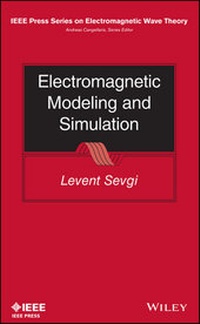
Electromagnetic Modeling and Simulation
Description

More details
Other editions
Additional editions
Person
Content
About the Author xxvii
Acknowledgments xxix
1 Introduction to MODSIM 1
1.1 Models and Modeling, 2
1.2 Validation, Verifi cation, and Calibration, 5
1.3 Available Core Models, 7
1.4 Model Selection Criteria, 9
1.5 Graduate Level EM MODSIM Course, 11
1.5.1 Course Description and Plan, 11
1.5.2 Available Virtual EM Tools, 12
1.6 EM-MODSIM Lecture Flow, 12
1.7 Two Level EM Guided Wave Lecture, 17
1.8 Conclusions, 19
References, 19
2 Engineers Speak with Numbers 23
2.1 Introduction, 23
2.2 Measurement, Calculation, and Error Analysis, 24
2.3 Significant Digits, Truncation, and Round-Off Errors, 27
2.4 Error Propagation, 28
2.5 Error and Confi dence Level, 29
2.5.1 Predicting the Population's Confidence Interval, 33
2.6 Hypothesis Testing, 36
2.6.1 Testing Population Mean, 38
2.6.2 Testing Population Proportion, 39
2.6.3 Testing Two Population Averages, 39
2.6.4 Testing Two Population Proportions, 39
2.6.5 Testing Paired Data, 40
2.7 Hypothetical Tests on Cell Phones, 41
2.8 Conclusions, 45
References, 45
3 Numerical Analysis in Electromagnetics 47
3.1 Taylor's Expansion and Numerical Differentiation, 47
3.1.1 Taylor's Expansion and Ordinary Differential Equations, 50
3.1.2 Poisson and Laplace Equations, 52
3.1.3 An Iterative (Finite-Difference) Solution, 53
3.2 Numerical Integration, 58
3.2.1 Rectangular Method, 58
3.3 Nonlinear Equations and Root Search, 62
3.4 Linear Systems of Equations, 64
References, 69
4 Fourier Transform and Fourier Series 71
4.1 Introduction, 71
4.2 Fourier Transform, 72
4.2.1 Fourier Transform (FT), 72
4.2.2 Discrete Fourier Transform (DFT), 74
4.2.3 Fast Fourier Transform (FFT), 76
4.2.4 Aliasing, Spectral Leakage, and Scalloping Loss, 77
4.2.5 Windowing and Window Functions, 80
4.3 Basic Discretization Requirements, 81
4.4 Fourier Series Representation, 85
4.5 Rectangular Pulse and Its Harmonics, 92
4.6 Conclusions, 92
References, 94
5 Stochastic Modeling in Electromagnetics 95
5.1 Introduction, 95
5.2 Radar Signal Environment, 98
5.2.1 Random Number Generation, 98
5.2.2 Noise Generation, 101
5.2.3 Signal Generation, 108
5.2.4 Clutter Generation, 108
5.3 Total Radar Signal, 111
5.4 Decision Making and Detection, 114
5.4.1 Hypothesis Operating Characteristics (HOCs), 115
5.4.2 A Communication/Radar Receiver, 119
5.5 Conclusions, 129
References, 130
6 Electromagnetic Theory: Basic Review 133
6.1 Maxwell Equations and Reduction, 133
6.2 Waveguiding Structures, 134
6.3 Radiation Problems and Vector Potentials, 136
6.4 The Delta Dirac Function, 138
6.5 Coordinate Systems and Basic Operators, 139
6.6 The Point Source Representation, 141
6.7 Field Representation of a Point/Line Source, 142
6.8 Alternative Field Representations, 143
6.9 Transverse Electric/Magnetic Fields, 145
6.9.1 The 3D TE/TM Waves, 145
6.9.2 The 2D TE/TM Waves, 146
6.10 The TE/TM Source Injection, 151
6.11 Second-Order EM Differential Equations, 154
6.12 EM Wave-Transmission Line Analogy, 155
6.13 Time Dependence in Maxwell Equations, 157
6.14 Physical Fundamentals, 158
References, 158
7 Sturm-Liouville Equation: The Bridge between Eigenvalue and Green's Function Problems 161
7.1 Introduction, 161
7.2 Guided Wave Scenarios, 162
7.3 The Sturm-Liouville Equation, 165
7.3.1 The Eigenvalue Problem, 167
7.3.2 The Green's Function (GF) Problem, 168
7.3.3 Finite z-Domain Problem, 169
7.3.4 Infi nite z-Domain Problem, 170
7.3.5 Relation between Eigenvalue and Green's Function Problems, 171
7.4 Conclusions, 172
References, 173
8 The 2D Nonpenetrable Parallel Plate Waveguide 175
8.1 Introduction, 176
8.2 Propagation Inside a 2D-PEC Parallel Plate Waveguide, 177
8.2.1 Formulation of the TE- and TM-Type Problems, 178
8.2.2 The Green's Function Problem, 181
8.2.3 Accessing the Spectral Domain: Separation of Variables, 182
8.2.4 Spectral Representations: Eigenvalue Problems, 183
8.2.5 Spectral Representations: 1D Characteristic Green's Functions, 184
8.2.6 The 2D Green's Function Problem: Alternative Representations, 185
8.3 Alternative Representation: Eigenray Solution, 187
8.3.1 Relation between Eigenmode and Eigenray Representations, 191
8.3.2 2D GF and Hybrid Ray-Mode Decomposition, 192
8.4 A 2D-PEC Parallel Plate Waveguide Simulator, 194
8.4.1 Representations Used for Mode, Ray, and Hybrid Solutions, 195
8.4.2 MATLAB Packages: RayMode and Hybrid, 207
8.4.3 Numerical Examples, 210
8.5 Eigenvalue Extraction from Propagation Characteristics, 215
8.5.1 Longitudinal Correlation Function, 215
8.5.2 Numerical Illustrations, 217
8.6 Tilted Beam Excitation, 221
8.7 Conclusions, 223
References, 225
9 Wedge Waveguide with Nonpenetrable Boundaries 227
9.1 Introduction, 228
9.2 Statement of the Problem: Physical Configuration and Ray-Asymptotic Guided Wave Schematizations, 229
9.3 Source-Free Solutions, 230
9.3.1 Separable Coordinates: Conventional NM, 230
9.3.2 Weakly Nonseparable Coordinates: AM, 231
9.3.3 Uniformizing the AM Near Caustics: IM, 232
9.4 Test Problem: The 2D Line-Source-Excited Nonpenetrable Wedge Waveguide, 234
9.4.1 Exact Solution in Cylindrical Coordinate, 234
9.4.2 Approximate Solutions in Rectangular Coordinates, 241
9.4.3 IM Spectral Representation, 244
9.5 The MATLAB Package "WedgeGUIDE," 247
9.6 Numerical Tests and Illustrations, 249
9.7 Conclusions, 256
Appendix 9A: Formation of the Spectral IM Integral in Section 9.3.3, 257
References, 262
10 High Frequency Asymptotics: The 2D Wedge Diffraction Problem 265
10.1 Introduction, 266
10.2 Plane Wave Illumination and HFA Models, 268
10.2.1 Exact Solution by Series Summation, 268
10.2.2 The Physical Optics (PO) Solution, 270
10.2.3 The PTD Solution, 272
10.2.4 The UTD Solution, 273
10.2.5 The Parabolic Equation (PE) Solution, 275
10.3 HFA Models under Line Source (LS) Excitations, 275
10.3.1 Exact Solution by Series Summation, 276
10.3.2 Exact Solution by Integral, 277
10.3.3 The Parabolic Equation (PE) Solution, 277
10.4 Basic MATLAB Scripts, 278
10.5 The WedgeGUI Virtual Tool and Some Examples, 291
10.6 Conclusions, 297
References, 298
11 Antennas: Isotropic Radiators and Beam Forming/Beam Steering 301
11.1 Introduction, 301
11.2 Arrays of Isotropic Radiators, 303
11.3 The ARRAY Package, 306
11.4 Beam Forming/Steering Examples, 310
11.5 Conclusions, 317
References, 318
12 Simple Propagation Models and Ray Solutions 319
12.1 Introduction, 320
12.2 Ray-Tracing Approaches, 321
12.3 A Ray-Shooting MATLAB Package, 323
12.4 Characteristic Examples, 329
12.5 Flat-Earth Problem and 2Ray Model, 333
12.6 Knife-Edge Problem and 4Ray Model, 338
12.7 Ray Plus Diffraction Models, 348
12.8 Conclusions, 351
References, 351
13 Method of Moments 353
13.1 Introduction, 353
13.2 Approximating a Periodic Function by Other Functions: Fourier Series Representation, 354
13.3 Introduction to the MoM, 359
13.4 Simple Applications of MoM, 361
13.4.1 An Ordinary Differential Equation, 361
13.4.2 The Parallel Plate Capacitor, 364
13.4.3 Propagation over PEC Flat Earth, 366
13.5 MoM Applied to Radiation and Scattering Problems, 372
13.5.1 A Complex Antenna Structure, 372
13.5.2 Ground Wave Propagation Modeling, 373
13.5.3 EM Scattering from Infinitely Long Cylinder, 376
13.5.4 3D RCS Modeling, 381
13.6 MoM Applied to Wedge Diffraction Problem, 386
13.7 MoM Applied to Wedge Waveguide Problem, 397
13.8 Conclusions, 402
References, 402
14 Finite-Difference Time-Domain Method 407
14.1 FDTD Representation of EM Plane Waves, 407
14.1.1 Maxwell Equations and Plane Waves, 408
14.1.2 FDTD and Discretization, 410
14.1.3 A One-Dimensional FDTD MATLAB Script, 417
14.1.4 MATLAB-Based FDTD1D Package, 417
14.2 Transmission Lines and Time-Domain Reflectometer, 429
14.2.1 Transmission Line (TL) Theory, 430
14.2.2 Plane Wave-Transmission Line Analogy, 434
14.2.3 FDTD Representation of TL Equations, 437
14.2.4 MATLAB-Based TDRMeter Package, 447
14.2.5 Fourier Analysis and Reflection Characteristics, 454
14.2.6 Laplace Analysis and Fault Identification, 456
14.2.7 Step Response, 464
14.3 1D FDTD with Second-Order Differential Equations, 468
14.4 Two-Dimensional (2D) FDTD Modeling, 472
14.4.1 Field Components and FDTD Equations, 476
14.4.2 FDTD-Based Virtual Tool: MGL2D Package, 477
14.4.3 Characteristic Examples, 479
14.5 Canonical 2D Wedge Scattering Problem, 494
14.5.1 Problem Postulation, 494
14.5.2 Review of Analytical Models, 496
14.5.3 The FDTD Model, 499
14.5.4 Discretization and Dey-Mittra Approach, 502
14.5.5 The WedgeFDTD Package and Examples, 505
14.5.6 Wedge Diffraction and FDTD versus MoM, 510
14.6 Conclusions, 512
References, 512
15 Parabolic Equation Method 515
15.1 Introduction, 516
15.2 The Parabolic Equation (PE) Model, 518
15.3 The Split-Step Parabolic Equation (SSPE) Propagation Tool, 520
15.4 The Finite Element Method-Based PE Propagation Tool, 528
15.5 Atmospheric Refractivity Effects, 531
15.6 A 2D Surface Duct Scenario and Reference Solutions, 533
15.7 LINPE Algorithm and Canonical Tests/Comparisons, 538
15.8 The GrSSPE Package, 558
15.9 The Single-Knife-Edge Problem, 566
15.10 Accurate Source Modeling, 571
15.11 Dielectric Slab Waveguide, 580
15.11.1 Even and Odd Symmetric Solutions, 582
15.11.2 The SSPE Propagator and Eigenvalue Extraction, 584
15.11.3 The Matlab-Based DiSLAB Package, 585
15.12 Conclusions, 591
References, 591
16 Parallel Plate Waveguide Problem 595
16.1 Introduction, 595
16.2 Problem Postulation and Analytical Solutions: Revisited, 599
16.2.1 Green's Function in Terms of Mode Summation, 602
16.2.2 Mode Summation for a Tilted/Directive Antenna, 604
16.2.3 Eigenray Representation, 606
16.2.4 Hybrid Ray + Image Method, 613
16.3 Numerical Models, 613
16.3.1 Split Step Parabolic Equation Model, 613
16.3.2 Finite-Difference Time-Domain Model, 617
16.3.3 Method of Moments (MoM), 622
16.4 Conclusions, 638
References, 639
Appendix A Introduction to MATLAB 643
Appendix B Suggested References 653
Appendix C Suggested Tutorials and Feature Articles 655
Index 659
Preface
Today, addressing the technical challenges posed by system complexities requires a broad range of innovative, multidisciplinary, physics-based, problem-matched analytical and computational skills that are not adequately covered in conventional electrical-electronics (EE) engineering curricula. A great many higher educational institutions are now actively engaged in efforts to define “what makes a modern engineer” and to design curricula for teaching the necessary skills to a computer-weaned generation of students, with access to the internet and consequent globalization of information. The explosive growth of computer capabilities has revolutionized communication and the analysis of complex systems, and has made interdisciplinary exposure necessary in modern EE engineering. Physics-based modeling, observation-based parameterization, computer-based simulations, and code calibration against canonical problems (i.e., problems that have mathematical exactness and numerically computable forms) are the key issues of these challenges.
As phrased by Einstein, “in the matter of physics, first lessons should contain nothing but what is experimental and interesting to see—experimentation and hands-on training are the key issues in engineering education at least at undergraduate level.” On the other hand, with the development of new computer technologies, interactive multimedia programming languages, and the Internet, it is now possible to simulate engineering and science laboratory projects of all sorts on a computer all around the world. Experiment-oriented problems can be offered without the overhead incurred when maintaining a full laboratory. At this point the question arises: should an intelligent balance be established between real and virtual experimentations and how? Another similar problem is the balance to be maintained between teaching essentials (theory) and cranking the gear (blind computer applications). It is a general observation that the motto “I did it, it works” is widespread among the youth of today, without really grasping the general principles and boundaries of validity of the underlying phenomena and what is even worse with a false sense of satisfaction.
Engineering, as given in the American Society for Engineering Education web site (www.asee.org), is “the art of applying scientific and mathematical principles, experience, judgment, and common sense to make things that benefit people.” That is, it is the process of producing a technical product or system to meet a specific need in a society. Engineering education is a university education, where knowledge of mathematics and natural sciences are gained, followed up by lifetime self-education where experience is piled up with practice. Therefore, the four keywords mathematics, physics, experience, and practice are the untouchables of engineering education.
Many applications in science and technology rely increasingly on field theory and circuit theory computations in either man-made or natural complex structures. Wireless communication systems, for example, pose challenging problems with respect to field propagation prediction, microwave hardware design, compatibility issues, biological hazards, and so on. Nanotechnologies, on the other hand, have challenges of locating multimillion circuit elements and subsystems on a few square centimeter chips, with very low emissions and immune to environmental interference. Moreover, need to and use of these theories are not limited to EE applications only; they are exploited in a very wide spectrum ranging from biomedical to geophysical applications. Since different problems have their own combination of geometrical features and scales, frequency ranges, material properties, and so on, no single method or approach is best suited for handling all possible cases; instead, a combination of methods, “hybridization,” is needed to attain the greatest flexibility and efficiency in engineering. Relations between field theory and network (circuit) theory play an important role in this respect.
The necessity for hybrid methods has already been recognized in the past: for example, in scattering and antenna problems, techniques have been devised that combine the method of moments (MoM) and the geometrical theory of diffraction (GTD) or physical theory of diffraction (PTD). Similarly, numerical methods such as finite elements (FE) or finite differences (FD) have been considered in conjunction with MoM, with integral equations, with boundary integrals, with modal techniques, with multipole methods, and so on. Combinations of other methods, for example, boundary contour and mode matching or hybrid electric field integral equations (EFIE) and magnetic field integral equations (MFIE) denoted as HEM, have also been proposed.
Physics-based modeling and observable-based parameterization are very important in EE engineering education. The models that are established via well-known Maxwell equations (field theory) and transmission line equations (circuit theory) in both time and frequency domains parameterize a complex physical problem well defined that guarantees existence, uniqueness, and convergence. Field and circuit theories are dual; that is, any field problem (e.g., antenna radiation) can be transformed into a circuit theory problem and solved there (or vice versa). Starting after World War II, circuit formulations of field problems have also been employed extensively in the design of microwave, optical, and other closed and open waveguiding and radiating systems.
Another very important occurrence of hybridization is the increase in integrated circuit (IC) performance being exponential in time at rates of more than 100/decade, with the critical device dimensions shrinking and the interconnects between devices becoming smaller and more closely spaced, interconnect delays (ID) started to dominate over gate delays (GD); the ratio GD/ID of the order of 7–8 in favor of interconnects in early nineties is expected to be of the order of nearly 1/20 in favor of gates within a couple of years. As the count of active devices exceeds several tens of millions and the number of interconnects among these devices grows superlinearly with this count, efficient evaluation of time delays and signal integrity becomes more difficult and important. Devices with operating frequencies exceeding a hundred gigahertz have already appeared and today's circuits contain millions of transistors per unit area as opposed to 1970s SPICE targeted for circuits with a few hundred transistors. Hence the need arises for a new generation of simulators with improved numerical methods using, if possible, analytic solution techniques to handle very large circuits.
Engineering as defined above is based on practice. The minima of this practice should be given during the EE education. This has become more and more comprehensive and expensive parallel to high-technology devices developed and presented to societies: computers and other microprocessor-based devices make EE engineering education not only very complex but also interdisciplinary as well. The cost of building undergraduate labs in EE may vary from 1 unit to 105 units; for example, a spectrum or a network analyzer may cost few 104 units, whereas a simple software of 1 unit with or without the addition of specific cards costing 102 units may turn a regular personal computer (PC) into a virtual lab. The key question therefore is to establish a balance between virtual and real labs, so as to optimize cost problems, while graduating sophisticated engineers with enough practice.
Doing numerical simulations in EE engineering has become as easy (as well as difficult) as doing measurements. It is easy because one can purchase commercial codes that do almost everything, such as supplying computer-controlled devices for measurements. The simulation packages are user friendly, have self-checking routines for control, and all can be calibrated, like most of high-tech measurement devices. On the other hand all the efforts of simulation can be in vain if one does not know how to interpret the resulting numbers. In addition, they are capable of doing only what has already been planned and included by the developer. Moreover, important concepts such as accuracy, precision, and resolution, in short the underlying theory, should be well understood by engineers.
This book aims to introduce simple, easy-to-use, but effective short codes as well as virtual tools that can be used in broad range of EE engineering lectures. The book itself may serve as a textbook for several lectures such as electromagnetic modeling and simulation, computational electromagnetics, transmission line theory, guided wave theory, diffraction theory, and others. Almost all of the virtual tools are coded in MATLAB; therefore, the reader is strongly advised to get used to working with MATLAB. The book contains 16 chapters. Roughly speaking, the first five chapters are introductory, the next five chapters are for analytical modeling, and the last six chapters are for numerical modeling and simulation.
People had to simplify problems as much as possible a century ago in order to get the feeling on the results. This is why we have had excellent canonical problems with simple analytical models. Today, we very often revisit these problems for (i) teaching electromagnetics and (ii) validation, verification, and calibration of numerical models. That is why we included many canonical problems in this book (although not very often, we also use numerical models in validation and verification of analytical...
