

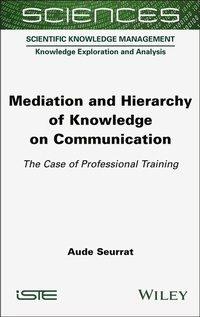
Mediation and Hierarchy of Knowledge on Communication
Description

This book explores the various forms of knowledge selection and mediation concerning communication in organizations, particularly focusing on professional communication training courses. The work is based on a corpus study of training catalogues, an interview survey of trainers, as well as ethnographic observations of professional communication training courses.
Mediation and Hierarchy of Knowledge on Communication analyzes how the pursuit of certainty contributes to favoring certain types of 'learned' knowledge over others. This analysis reveals that the theoretical frameworks employed in vocational training for communicators predominantly rely on experimental reasoning and explanatory models, drawing upon insights from psychosocial experiments, neuroscience and management science.
This quest for certainty has positioned the life sciences as the benchmark for scientific validity, resulting in a form of biologization of communication that this book aims to deconstruct.
More details
Other editions
Additional editions
Person
Aude Seurrat is a university professor in Information and Communication Sciences at UPEC and teaches at the Créteil Inspé, Paris, France. As co-director of the Céditec laboratory, her research focuses on knowledge mediation and media and digital literacy.
Content
Foreword vii
Pierre MOEGLIN
Acknowledgements xiii
Introduction xv
Chapter 1. The Promises of Communication Training Programs 1
1.1. Diversity of structures, diversity of authoritative discourses 1
1.2. Segmentation of communication fields 18
1.3. Mediation and the performative ideal: the promises of guaranteed learning 26
1.4. Instrumented mediation: the digital seen as an educational panacea 37
1.5. The explicit request for communication "tools" and "techniques" 49
Chapter 2. Mastery Over Communication: Professionalization and the Injunction to Efficacy 57
2.1. The figures of facilitators and the legitimization of communication expertise 57
2.2. "Mastering" communication to gain professional efficacy 69
2.3. Reinforcing the professionalism of communicators 79
2.4. The argument of the paradigm shift and communication conceptions 89
Chapter 3. Procedures and Standards for "Communicating Properly" 99
3.1. Toolboxes and communicational claims 99
3.2. Prescription and planning to "master" communication 107
3.3. "Best practices" and the circulation of standards 115
3.4. Prescribing and standardizing "creativity"? 120
3.5. Debates on standards and the reflexivity of social actors 128
Chapter 4. Exemplification, Modeling and Memorization of Instrumented Bodies of Knowledge in Communication 137
4.1. Casuist mediation: the presumed efficacy of practical wisdom 137
4.2. The order of "scholarly" discourses in professional training 146
4.3. The quest for certainty and the scientistic relationship with knowledge 152
4.4. The neuroscience, experimental psychology and management science triptych 156
4.5. Theory and memorization: understanding versus mastering? 165
Chapter 5. Communication in the Face of Evaluation: Efficacy and Extension of the Managerial Model 177
5.1. Evaluation and institutionalization of values 177
5.2. Evaluation and (willing) (temporary) suspension of reflexivity 185
5.3. Metrics and quantitativist reduction 193
5.4. Knowledge about communication and managerial regime 198
Conclusion 203
References 211
Index 229
